Waiting for the Ride by Biplab Majumder
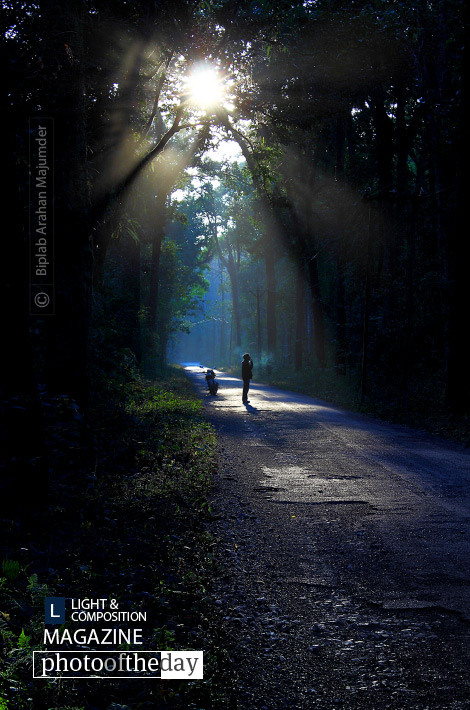
Captured during a journey through the forest village of Jayanti, this photograph documents a serene pause in the journey. As the midday sun filtered through the dense canopy, it created a magnificent interplay of light and dust, transforming an ordinary roadside stop into a moment of ethereal beauty. The photographer expertly utilized the natural light to emphasize the atmosphere of the woodland setting. This image is award-worthy for its masterful handling of light and shadow, capturing a fleeting, quiet moment of stillness that invites the viewer to experience the tranquility of the forest.
Biplab Majumder
Based in Alipurduar, West Bengal, Biplab Arahan Majumder has spent the last four years refining his artistic voice through the lens. Initially discovering photography as an intuitive language of personal perspective, he has dedicated himself to mastering the technical and creative nuances of the craft. His work is defined by a deep appreciation for the diverse ways light and composition can shape a narrative, reflecting a continuous journey of learning and growth within the international photography community.
Resonance Score Breakdown
Transparency Note: The resonance score (12.7/20) is calculated based on social engagement metrics collected before the award announcement.
Expert Photography Reviews · 8
The Architecture of Stillness
We spend our lives in a state of perpetual motion, convinced that to be still is to be left behind. Yet, there is a profound geometry to waiting. It is not an absence of action, but a gathering of the self, like roots deepening in the dark before the spring push.
Read the reflection →The Weight of Stillness
To wait is to practice a kind of surrender. We are taught that time is a resource to be spent, a currency to be traded for progress. But there are moments when the clock loses its authority.
Read the reflection →Reviews & Comments
Share your thoughts about this award-winning photograph. Your reviews contribute to the community engagement score.
The dust motes hang in the light. A stillness settles in the throat. I’ve stood on that road in Jayanti, waiting for nothing at all. The frame doesn’t crowd the subject. It lets the forest breathe. Nothing here is accidental. The empty corner is not empty. It’s the weight of the pause. I feel a sudden, sharp ache for that silence. It’s rare to find a frame that knows when to stop.
The forest doesn’t reveal itself to those rushing through. Biplab stood in the dappled silence of Jayanti, waiting for the canopy to breathe. That dust dancing in the shafts of light—it’s a holy, fleeting architecture. I’ve felt that same stillness, where the air grows heavy with anticipation. It’s not just a roadside stop; it’s a prayer. I find myself holding my breath, wanting to step into that cooling shade and simply listen to the trees.
Light here doesn’t merely fall; it interrogates the forest floor. Majumder captures the dust motes as suspended fragments of time, yet it’s the encroaching darkness at the frame’s edge that truly haunts me. It’s a heavy, suffocating silence that reminds me of Tarkovsky’s Stalker. I’ve stared at this roadside stillness until I felt the damp earth beneath my own feet. The shadows aren’t hiding the path; they are demanding we justify our presence within them.
At f/6.3, the Canon 50d’s sensor resolves the forest’s particulate matter with startling clarity. The diffraction of light across those suspended dust motes is, in the strictest physical sense, extraordinary. It’s rare to see a 55mm focal length render such atmospheric depth without succumbing to chromatic aberration. I’m genuinely moved by how the focal plane isolates that quiet stillness; it’s as if the lens finally caught the very breath of the Jayanti canopy. It’s simply beautiful.
The ochre dust, suspended in that humid, filtered light, evokes the quiet, chalky stillness of a Morandi still life, yet it’s the way the forest’s deep, mossy emeralds bleed into the road’s pale, sun-bleached earth that truly arrests the breath. I’m utterly undone by how the shadows don’t merely fall but seem to pool like spilled ink, creating a chromatic tension that feels less like a roadside stop and more like a lingering, melancholic dream.
Most entries in this category rely on heavy-handed post-processing to force an atmosphere. Majumder avoids that trap. The way the light catches the dust motes against the deep, unforgiving shadows of the Jayanti forest creates a rare, tactile stillness. It’s a quiet scene, yet it feels heavy with time. I find myself wanting to sit on that bench just to breathe the air. In thirty years, this honesty will still hold its weight.
The frame’s geometry relies on the verticality of the trees to anchor the composition. It’s a rigid architecture. The light doesn’t merely illuminate; it defines the spatial tension between the foreground subject and the receding woodland. I’m genuinely irritated by the lack of a stronger fulcrum to balance the heavy left-hand mass. The negative space is underutilized. It doesn’t hold the weight it should. The structure is nearly there, but it’s ultimately too loose.
Midday light in a dense forest is usually a photographer’s nightmare, a chaotic mess of blown highlights. Yet, here, the dust motes dance with a deliberate, quiet grace. One wonders how many hours Majumder spent swatting mosquitoes in that Jayanti heat before the atmosphere finally settled. It’s a rare, honest stillness. I’ve spent enough afternoons in similar humidity to know this wasn’t luck. He didn’t just find this moment; he sat with it until it surrendered.