The Sentry By Ruben Alexander
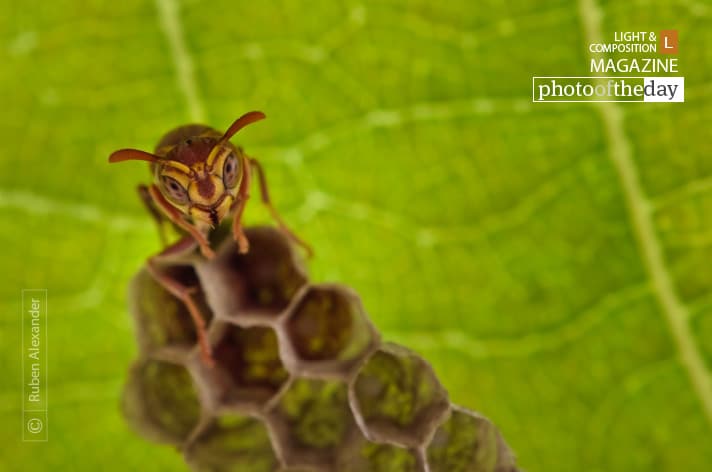
In a display of patience and precision, the photographer captured this intimate macro study of a wasp guarding her nest. Utilizing a reverse lens technique to achieve extreme magnification, the photographer braved the risk of a sting to document the subject’s protective stance. The resulting image highlights the intricate textures and fierce determination of the insect, transforming a common garden encounter into a compelling wildlife portrait. This photograph is award-worthy for its technical ingenuity, demonstrating how creative improvisation can yield professional-grade macro results under challenging conditions.
Ruben Alexander
Ruben Alexander is a Bangalore-based photographer who balances a professional career in the IT industry with a passionate pursuit of the visual arts. As a self-taught practitioner, he utilizes photography as both a creative outlet and a meditative escape from his technical work. His portfolio primarily explores the delicate details of nature and macro subjects, though he is actively expanding his expertise into landscape, street, and portrait photography as he continues his artistic journey.
Resonance Score Breakdown
Transparency Note: The resonance score (14.3/20) is calculated based on social engagement metrics collected before the award announcement.
Expert Photography Reviews · 4
The Architecture of Vigilance
In the quiet corners of a garden, there exists a form of governance that requires no laws, only an unwavering, singular devotion. We often mistake stillness for absence, assuming that if a creature is not in motion, it has ceased to be.
Read the reflection →The Quiet Watcher
I spent an hour this morning trying to fix a loose hinge on my garden gate. It was a small, annoying task that I had been putting off for weeks. As I knelt there, screwdriver in hand, I noticed a spider weaving a web in the corner of the frame.
Read the reflection →Reviews & Comments
Share your thoughts about this award-winning photograph. Your reviews contribute to the community engagement score.
Most macro work is a frantic affair, but Alexander clearly sat in the dirt long enough for the wasp to stop viewing him as a threat. That reverse lens technique is a fussy, temperamental business, yet he’s managed to keep the mandibles sharp. I’ve spent enough afternoons being swarmed by stinging things to appreciate the stillness required here. It’s a rare instance where the photographer actually earned his proximity. He didn’t just find it; he waited.
Shadow isn’t merely the absence of light here; it’s the wasp’s armor. Alexander forces us into the creature’s claustrophobic vigil, where the darkness between the nest’s fibers feels heavy, almost suffocating. It’s not just a macro study; it’s a confrontation with a primal, unblinking intent. I’ve stared at these mandibles for an hour, and honestly, the sheer hostility in those deep, ink-black recesses makes me shudder. It’s a terrifying, beautiful refusal to be ignored.
Reverse-mounting a lens pushes the focal plane into a razor-thin sliver, forcing the diffraction limit to its absolute edge. Alexander’s capture of the wasp’s compound eye is startling; I’ve rarely seen such crystalline resolution of those hexagonal ommatidia. It’s physically unnerving how the bokeh, a function of that extreme magnification, isolates the mandibles against the nest’s chaotic texture. Honestly, it makes my skin crawl, yet I can’t stop tracing the light refracting across that chitinous armor. It’s brilliant.
The wasp’s carapace glows with the bruised, metallic iridescence of a beetle in a Dutch still life, shifting from burnt ochre to the cold, shadowed violet of a storm-tossed Aegean. It’s a chromatic tension that makes my pulse quicken, as if I’m watching a Morandi vessel suddenly ignite. One finds the nest’s papery, parchment-pale beige provides a fragile, muted stage for such fierce, shimmering intensity, creating a harmony that’s both unsettling and utterly sublime.
Never see it bfor . It really amazing !!!8)