Deep Calls to Deep By Ruben Alexander
Captured at the majestic twin waterfalls of Shivanasamudra, this long-exposure photograph masterfully illustrates the raw power of the Cauvery River as it splits into the Gaganachukki and Bharachukki branches. By utilizing a 180-second exposure at f/16, the photographer has transformed the rushing water into a silky, ethereal veil, contrasting beautifully against the rugged landscape. This image is award-worthy for its technical precision in managing light and motion, effectively capturing the serene yet imposing atmosphere of one of India's most significant hydro-electric sites. It serves as a testament to the photographer's ability to find profound stillness within a dynamic natural environment.
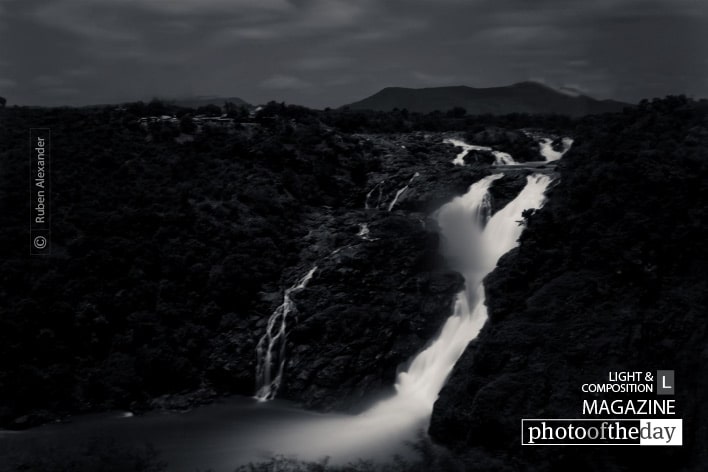
Exposure 180sec @ f/16 | ISO 100 | Focal Length 24mm
Ruben Alexander
Based in Bangalore, India, Ruben Alexander balances a professional career in the IT industry with a passionate pursuit of photography. As a self-taught artist, he utilizes the camera as a creative outlet and a means of personal expression, focusing primarily on nature, macro, and still life compositions. His evolving portfolio reflects a growing interest in landscape, travel, and street photography, driven by a commitment to continuous learning and the exploration of diverse visual narratives.
Resonance Score Breakdown
Transparency Note: The resonance score (14.5/20) is calculated based on social engagement metrics collected before the award announcement.
Expert Photography Reviews · 7
The Weight of Falling Water
The smell of wet stone always brings me back to the monsoon, to the way the air turns heavy and thick enough to swallow. It is a damp, metallic scent that clings to the back of the throat, tasting of minerals and ancient earth.
Read the reflection →The White Breath of Stone
We often mistake silence for an absence of sound, yet there are places where the roar is so absolute it becomes a stillness of its own. It is the sound of gravity surrendering to the earth, a constant, rushing prayer that never asks for an answer.
Read the reflection →Reviews & Comments
Share your thoughts about this award-winning photograph. Your reviews contribute to the community engagement score.
The water isn’t rushing anymore. It’s a ghost. Three minutes of exposure have erased the roar, leaving only a pale, heavy stillness. I’ve stood by the Cauvery, but I’ve never heard it this quiet. The rock holds the frame. It’s anchored. Nothing here is accidental. The empty corner is not empty. It’s a breath held in the dark. I find myself leaning in, waiting for the sound that never comes. It’s perfect.
Three minutes of exposure turns the Cauvery’s roar into a prayer. He stood here in the cooling hour, listening as the water surrendered its violence to the stillness of the frame. I’ve spent enough time by such falls to know the damp chill that settles in your bones during a long wait. It’s haunting. He didn’t just capture the river; he let the landscape exhale, revealing a silence that’s usually hidden beneath the noise.
The churning froth of the Cauvery dissolves into a ghostly, pale celadon, a hue reminiscent of Turner’s most turbulent, vaporous horizons. It’s a haunting, spectral light that makes one’s breath hitch in the throat, as if the very air were cooling. I’m utterly seduced by how these silken, desaturated tones quarrel with the rugged, ochre-dusted stone, creating a chromatic tension that feels less like a landscape and more like a fever dream of liquid mercury.
Of the thousands of long-exposure landscapes I’ve reviewed, most drown in their own blur. Alexander’s work avoids this by anchoring that silky, three-minute water against the jagged, unyielding rock face. It’s the tension between the fluid and the static that makes me stop and breathe. In thirty years, this won’t feel like a dated trend; it’s a quiet, permanent record of the Cauvery’s raw force. It’s rare to see such patience yield this much clarity.
At f/16, the diffraction limit begins to soften the micro-contrast of the rocks, yet it’s a necessary trade-off for that 180-second integration. The sensor’s photon accumulation turns the Cauvery’s turbulence into a laminar flow of pure light. I’m genuinely moved by how the lens resolves the mist; it’s a ghostly, ethereal veil that the human eye simply can’t hold. It’s not just a landscape; it’s a physical manifestation of time passing through glass.
Three minutes of exposure turns the Cauvery into a ghost, a shroud draped over the jagged indifference of the rock. It’s a haunting erasure. I find myself shivering, not from the spray, but from the silence forced upon that violent water. By bleaching the motion into stillness, Alexander denies the river its roar. He’s chosen to bury the truth in the light, and frankly, it’s a terrifying, beautiful lie that leaves me feeling utterly hollow.
The long exposure flattens the Cauvery into a static, milky shroud, yet the frame’s architecture remains precarious. The heavy rock formations anchor the left, creating a necessary fulcrum against the blurred torrent. It’s a rigid, calculated geometry that prevents the water from dissolving into mere sentiment. I’ve grown weary of such blurred motion, but the spatial tension here holds. The composition doesn’t collapse under the weight of the technique. It’s a disciplined, cold success.