The Hunter by Mai Phuong Duong
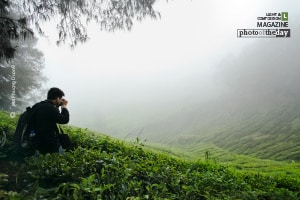
After a disappointing sunrise obscured by heavy clouds, the photographer discovered a serene, misty landscape within a tea plantation. As the light shifted, her husband waited patiently for the clouds to break, allowing shafts of light to illuminate the fields. This moment of quiet anticipation transformed the scene, adding a human element that completed the composition. The image is award-worthy for its atmospheric depth and the photographer’s ability to find beauty in unexpected conditions, turning a failed sunrise into a compelling narrative of light and patience.
Mai Phuong Duong
Based in Singapore, Mai Phuong Duong is a dedicated photographer who balances her creative pursuits alongside a professional career. Alongside her husband and fellow photographer, Minh Nghia Le, she explores the world through a lens, capturing evocative travel and street photography. Her work reflects a deep-seated passion for visual storytelling, aiming to share unique perspectives of the world with an international audience through her diverse portfolio.
Resonance Score Breakdown
Transparency Note: The resonance score (12.2/20) is calculated based on social engagement metrics collected before the award announcement.
Expert Photography Reviews · 8
Waiting for the Break
I spent an hour this morning staring at a stubborn stain on my kitchen rug, waiting for the sunlight to hit it just right so I could scrub it away. I kept checking the window, annoyed that the clouds wouldn't move.
Read the reflection →The Architecture of Waiting
We are taught that time is a river, something that must always be moving, always arriving at a destination. But there is a different kind of time—the time of the root, the time of the stone.
Read the reflection →Reviews & Comments
Share your thoughts about this award-winning photograph. Your reviews contribute to the community engagement score.
The clouds didn’t break; they surrendered. I’ve spent enough mornings in the Highlands to know that damp, heavy silence. She didn’t force the shot. She let the tea leaves drink the light instead. When her husband stood there, waiting for those shafts to pierce the mist, he wasn’t just a subject; he was a prayer. It’s a quiet, aching reminder that we don’t capture landscapes. We simply wait for them to reveal their grace.
The wide-angle distortion at 17mm pulls the tea rows into a forced convergence, creating a rigid geometric spine. It’s a calculated architecture. The figure acts as a necessary fulcrum, anchoring the vast, misty negative space. Without that human mass, the frame would collapse into mere atmospheric drift. I’m actually annoyed by the soft edges, but the structural discipline holds. It doesn’t rely on sentiment. The composition demands this exact placement to function. It’s precise.
The verdant, mossy greens of these tea terraces possess a Morandi-esque restraint, yet it’s the sudden, ethereal shaft of light—a pale, buttery gold—that truly arrests the senses. One feels a sudden, sharp ache in the chest watching that lone figure anchored against such vast, misty emerald depths. It’s a quiet, chromatic symphony where the humidity itself seems to hold the colour, suspended in a cool, damp suspension that I’ve rarely seen captured with such delicate, painterly grace.
At 17mm, the 5D Mark II’s sensor struggles with the high ISO noise, yet the diffraction limit at f/8 keeps the tea rows remarkably crisp. I’m genuinely moved by how the light shafts pierce the mist; it’s a beautiful interaction of photon scattering and atmospheric density. The lens doesn’t quite resolve the distant foliage, but that soft roll-off creates a depth I’ve rarely seen in wide-angle work. It’s a quiet, technically honest triumph of patience.
Most travel photography is just postcard filler, but this survives because of the restraint. I’ve seen thousands of tea plantation shots, yet this one avoids the usual saturated trap. By placing the figure small against the vast, misty rows, Duong captures the actual weight of waiting. It’s the silence in the frame that gets me; I can almost feel the damp air. It’s a quiet, enduring study of patience that will still matter in thirty years.
The mist doesn’t hide the tea fields; it interrogates them. Mai Phuong Duong’s frame captures a man suspended in the heavy, humid silence of the highlands, waiting for a light that refuses to be generous. It’s a haunting study of patience as a form of resistance. I’ve felt that same ache, standing in the dark, hoping the world might finally reveal its intent. Here, the shadows aren’t empty—they’re the only things that truly know the truth.
Mist clings to the tea rows. A man stands, small against the vast, grey damp. He isn’t hunting game; he’s hunting light. I’ve felt that cold patience myself, waiting for the clouds to yield. It’s a quiet ache. The frame breathes because of what isn’t there. The fog swallows the rest. Nothing here is accidental. The empty corner is not empty. It’s a pause. A deep, necessary breath in the Highlands. It’s enough.
Most would have packed their bags when the sunrise failed. It’s a common weakness. Instead, they stayed, shivering in the damp Cameron Highlands until the mist finally relented. I’ve spent enough mornings in similar tea fields to know that particular chill in one’s bones. It’s a miserable, necessary sort of cold. By waiting for those shafts of light to strike, they’ve earned a frame that feels honest. It’s a decent bit of work, that.
Thanks a lot for everyone’s support!