For a Greener Progeny by Kamalesh Das
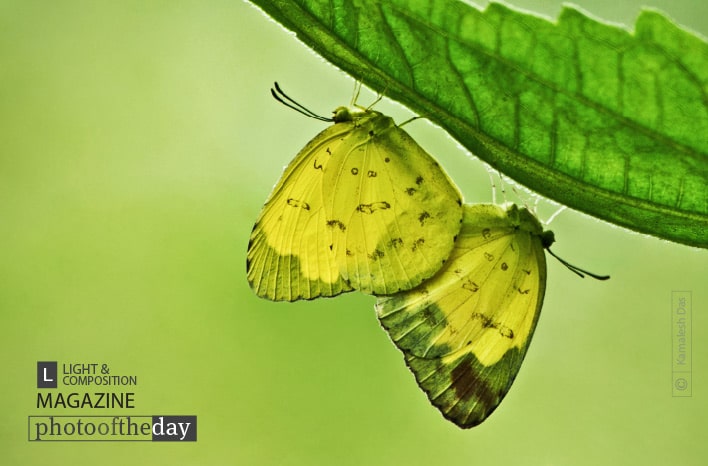
Captured within the dense, untamed environment of the Buxa Tiger Reserve Forest, this image showcases a delicate moment of wildlife in its natural habitat. The photographer, constrained by the need for absolute stillness to avoid startling the subjects, utilized a 55-300mm zoom lens at its minimum focus distance to secure the shot. This technical discipline, combined with the patience required to frame the scene without disturbing the wildlife, highlights the photographer's commitment to capturing authentic, fleeting encounters. The resulting image is a testament to the beauty of nature’s progeny, rendered with precision and a profound respect for the wild.
Kamalesh Das
Born and raised in the scenic city of Cooch Behar, India, Kamalesh Das is a dedicated school teacher who discovered his passion for photography after beginning his professional career. His artistic journey began with a Nikon D40, which allowed him to explore diverse genres ranging from macro to landscape photography before upgrading to his current Nikon D90 system. Deeply inspired by the vast, untapped landscapes of his home country, Das approaches every shutter click as a fresh challenge, constantly striving to frame the world through a unique and evolving perspective.
Resonance Score Breakdown
Transparency Note: The resonance score (12.9/20) is calculated based on social engagement metrics collected before the award announcement.
Expert Photography Reviews · 6
The Inheritance of Leaves
We are all architects of a future we will never inhabit, planting seeds in soil that will only know our names as echoes. There is a quiet, heavy grace in the way the wild world prepares for what comes next—a slow, deliberate unfolding of green that asks for nothing in return.
Read the reflection →The Quiet Inheritance
I spent this morning trying to fix a broken ceramic pot in my kitchen. My hands were shaking a little, and I kept worrying about whether the glue would hold or if the cracks would always show. It felt like such a fragile task.
Read the reflection →Reviews & Comments
Share your thoughts about this award-winning photograph. Your reviews contribute to the community engagement score.
Shooting at 300mm with a D90 requires a steady hand and a spine made of iron. One suspects Das spent hours in the damp heat of Buxa, motionless, waiting for the subjects to forget he existed. It’s a rare bit of discipline. I’ve spent enough miserable mornings in the brush to know the ache of that stillness. He didn’t just find this; he earned it. It’s a quiet, honest piece of work. Well done.
Buxa’s canopy doesn’t just filter light; it interrogates the subjects below. Das captures a fragile existence, yet I’m struck by how the shadows here refuse to yield. They aren’t mere voids, but the very silence the animals inhabit. It’s haunting, really. When I look at those deep, encroaching blacks, I feel the weight of a world that doesn’t care if we’re watching. It’s a brutal, necessary darkness that keeps the wild, well, wild.
At 300mm, the Nikkor’s focal plane is razor-thin, pushing the limits of the D90’s sensor. Shooting at f/8, Das avoids the diffraction limit while maintaining enough depth to resolve the subject’s fine textures. I’m genuinely moved by how the bokeh renders the Buxa foliage into a soft, chromatic wash. It’s a delicate optical balance; he’s captured a fleeting biological reality that my own eyes would have surely blurred into the chaotic green of the forest.
The forest floor recedes. It’s a blur of green, a soft hum of life. Then, the subject. Still. Watching. I’ve spent minutes just breathing with it. The frame doesn’t crowd the creature. It gives it room to exist. Nothing here is accidental. The empty corner is not empty. It’s the weight of the Buxa air. I feel a sudden, sharp ache for that silence. It’s rare to see such restraint in the wild.
The verdant, suffocating emerald of Buxa’s canopy doesn’t merely frame the subject; it swallows it in a humid, chlorophyll-drenched embrace that recalls the brooding, tonal density of a Morandi still life. I’m breathless at the way those chartreuse highlights dance against the deep, mossy shadows, creating a chromatic tension that feels almost tactile. It’s a lush, feverish symphony of greens where one finds the very pulse of the forest, vibrating with an ancient, untamed, and deeply unsettling vitality.
Most wildlife shots from Buxa are cluttered, but Das found a rare, clean pocket of light. It’s the restraint here that matters. He didn’t chase the action; he waited for the stillness. I’ve seen thousands of tiger reserve shots, and frankly, most are just snapshots. This one lingers because of the depth of field—it’s tight, honest, and quiet. It makes me want to hold my breath. In thirty years, this clarity will still feel vital.