Ascenso by Javier Mosquera
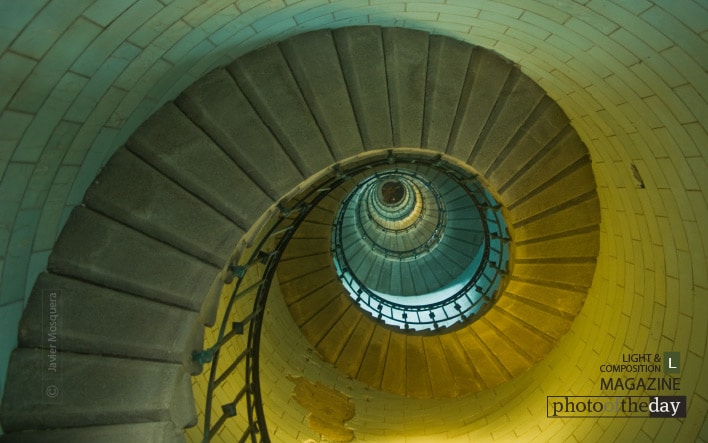
Captured within the iconic Eckmuhl lighthouse in Penmarc'h, France, this image masterfully contrasts the warmth of interior light with the cool, ethereal glow awaiting at the summit. The photographer utilized the lighthouse's spiraling architecture to create a compelling sense of upward movement, drawing the viewer's eye through the rhythmic geometry of the stairs. This photograph is award-worthy for its sophisticated handling of mixed lighting conditions and its ability to transform a functional architectural space into a poetic narrative of ascent and discovery, highlighting the intersection of structural precision and atmospheric beauty.
Javier Mosquera
Born in 1978 in Ourense, Galicia, Javier Mosquera Cid developed a deep appreciation for the natural world, eventually earning a degree in Marine Biology. His professional travels as a biologist to diverse regions such as the Azores, Iceland, and the Amazon ignited a passion for documenting the beauty of landscapes, wildlife, and human culture. Through his photography, he seeks to capture the essence of the environments he explores, blending his scientific background with a keen artistic eye for light and composition.
Resonance Score Breakdown
Transparency Note: The resonance score (11.5/20) is calculated based on social engagement metrics collected before the award announcement.
Expert Photography Reviews · 8
The Spiral of Breath
The smell of cold iron always brings me back to the damp basements of my childhood, where the air tasted of wet stone and ancient, sleeping dust. There is a specific rhythm to climbing stairs that no one talks about—the way your lungs begin to count the steps before your feet do.
Read the reflection →The Weight of the Climb
I spent this morning trying to organize the books on my top shelf. I kept dropping them, one by one, until I finally just sat on the floor and stared at the ceiling.
Read the reflection →Reviews & Comments
Share your thoughts about this award-winning photograph. Your reviews contribute to the community engagement score.
At f/3.8, the Nikon D90’s sensor captures a delicate transition where the focal plane barely clings to the ironwork. I’m mesmerized by how the lens handles the chromatic aberration bleeding into the stairwell’s shadows; it’s a physical manifestation of light struggling against geometry. The diffraction limit isn’t reached here, yet the soft bokeh as a function of that wide aperture creates a dizzying, ethereal ascent. It’s technically imperfect, but honestly, it makes my heart race.
The ochre warmth clinging to these iron stairs, reminiscent of a Morandi still life, doesn’t just invite the eye; it pulls one upward toward that bruised, Atlantic-grey light waiting at the summit. It’s a chromatic friction that makes my chest ache, a collision between the furnace of the interior and the cold, salt-dampened air of Bretagne. I’ve never seen a spiral hold such tension, where the shadows aren’t merely dark, but heavy with silence.
The spiral pulls the breath from your lungs. Javier stood here in the cooling hour, listening to the stone hum. It’s a quiet climb, isn’t it? The way the light bleeds from the warm, grounded base toward that ethereal, distant summit feels like a prayer. I’ve spent hours in such hollow spaces, and I can feel the vertigo he must have felt. It’s not just architecture; it’s the physical weight of longing reaching for the sky.
The spiral of the Eckmuhl lighthouse doesn’t just climb; it interrogates the void. Mosquera understands that darkness isn’t an absence here, but a heavy, suffocating weight that defines the ascent. I’ve spent hours staring into those iron shadows, and it’s unsettling how they pull at my own sense of gravity. It’s a brutal, beautiful geometry. When the light finally breaks at the summit, it feels less like a discovery and more like a necessary, painful escape.
The spiral at Eckmuhl is a dizzying climb, and I’ve certainly felt the burn in my own calves just looking at this. It’s a clean, disciplined frame. One suspects Mosquera spent a fair few hours waiting for the tourists to clear the landings, which is the only way to earn such silence. It’s a quiet, cold piece of work. He didn’t just stumble upon this geometry; he clearly committed to the ascent. Well played.
The spiral pulls. It’s a rhythmic climb into nothingness. I’ve stood in stairwells like this, feeling the vertigo of the void. Mosquera doesn’t crowd the frame. He lets the shadows breathe between the iron steps. The light at the top isn’t a destination; it’s a release. Nothing here is accidental. The empty corner is not empty. It’s a pause. I find myself holding my breath, waiting for the echo of a footfall that never comes.
The spiral’s geometry dictates the viewer’s path. It’s a relentless, rhythmic ascent. The negative space between the iron railings creates a necessary friction, preventing the composition from collapsing into mere repetition. I’m genuinely unsettled by how the vertical axis anchors the frame, forcing the eye toward that distant, cool aperture. It doesn’t rely on sentiment. The structural weight is absolute. It’s a rare instance where the architecture’s inherent discipline is perfectly mirrored by the photographer’s own.
Most architectural shots of Eckmuhl feel like geometry homework, but this one breathes. I’ve seen hundreds of stairwell spirals, yet Mosquera’s choice to let the shadows swallow the lower steps while the summit light bleeds through the ironwork creates a genuine sense of vertigo. It’s the tension between the cold, industrial steel and that warm, beckoning glow that makes me want to climb it myself. Thirty years from now, that climb will still feel urgent.