Harding Ice Field by Karin Eibenberger
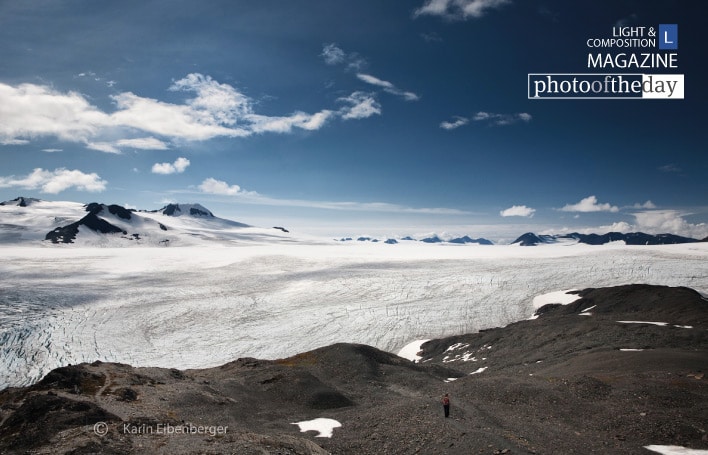
The Harding Ice Field photograph captures the vast, frozen expanse of Alaska’s Kenai Fjords National Park under unusually clear, brilliant skies. Karin Eibenberger undertook the strenuous seven-hour trek along Exit Glacier, meticulously carrying her gear to the summit to document the immense scale of the ice field. The image is award-worthy for its crisp rendering of the rugged, glacial landscape and the photographer’s dedication to capturing the raw, untouched beauty of the wilderness. It serves as a testament to the endurance required to reach such remote vantage points and the profound emotional connection between the photographer and the natural world.
Karin Eibenberger
Born and raised in Waidhofen, Austria, Karin Eibenberger is a multifaceted professional who transitioned from a career in literature and translation to become a biomedical engineer. Currently based in Baltimore, she balances her research work at Johns Hopkins University with an adventurous spirit that fuels her photography. Her work is deeply rooted in her love for trekking and exploration, using the camera as a powerful tool to communicate the beauty of the outdoors and evoke emotional responses from her audience.
Resonance Score Breakdown
Transparency Note: The resonance score (12.7/20) is calculated based on social engagement metrics collected before the award announcement.
Expert Photography Reviews · 5
The Archive of Breath
Time is not a line, but a layering of winters. We think of the earth as something solid, a foundation beneath our boots, yet there are places where the world is merely holding its breath, waiting for the sun to remember it.
Read the reflection →The Weight of Silence
In the high latitudes, the air is said to be thin, but it feels heavier, as if it carries the accumulated silence of centuries.
Read the reflection →Reviews & Comments
Share your thoughts about this award-winning photograph. Your reviews contribute to the community engagement score.
The horizon doesn’t end. It just recedes. I’ve stood in places like this, where the cold makes your lungs ache, and it’s humbling. Eibenberger leaves the frame open. There’s no clutter. Just the white weight of the ice field pressing against the blue. It’s quiet. Nothing here is accidental. The empty corner is not empty. It’s a pause. I find myself holding my breath, waiting for the wind to finally arrive. It never does.
Ice shouldn’t be this loud. Eibenberger’s frame is a blinding, clinical silence that refuses to let the eye rest. I’ve spent hours staring into these crevices, and it’s the lack of deep, anchoring shadow that haunts me. It’s too bright, too exposed; it’s a landscape stripped of its secrets. When light consumes everything, it leaves no room for the soul to hide. I feel a cold, hollow ache looking at it. It’s beautiful, but it’s terrified.
The cerulean bite of this ice field, reminiscent of a Vermeer sky stripped of its warmth, vibrates against the jagged, slate-grey shadows with a chilling, crystalline intensity that makes one’s breath hitch in the throat. It’s a frigid, monochromatic symphony where the light doesn’t merely illuminate; it carves. I’m utterly haunted by those glacial fissures, those veins of deep, bruised indigo that feel like the very pulse of the earth slowing down to a permanent, silent winter.
Seven hours of hauling glass up to the Harding Ice Field is a proper way to spend a day. Most wouldn’t bother, preferring the roadside view. I’ve spent enough time shivering on glaciers to know that the clarity here isn’t just luck; it’s the result of someone who didn’t turn back when the wind picked up. It’s a cold, honest frame. I find myself wanting to pull my coat tighter just looking at it.
Most landscape entries I’ve seen this year rely on sunset theatrics to hide a lack of substance. Eibenberger’s work succeeds because it’s brutally honest. The 72mm compression flattens the Harding Ice Field into a terrifying, infinite white void that makes me feel small, almost cold just looking at it. It’s not just a trek; it’s a document of a vanishing world. In thirty years, this clarity will be the only thing that matters. It’s earned its place.