Deadvlei by Rainer Mirau
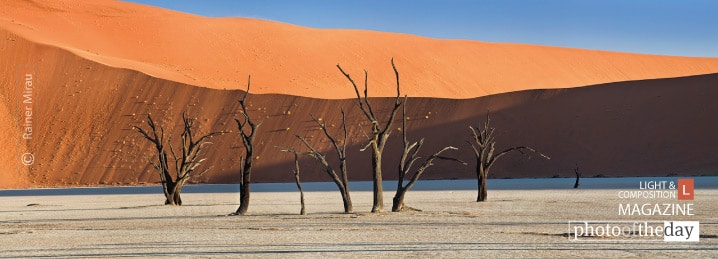
Capturing the stark, surreal beauty of Namibia’s Deadvlei, this photograph highlights the ancient camel thorn trees set against a backdrop of towering orange dunes. The photographer navigated the challenging desert heat and persistent winds to frame this graphic, minimalist landscape as the sun began its leisurely descent. By balancing the clear, crisp light with the deep, skeletal forms of the trees, the image transforms a natural wonder into a striking, almost painterly composition. It is this ability to distill a complex, untypical environment into a moment of profound clarity and simple, elegant geometry that makes the work truly award-worthy.
Rainer Mirau
Born in Vienna in 1976, Rainer Mirau resides in the picturesque town of Baden, Austria. His photographic journey began in his youth, eventually evolving into a dedicated pursuit of landscape photography inspired by the rugged beauty of Scandinavia and the technical mastery of legends like Ansel Adams. Today, Mirau balances his professional life with frequent expeditions in his camping van, finding necessary inspiration and creative fulfillment in the natural world. His work has earned recognition in numerous international competitions, reflecting his ongoing commitment to capturing the intersection of nature and technical precision.
Resonance Score Breakdown
Transparency Note: The resonance score (13.9/20) is calculated based on social engagement metrics collected before the award announcement.
Expert Photography Reviews · 4
The Weight of Stillness
I spent this morning trying to fix a broken shelf in the hallway. I kept moving things around, shifting books and heavy vases, trying to find a balance that wouldn't collapse under the weight. It was frustrating work.
Read the reflection →The Persistence of Bone
There is a patience in things that have stopped growing. In the north, we see this in the driftwood bleached by salt and wind, or the skeletons of trees caught in the permafrost. They do not decay; they wait.
Read the reflection →Reviews & Comments
Share your thoughts about this award-winning photograph. Your reviews contribute to the community engagement score.
The ochre of these dunes, a scorched, burnt-sienna intensity reminiscent of Turner’s most fevered sunsets, clashes violently yet beautifully with the skeletal, ink-black charcoal of the acacia trees. It’s a chromatic dissonance that makes my heart ache; one feels the parched, breathless silence of the Namib. The light, caught in that fleeting, bruised transition toward twilight, renders the clay pan a pale, ghostly bone-white, creating a palette that feels like a Morandi still life gone wild.
Deadvlei is a graveyard for the impatient. Most tourists arrive at noon, snap a frame, and retreat to the air-conditioning. Mirau clearly didn’t. He’s waited for the shadows to stretch, turning those skeletal trees into ink against the dunes. I’ve spent enough hours in that heat to know the grit in one’s teeth is the price of admission. It’s a quiet, disciplined piece of work. He earned this light, and it shows.
Deadvlei isn’t merely a landscape; it’s a graveyard of time. These skeletal trees don’t just occupy space—they puncture the horizon, demanding we confront the void. Mirau’s shadows are heavy, obsidian anchors against the dunes’ aggressive orange. I’ve stared at these charred limbs until my own pulse slowed, feeling the suffocating silence of a sun that refuses to offer mercy. It’s a brutal, honest geometry. When light dies here, it doesn’t leave; it simply waits.
The sun was retreating, casting that long, heavy shadow that only the desert knows. I feel a sudden, aching thirst just looking at these skeletal trees. They’ve been waiting for centuries, and Rainer finally listened. He didn’t force the frame; he let the orange dunes hold the silence until the light softened enough to breathe. It’s a quiet, holy geometry. I’ve stood in such heat, and it’s humbling to see the land finally speak its truth.