Stunning Beach by Marissa Tejada
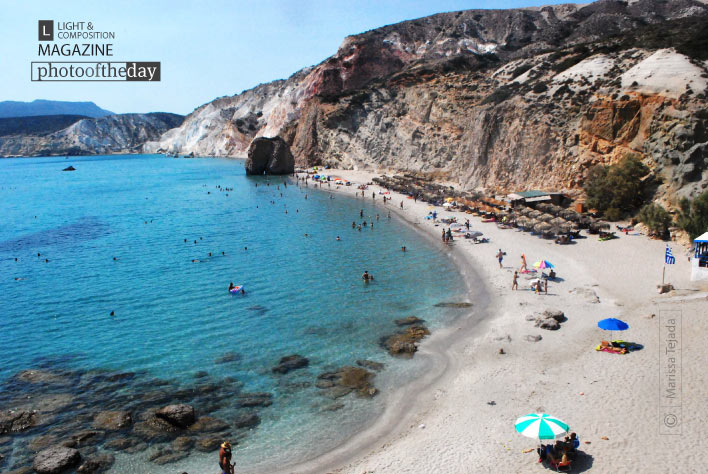
Captured after a brief trek along a dusty path, this photograph reveals the breathtaking expanse of Firiplaka Beach on Milos Island. The photographer was struck by the dramatic contrast between the silver sands and the vibrant, clear aqua waters of the bay. A striking, light-colored mountain formation frames the scene, appearing to cradle the coastline in a protective embrace. The image is award-worthy for its masterful composition and the way it translates the raw, serene beauty of the Greek landscape into a singular, evocative moment of discovery.
Marissa Tejada
Born in Brooklyn and raised on Long Island, Marissa Tejada is an award-winning American freelance journalist and travel writer currently based in Athens, Greece. Her diverse career has spanned international news production and television reporting across several major cities, eventually leading her to settle in Europe. This transition inspired her debut novel, Chasing Athens, and continues to fuel her creative pursuits as she documents her travel insights and photographic journeys through her dedicated blog.
Resonance Score Breakdown
Transparency Note: The resonance score (13.4/20) is calculated based on social engagement metrics collected before the award announcement.
Expert Photography Reviews · 7
The Architecture of Arrival
There is a peculiar weight to the threshold. We spend our lives moving toward things—a destination, a person, a change in the weather—but we rarely consider the moment just before the arrival.
Read the reflection →Salt on the Skin
The memory of the sea is never in the eyes; it is in the grit of salt drying on your collarbone. It is the way the air feels thick and heavy, like a damp wool blanket draped over your shoulders after a long day in the sun.
Read the reflection →Reviews & Comments
Share your thoughts about this award-winning photograph. Your reviews contribute to the community engagement score.
A dusty trek and a quick shutter don’t make a landscape. At f/16 and ISO 1600, one suspects the light was merely stumbled upon rather than courted. It’s a pleasant enough view of Milos, but I’ve spent enough mornings shivering on cliffs to know when a photographer hasn’t bothered to return. It’s pretty, certainly, but it’s a tourist’s snapshot, not a hard-won prize. I’m left wanting the grit of a real commitment.
The light here isn’t just illumination; it’s a conversation with the limestone cliffs. She stood on that dusty path, waiting for the sun to soften against the volcanic rock. I’ve felt that same stillness, where the air hums with the sea’s rhythm. It’s a quiet, holy cradle of aqua and silver. Looking at it, I can almost taste the salt on the wind. She didn’t rush the land; she simply let it reveal its grace.
Of the thousands of travel shots I’ve reviewed, most are just postcards. What separates this from the rest is the way the cliff’s curve forces your eye toward the water’s edge. It’s a quiet, geological embrace. I’ve stared at these silver sands for ten minutes, and I’m still struck by how the light hits that rock face. It’s not just a beach; it’s a place I’d actually want to be in thirty years.
At f/16, the diffraction limit begins to soften the fine crystalline structure of the Milos sand, yet the Nikon D60’s sensor captures a startling clarity in the aqua shallows. It’s a fascinating trade-off; the deep focal plane preserves the mountain’s geological texture, even if it sacrifices micro-contrast. I’m genuinely moved by how the light refracts through that shallow surf. It’s not just a beach; it’s a precise, luminous collision of photons against the Aegean basin.
The cliff face leans in. It’s a heavy, limestone shoulder. Below, the water thins to a pale, translucent edge. I’ve walked this path. I feel the grit of the dust under my boots. The frame doesn’t crowd the eye. It lets the horizon breathe. Nothing here is accidental. The empty corner is not empty. It’s a quiet invitation to step away from the noise. I find myself holding my breath. It’s enough.
The frame’s architecture relies on the cliff’s heavy mass to anchor the composition. It’s a precarious balance. The negative space of the aqua water provides necessary relief, yet the horizon line feels slightly adrift. I’ve seen better control of the picture plane, but the spatial tension here holds. It doesn’t collapse under the weight of the mountain formation. It’s a rigid, disciplined geometry that I find surprisingly satisfying. The frame barely contains the scene’s inherent sprawl.
The turquoise here isn’t merely water; it’s the liquid, electric blue of a Vermeer bodice, vibrating against the bleached, calcified bone-white of those Milos cliffs. I’m breathless, truly, watching how the silver sand drinks the Aegean light, creating a chromatic tension that feels like a Morandi still life expanded into the infinite. It’s a rare, shivering harmony where the heat of the stone doesn’t just sit beside the cool, tidal depth—it’s entirely consumed by it.