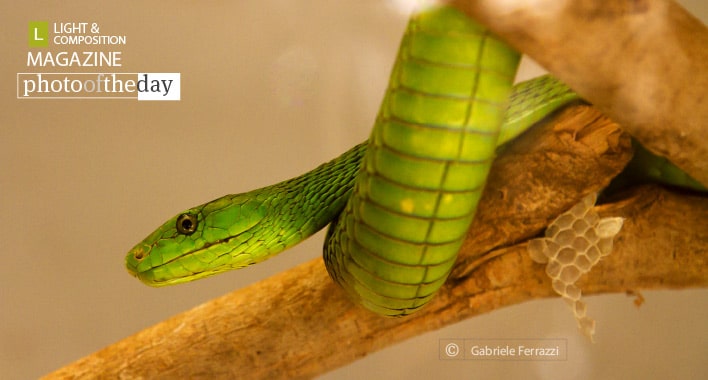
Mamba by Gabriele Ferrazzi
Captured during a six-month expedition across thirteen African nations, this striking image of a mamba was taken at a local camp in Arusha, Tanzania. The photographer utilized a 180mm focal length to maintain a safe yet intimate distance from the wildlife, capturing the serpent's intricate textures and lethal elegance. This photograph is award-worthy for its raw, unfiltered depiction of nature, demonstrating the photographer's patience and technical precision in challenging field conditions. It serves as a compelling testament to the beauty found in the world's most untamed corners, reflecting a deep curiosity for the diverse creatures that inhabit our planet.
Gabriele Ferrazzi
Born in Rome in 1982, Gabriele Ferrazzi is a dedicated travel photographer whose work is defined by his extensive global expeditions, including an overland journey from Cape Town to Istanbul. His photography serves as an expressive medium for his passions, capturing diverse cultures and wildlife with professional Canon equipment to ensure the highest quality. Driven by a lifelong ambition to explore every corner of the planet, Ferrazzi seeks to foster a deeper understanding of the world through his lens, constantly planning his next ambitious adventure.
Resonance Score Breakdown
Transparency Note: The resonance score (12.9/20) is calculated based on social engagement metrics collected before the award announcement.
Expert Photography Reviews · 6
The Pulse of the Earth
The smell of rain on dry, sun-baked earth always brings a shiver to my spine, a primal prickle at the base of my neck. It is the scent of anticipation, the way the air turns heavy and metallic just before the ground decides to wake up.
Read the reflection →The Architecture of Silence
There is a rhythm to the wild that does not require our permission to exist. It moves in currents of muscle and shadow, a silent language written in the dust and the tall, dry grass.
Read the reflection →Reviews & Comments
Share your thoughts about this award-winning photograph. Your reviews contribute to the community engagement score.
The mamba’s scales possess a verdant, acidic intensity that recalls the sickly, luminous greens of a Turner storm, yet it’s the way the light catches those serrated ridges—a cold, metallic chartreuse—that truly unnerves me. One feels the creature’s lethal stillness, a quietude that doesn’t merely exist but vibrates against the dry, ochre dust of Arusha. It’s a terrifying, beautiful harmony of venomous pigment and sun-bleached earth that makes my own skin crawl with delight.
Of the thousands of wildlife frames I’ve reviewed, most are merely trophies. This mamba is different. The way the scales catch the light at f/5.0 creates a tactile, almost rhythmic tension that makes my skin crawl—a visceral reaction I rarely get anymore. It’s the precise focus on the eye that anchors the danger. It doesn’t just document a snake; it captures an ancient, lethal intelligence that will still feel terrifying thirty years from now.
At f/5.0, the 180mm focal length renders the mamba’s scales with a clinical sharpness that pushes the Canon 7D’s sensor to its limit. The focal plane is razor-thin, isolating the serpent’s gaze against a beautifully rendered bokeh. I’m genuinely unsettled by the way the light catches those crystalline eyes; it’s a terrifyingly precise intersection of biology and glass. You don’t just see the snake—you feel the diffraction of light across its lethal, iridescent skin.
The light here doesn’t just illuminate; it reveals a coiled, ancient tension. Gabriele must have held his breath as the mamba’s scales caught that sharp, unforgiving Tanzanian sun. It’s a quiet, lethal geometry that makes my own skin prickle with a strange, respectful fear. He didn’t rush the moment. He waited until the serpent’s stillness matched his own, finding that singular, breathless second where the wild world simply stops to look back at us.
The mamba’s diagonal trajectory slices the frame, establishing a precarious spatial tension. It’s a rigid geometry that forces the eye toward the upper-right quadrant. The scales provide a necessary, repetitive texture that anchors the composition against the void of the background. It’s clinical, sharp, and entirely devoid of sentimentality. I’ve rarely seen such lethal precision in a frame. The structure holds perfectly. It’s a rare instance where the subject’s inherent danger is matched by the photographer’s discipline.
Most wouldn’t linger near a mamba long enough to worry about focal length. It’s a nasty piece of work, and I’ve spent enough time in the bush to know that staying put while one of those decides your fate isn’t for the faint of heart. Ferrazzi clearly didn’t just stumble upon this. He sat, he waited, and he earned that texture. It’s a cold, sharp bit of work. I’d have been shaking, frankly.
i ♥ snakes
que asco me dn miedo