eSolitud by Debjani Chowdhury
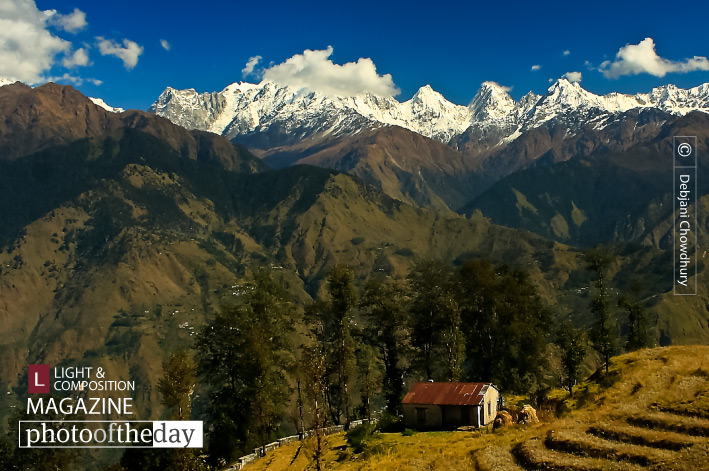
Captured in the serene heights of Munsiyari, Uttarakhand, this photograph depicts a solitary house perched atop a hill, standing in quiet isolation above the bustling town below. The photographer utilized a wide-angle perspective to emphasize the vastness of the Himalayan landscape and the profound stillness of the structure. By focusing on the singular dwelling against the backdrop of the great mountain range, the image captures a poignant sense of detachment and peace. Its award-worthy quality lies in the evocative composition, which transforms a simple architectural subject into a powerful narrative of solitude amidst the grandeur of nature.
Debjani Chowdhury
Based in Howrah, West Bengal, Debjani Chowdhury is a dedicated photographer and student of economics. Her artistic journey has garnered significant acclaim, including features in Asian Photography and National Geographic, where her work was selected for the 'Your Shot: Editor's Choice' section. Driven by a passion for capturing the world's nuances, she continues to refine her craft, transforming her observations into compelling visual stories that resonate with audiences internationally.
Resonance Score Breakdown
Transparency Note: The resonance score (12.8/20) is calculated based on social engagement metrics collected before the award announcement.
Expert Photography Reviews · 6
The Architecture of Silence
We often mistake loneliness for a lack of company, as if the absence of voices is a deficit to be corrected. Yet, there is a specific, heavy kind of quiet that exists only when we are truly apart from the hum of the collective. It is not an emptiness, but a density.
Read the reflection →The Architecture of Silence
To live at the edge of the sky is to learn the language of wind. Down in the valley, words are heavy, tangled in the thicket of daily demands and the relentless hum of proximity. But up where the air thins, the world sheds its noise like a snake shedding skin.
Read the reflection →Reviews & Comments
Share your thoughts about this award-winning photograph. Your reviews contribute to the community engagement score.
Excellent Photography… Carry on…
Munsiyari’s thin air doesn’t just surround that house; it consumes it. Chowdhury understands that true solitude isn’t found in the light, but in the encroaching gloom that threatens to swallow the structure whole. I’ve stared at these shadows for an hour, and they feel like a physical weight against my chest. Heidegger would argue that we only truly dwell when we are hidden. Here, the darkness isn’t empty. It’s where the mountain finally begins to think.
The air in Munsiyari is thin, and I can feel the silence pressing against the walls of that solitary house. Debjani didn’t rush; she waited for the light to settle into that flat, honest clarity. It’s a quiet ache, seeing a home so small against the vast, indifferent peaks. I’ve stood in such places, shivering as the world falls away. It’s not just a view; it’s a breath held in the presence of giants.
Of the thousands of mountain landscapes I’ve reviewed, most drown in the scale of the peaks. Chowdhury avoids this by anchoring the frame with that singular, fragile house. It’s the tension between the domestic roofline and the jagged, indifferent Himalayan horizon that makes me catch my breath. It’s not just a pretty view; it’s a quiet argument for the necessity of being alone. Thirty years from now, that house will still be holding its ground against the silence.
Munsiyari isn’t a place one stumbles upon between tea breaks. It’s a long, lung-burning climb. I’ve spent enough nights shivering in those altitudes to know that house didn’t just pose for a quick snap. The light here is thin and honest, suggesting the photographer didn’t rush the descent. It’s a quiet, lonely frame that makes me miss the biting cold of the high ridges. One doesn’t get this stillness without paying the fare.
The frame’s geometry is its saving grace. The house functions as a necessary fulcrum, anchoring the vast, chaotic topography of the Uttarakhand range. It’s a precarious balance, yet the wide-angle perspective maintains the spatial tension required to keep the composition from collapsing into sentimentality. I’ve grown weary of mountain vistas, but this one doesn’t drift. The negative space above the roofline is disciplined, sharp, and cold. It’s a rare instance where the architecture actually holds.
The ochre of the dwelling, a shade reminiscent of Morandi’s dust-choked clay, vibrates against the Himalayan sky’s bruised, glacial violet. It’s a chromatic dissonance that aches, pulling the eye into a cold, thin air where one feels the sudden, sharp sting of true isolation. I’m breathless, really, watching how the light bleeds into that pale, chalky blue; it’s not merely a landscape, but a silent, shivering conversation between the earth’s ancient, weary bones and the infinite.