A Moment in Time by Zabeeh Afaque
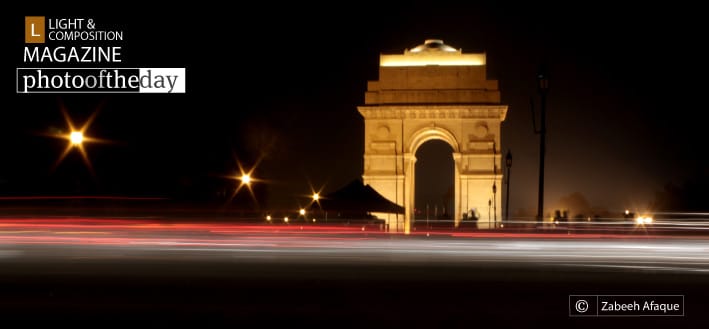
Captured at 8:30 PM on May 2, 2010, at the India Gate war memorial, this image represents a synchronized global effort to document a single, fleeting moment in time. The photographer utilized a long exposure of 26 seconds to transform the bustling atmosphere of New Delhi into a serene, ethereal scene. By choosing a narrow aperture of f/25, the photographer ensured deep depth of field, allowing the architectural grandeur of the memorial to stand in sharp contrast against the blurred motion of the city. This photograph is award-worthy for its technical precision and its ability to turn a high-alert urban environment into a poetic, timeless reflection of human existence.
Zabeeh Afaque
Based in New Delhi, India, Zabeeh Afaque is a dedicated photographer and media activist who began his creative journey in 2007. Working professionally within the newspaper industry, he has developed a modern, photo-journalistic style that seamlessly blends contemporary perspectives with a timeless, classical edge. His work is defined by a passionate exploration of light and shadow, reflecting his commitment to documenting the world through a thoughtful and distinctive lens.
Resonance Score Breakdown
Transparency Note: The resonance score (12.9/20) is calculated based on social engagement metrics collected before the award announcement.
Expert Photography Reviews · 6
The Hum of the Unseen
The smell of hot asphalt after a summer rain is a heavy, metallic perfume that clings to the back of the throat. It is the scent of a city exhaling.
Read the reflection →The Ghost of Motion
We are taught that time is a line, a steady progression from one point to the next. We measure it in heartbeats, in the ticking of clocks, in the way the shadows stretch across the floorboards as the afternoon wanes. But there are moments when the line blurs.
Read the reflection →Reviews & Comments
Share your thoughts about this award-winning photograph. Your reviews contribute to the community engagement score.
Vous y trouvez quoi à cette image?
At 8:30 PM, the India Gate isn’t just stone; it’s a vessel for the city’s restless spirit. Zabeeh waited twenty-six seconds, letting the chaos of New Delhi dissolve into a soft, ghostly hum. I’ve spent enough nights in the dark to know the stillness he felt while the shutter stayed open. It’s haunting, really—that narrow aperture turning the world into a quiet, eternal breath. He didn’t just capture motion; he listened to the city’s heartbeat.
Most long exposures of India Gate are cluttered, messy affairs. What separates this from the thousands I’ve reviewed is the deliberate stillness of the stone against the ghostly, rhythmic smear of traffic. It’s a rare instance where f/25 doesn’t kill the soul of the shot. I’ll admit, the silence in this frame actually makes me hold my breath. Thirty years from now, this won’t just be a record of Delhi; it’ll be a haunting, quiet memory.
The India Gate acts as a rigid fulcrum, anchoring the frame against the chaotic smear of long-exposure light. It’s a disciplined geometry. The architecture’s mass forces the eye to settle, refusing the blur’s invitation to wander. I’ve grown weary of such predictable motion studies, yet the structural integrity here holds firm. The aperture choice creates a necessary, sharp contrast. It doesn’t just capture time; it traps it within a precise, cold, and entirely unforgiving visual architecture.
Twenty-six seconds at f/25 in the Delhi heat. One suspects the tripod was kicked more than once by passing crowds. It’s a tiresome business, waiting for the chaos to blur into submission while the sensor cooks. I’ve spent enough nights shivering in the dark to appreciate the sheer stubbornness required here. It isn’t just a long exposure; it’s a quiet victory over a frantic city. He clearly didn’t just stumble upon this. He earned it.
The India Gate dissolves into a ghostly, sepia-toned luminescence, where the amber glow of streetlamps bleeds into the bruised indigo of a Delhi night. It’s a chromatic alchemy that reminds me of Turner’s late, vaporous horizons, where light doesn’t just illuminate but consumes. I’m breathless at how the motion blurs into a velvet, ochre haze; it’s as if the city’s frantic pulse has finally surrendered to the quiet, melancholic dignity of a Morandi still life.
Twenty-six seconds of exposure turns the India Gate into a tomb of ghosts. It’s a haunting erasure of the living, where the city’s pulse dissolves into a hollow, spectral blur. I find the silence here genuinely unsettling; it’s as if the stone memorial has finally swallowed the noise of Delhi whole. Afaque doesn’t just capture motion; he forces the light to surrender its clarity, leaving us to confront the heavy, dark void where history actually resides.
awsemest………………..:)
Nice amalgam of lights and haloes…gud1…kudos :)
My all time fav :D
Brilliant.