Roar of an Uncontrolled Wheel by Jen Mitsuko
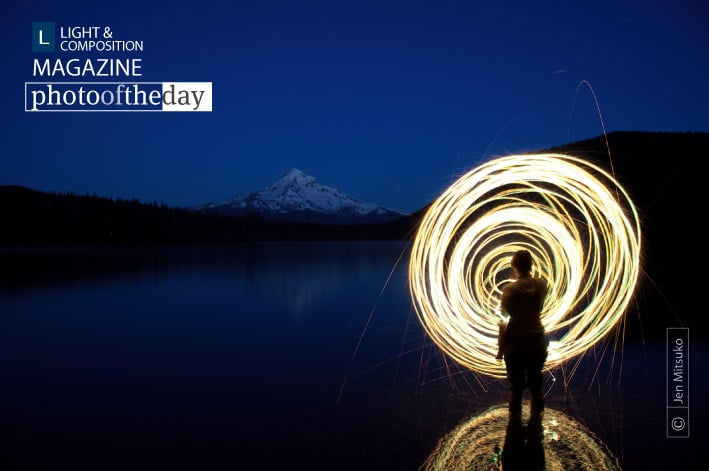
Captured during the ethereal twilight hour at Lost Lake in the Mt. Hood National Forest, this image is a centerpiece of Jen Mitsuko’s 'Capturing Time' series. By employing a long 30-second exposure, the photographer masterfully translates the passage of time into a visual narrative, transforming the landscape into a meditative study of motion and stillness. The composition is award-worthy for its technical precision and the deliberate, philosophical approach to light, which elevates a familiar natural setting into a profound exploration of temporal flow and artistic intent.
Jen Mitsuko
Based in Portland, Oregon, Jen Mitsuko holds a BFA in Photography and a BA in Film from the University of Nevada, Las Vegas. Her work bridges the gap between traditional photographic techniques and cinematic storytelling, aiming to challenge viewers intellectually while upholding high aesthetic standards. With a career marked by national gallery exhibitions and accolades from the Worldwide Photography Gala Awards and the Prix de la Photographie Paris, Mitsuko continues to refine her unique artistic vision.
Resonance Score Breakdown
Transparency Note: The resonance score (14.9/20) is calculated based on social engagement metrics collected before the award announcement.
Expert Photography Reviews · 6
The Weight of Turning
We are told that time is a river, something that flows away from us. But standing in the dark, watching the stars trace their slow, cold arcs across the sky, it feels different. It feels like a wheel.
Read the reflection →The Hum of the Earth
The smell of damp pine needles always brings me back to the feeling of wet wool against my skin. It is a heavy, grounding scent, like the earth exhaling after a long fever.
Read the reflection →Reviews & Comments
Share your thoughts about this award-winning photograph. Your reviews contribute to the community engagement score.
Awesome very beautiful
The circular motion of the stars creates a rigid geometry against the static horizon. It’s a precarious balance. The long exposure anchors the frame, yet the central vortex threatens to collapse the composition’s structural integrity. I’m unsettled by the lack of a true fulcrum; the weight shifts too aggressively toward the upper quadrant. It’s technically precise, but the visual architecture doesn’t quite hold. The frame is strained, and frankly, it’s exhausting to look at for long.
The indigo of the Oregon twilight bleeds into the charcoal of the pines, a chromatic melancholy that recalls the muted, dusty stillness of a Morandi canvas. It’s a haunting, liquid transition where the water’s surface dissolves into a bruised violet, and I’m frankly undone by the way the light clings to the motion. One feels the cold dampness of the forest floor, a symphony of shadows that doesn’t just exist, but breathes in the dark.
Thirty seconds of exposure at Lost Lake doesn’t capture time; it suffocates it. Mitsuko forces the water into a ghostly, featureless veil, stripping the mountain of its jagged, chaotic truth. I’ve stared at these blurred ripples until my eyes ached, searching for a single honest shadow to anchor the frame. It’s too clean, too afraid of the dark. When you erase the friction of the night, you’re left with nothing but a hollow, sanitized silence.
Thirty seconds of stillness at Lost Lake. She stood there as the light faded, listening to the water’s slow, rhythmic pulse against the shore. It’s a quiet surrender to the mountain’s breath. I’ve spent enough hours in the cold to recognize that ache in her patience; she didn’t force the motion, she let the lake reveal its own ghost. It’s haunting, really. When I look at this, I feel the damp air settling on my own skin.
Most long-exposure landscapes are just blurry distractions, but this one sticks. The thirty-second drag turns the water into a sheet of glass, forcing the jagged silhouette of Mt. Hood to hold the frame’s weight. It’s the stillness that gets me; I felt my own pulse slow down looking at it. While others cluttered their frames with unnecessary movement, Mitsuko understood that silence is a visual choice. In thirty years, this quiet clarity will still feel essential.
Thirty seconds at f/8 in the damp chill of a Lost Lake twilight. It’s a long time to stand still while the mosquitoes have their way with you. One suspects Mitsuko didn’t just stumble upon this; she likely shivered through a dozen failed attempts before the water settled into that perfect, glassy blur. I’ve spent enough nights in the Cascades to know that ache. It’s a quiet, earned piece of work. She clearly paid the price.