Serendipity by Rezwan Razzaq
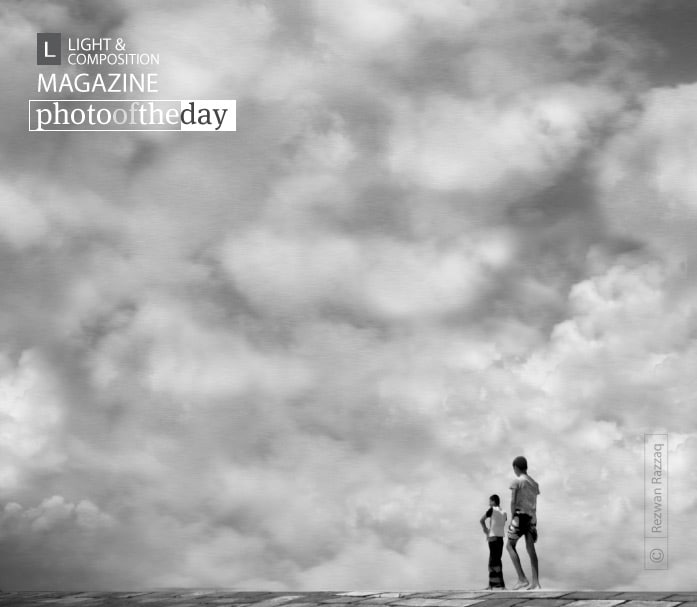
Captured at Kuakata Beach, Bangladesh, this image showcases a poignant moment of serendipity. The photographer utilized a low vantage point to frame the local boys against a dramatic, expansive cloudy sky, effectively stripping away distractions to emphasize the scene's inherent simplicity. By choosing a wide-angle perspective, the photographer transformed a fleeting encounter into a minimalist composition that highlights the vastness of the coastal environment. This photograph is award-worthy for its masterful use of negative space and its ability to elevate a simple, everyday interaction into a powerful, evocative visual narrative that resonates with the viewer.
Rezwan Razzaq
Based in Dhaka, Bangladesh, Rezwan Razzaq is a Creative Supervisor at a prominent advertising agency and a computer science graduate of North South University. His photographic journey began during his school years, evolving into a professional pursuit in 2002 with his first SLR. Razzaq is deeply committed to the philosophy of simplicity, often eschewing rigid rules in favor of capturing images that leave a distinct, lasting impact. His work reflects a dedicated endeavor to present a unique perspective on the world through a minimalist lens.
Resonance Score Breakdown
Transparency Note: The resonance score (14.5/20) is calculated based on social engagement metrics collected before the award announcement.
Expert Photography Reviews · 6
The Architecture of Breath
We spend our lives building walls against the wind, forgetting that the wind is the only thing that truly knows the shape of our faces. There is a quiet, hollow space between the earth and the clouds where time stops its frantic ticking.
Read the reflection →The Salt on the Skin
The smell of wet sand always brings me back to the feeling of grit between my toes, a coarse, grounding reminder of the earth beneath me. It is a sharp, briny scent that clings to the back of the throat, tasting faintly of iodine and ancient tides.
Read the reflection →Reviews & Comments
Share your thoughts about this award-winning photograph. Your reviews contribute to the community engagement score.
Excellently composed…
The flat, directionless light of a Kuakata noon doesn’t hide the soul here; it reveals it. He stood low in the wet sand, waiting for those boys to become part of the horizon’s vast, grey silence. It’s a quiet surrender to the elements. I’ve felt that same stillness, where the shutter is just a heartbeat. Looking at this, I feel a sudden, sharp ache for the simplicity of a world stripped of all noise.
A low vantage point in the sand usually suggests a photographer who isn’t afraid of a bit of grit in their trousers. It’s a clean frame, though one wonders if the tide was the real collaborator here. I’ve spent enough mornings waiting for the sky to clear in similar conditions to respect the patience required for this stillness. It’s a quiet, honest piece of work. They clearly didn’t rush this one. I find it rather refreshing.
The horizon line bisects the frame with surgical precision, anchoring the boys against an oppressive, monochromatic expanse. It’s a study in spatial tension. The wide-angle distortion pushes the figures toward the periphery, forcing the eye to negotiate the vast, empty sky. I’m genuinely unsettled by how the negative space threatens to swallow them whole. The composition holds because the weight of the clouds perfectly counterbalances the subjects. It’s a disciplined, structural success.
The bruised, slate-grey sky of Kuakata doesn’t merely hang; it presses against the horizon with the heavy, melancholic weight of a Morandi still life, forcing the boys’ silhouettes into a stark, ink-wash clarity that I find utterly devastating. It’s a chromatic ache, that transition from the damp, charcoal sands to the bruised violet of the atmosphere, where the light feels like it’s drowning, and honestly, it’s enough to make one weep for the sheer, quiet beauty.
Kuakata’s horizon doesn’t invite us in; it pushes back. Those boys aren’t merely figures; they’re anchors against a sky that threatens to dissolve them. I’ve stared at the way the shadows cling to their feet, refusing to let the light claim the ground. It’s a heavy, silent struggle. I feel a sudden, sharp ache in my chest looking at it. Razzaq understands that true minimalism isn’t about emptiness, but about the darkness that defines our existence.
Most entries in this category rely on cluttered chaos, but Razzaq’s restraint here is what makes it endure. By pushing the horizon low and embracing that heavy, brooding sky, he forces us to confront the scale of the coast against the fragility of the boys. It’s a quiet, lonely frame that actually makes me miss the silence of the beach. It’s not just a snapshot; it’s a deliberate choice to let the atmosphere do the heavy lifting.
nice.