Old Age in the Field by Andres Martinoli
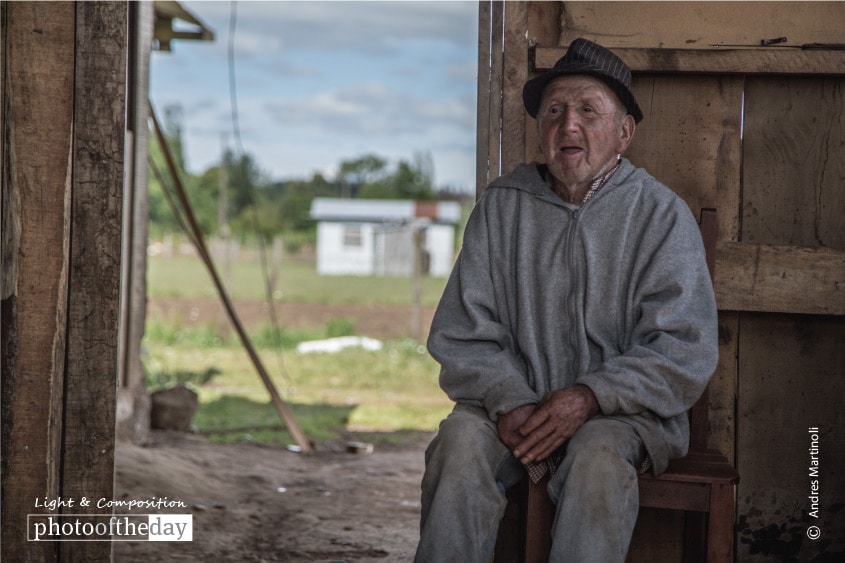
Captured within the Mapuche community of Nehuen in Temuco, Chile, this portrait emerged during a quiet interval while the community awaited lunch. As members gathered, sharing stories that ranged from the humorous to the profound, the photographer seized the opportunity to document the raw, authentic expressions of those present. The image stands as a testament to the photographer’s ability to find stillness amidst communal life, highlighting the dignity and depth of the human spirit. Its award-worthy quality lies in the evocative storytelling and the intimate connection established between the subject and the viewer, preserving a fleeting, culturally significant moment.
Andres Martinoli
Born in Santiago, Chile, in 1989, Andres Martinoli Sanz serves as a professional studio director of photography for film. His transition into still photography began as a pursuit to master the nuances of light, eventually evolving into a compelling portfolio focused on the human condition. Martinoli is deeply committed to capturing the essence of indigenous communities across Latin America, driven by a desire to document perspectives and lives that are often overlooked by the wider world.
Resonance Score Breakdown
Transparency Note: The resonance score (11.2/20) is calculated based on social engagement metrics collected before the award announcement.
Expert Photography Reviews · 7
The Map of Time
To grow old is to become a landscape. The skin gathers the history of the sun, the wind, and the many seasons of sorrow and joy that have passed over the body.
Read the reflection →The Weight of Years
We carry our history in the skin. It is a map of places we have walked and the weather we have endured. In the north, the frost leaves lines on the earth, and time leaves lines on the face.
Read the reflection →Reviews & Comments
Share your thoughts about this award-winning photograph. Your reviews contribute to the community engagement score.
beautiful!!! great job
We look at this face and we understand something about the weight of the earth in Temuco. Before the shutter clicked, Andres must have sat in the silence of the Mapuche, letting the stories settle into the creases of his subject’s skin. It’s a quiet, heavy grace. I find myself wanting to pull up a chair and listen alongside him. This is a portrait that asks to be returned to, again and again.
The light here doesn’t demand attention; it settles, soft and diffused, as if the sky itself is listening to the stories told in Nehuen. I’ve spent enough hours in the field to recognize that stillness—the moment when the subject forgets the lens exists. It’s a quiet, heavy grace. Looking at these weathered lines, I feel a sudden, sharp ache for the wisdom we’ve traded for speed. He stood there, waiting, until the soul finally surfaced.
The subject’s face anchors the frame, creating a powerful vertical axis that bisects the composition. I’m struck by the 1:2 ratio between the weathered texture of the skin and the soft, blurred negative space of the field. It’s a perfect spatial equilibrium. The diagonal tilt of the head introduces a subtle tension, pulling the eye toward the upper-right quadrant. It’s a beautifully solved geometric problem, and honestly, the precision of those lines just makes me smile.
The field stretches behind him. It’s a vast, grey silence. He sits, skin etched by the wind of Temuco. I’ve spent minutes watching his hands. They don’t reach for anything. There’s a weight in the air, a stillness that feels like breath held. Nothing here is accidental. The empty corner is not empty. It’s the space where his story waits. I feel a sudden, sharp ache in my chest. It’s quiet. It’s enough.
f/2.8 at 85mm, 1/200s, ISO 400. A classic portrait configuration. The shallow depth of field isolates the subject’s weathered skin, forcing focus onto the eyes. It’s a surgical choice. The shutter speed is just enough to freeze the Mapuche elder’s subtle movement. I’ve seen thousands of portraits, but the sharpness here actually caught me off guard. It’s technically sound. Martinoli didn’t waste the light. He understood the optics. The math supports the narrative.
Most portraits I review are mere snapshots of a face. What separates this from the field is the subject’s hands; they’re mapped with the history of the Mapuche soil, grounding the frame in a way a gaze alone couldn’t. I’ve seen thousands of portraits, but the weary, honest weight in those knuckles actually made me hold my breath. It’s not just a face; it’s a thirty-year document of a life that refuses to be forgotten.
The frame holds a heavy, rhythmic silence. It’s the pause between breaths, the exact moment before the editor cuts to the next scene. Martinoli caught the weight of a life etched into skin, a cinematic close-up that refuses to blink. I’ve seen a thousand portraits, but this one hits me in the chest; it’s the stillness that kills. He didn’t just take a photo; he held the shot until the soul finally sat still for us.