Passengers on the Open River Crossing
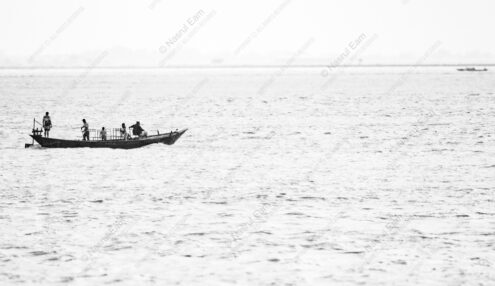
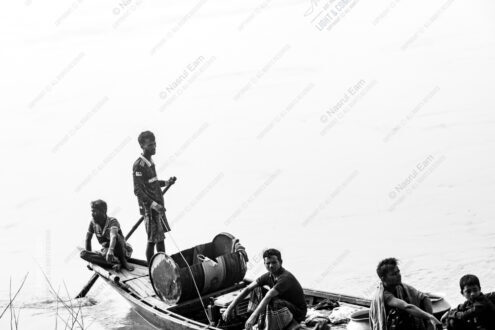
A slender wooden vessel cuts horizontally through a vast expanse of open water, situated deliberate in the lower-left quadrant of the frame. Five distinct human silhouettes populate the craft, ranging from an upright figure stationed at the stern helm to seated passengers and a contemplative elder wrapped in traditional cloth near the bow. The composition employs an expansive field of negative space, where the continuous texture of rhythmic surface chop overwhelms the visual plane, reducing the vessel to an intimate narrative anchor set against a low, distant horizon line that dissolves into pure white atmosphere.
The photograph excels through a high-key monochromatic register, stripping distracting chromatic cues to emphasize structural form and luminescent water reflections. The illumination is stark, bright daylight diffused through a humid sky, producing brilliant highlights across the undulating crests of the water. Deep, velvety charcoals in the hull and the figures’ garments establish a graphic chiaroscuro against the pale, silken tones of the river, demonstrating consummate tonal gradation that preserves delicate midrange detail within the boat’s exposed ribs and passenger forms.
Captured by photographer Nasrul Eam in September 2026, this scene documents the enduring pulse of everyday life across the wide river waterways of Bangladesh. Traveling along the delta’s vital aquatic thoroughfares, Eam observes the routine journeys that bind riverside communities together. The frame documents a quiet transit across immense natural geography, translating daily communal transportation into a profound meditation on distance, patience, and geographic scale.
Through this focused documentary gaze, Eam explores the delicate equilibrium between humanity and the boundless natural environment. His artistic philosophy foregrounds quiet resilience, rendering the daily routines of working-class commuters not as mundane tasks, but as timeless moments of shared endurance and solidarity. Stripped of temporal specificity by the monochrome palette, the figures embody an elemental kinship with the river, suspended between departure and arrival.
As a museum-grade acquisition, this print offers collectors an exceptional balance of minimalist modern composition and emotive human documentary. Rendered with archival pigment inks on heavyweight cotton rag, its deep blacks and luminous paper whites ensure exceptional tonal longevity. It represents a masterclass in spatial tension and social narrative, making it an indispensable centerpiece for connoisseurs of contemporary black-and-white photography.
About the Photographer
Nasrul Eam is a visionary art and documentary photographer whose work has deeply influenced the photography world since 2008. With over 60 publications to his name, including notable works like “The Quintessence of Photography: Understanding Composition” and “Masterclass in Portrait Photography: Echoes of Emotion”, he explores the intricacies of human emotion and visual storytelling. As the chief judge for Light & Composition University’s prestigious photography award for the past 14 years, Nasrul’s discerning eye and expertise have shaped the future of countless photographers. His role as Dean of the Department of Art and Photography further reflects his dedication to nurturing new talent. Nasrul’s photography, particularly through projects like “The Happy Children of the Third World,” captures the essence of his subjects with profound depth, inspiring collectors and photographers alike. His evocative images transcend time, culture, and genre, and have become highly sought after in the art world for their emotional depth and unique storytelling, making them a valuable addition to any high-end collection. His work continues to inspire and elevate the art of photography globally, solidifying his reputation as one of the foremost photographers of his generation.