White Dress at the Wet Shoreline
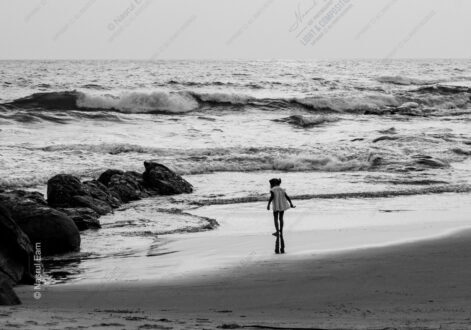
A lone child in a pale dress pauses at the threshold where receding tide meets polished sand, anchored in the lower-right quadrant of a vast monochromatic expanse. To the left, a cluster of dark, weathered coastal rocks introduces a heavy diagonal weight, grounding the scene against the surging motion of the ocean. Successive tiers of foaming breakers roll inward, their crests creating horizontal layers of kinetic energy that contrast sharply with the fragile, upright stance of the girl. The spatial tension is defined by scale: a diminutive human presence set against the unrelenting rhythm and boundless magnitude of the sea.
Rendered in rich grayscale, the photograph demonstrates a masterful handling of tonal graduation. The high, overcast sky yields a soft, omnidirectional luminosity that eliminates harsh shadows while sculpting the crests of the waves in luminous silver and chalky white. Below, the damp littoral strand functions as a dark mirror, capturing the girl’s crisp vertical reflection in pristine specular clarity. The deep, velvety blacks of the wet stones counterpoint the churned froth and salt spray, allowing atmospheric depth to unfold naturally across the picture plane without artificial enhancement.
Documented by Nasrul Eam in March 2009 along the windswept shores of Morjim in northern Goa, this work captures a singular, unposed encounter with the Arabian Sea. Known for its expansive coastal stretches and dynamic surf, Morjim provides an evocative setting where the land gently dissolves into the ocean. The artist’s journey along this coastal territory emphasizes quiet observance over spectacle, seizing a fleeting moment when human childhood intersects with the primeval expanse of the maritime wilderness.
Eam’s artistic vision frequently examines themes of vulnerability, innocence, and the relationship between the human figure and the sublime forces of nature. Rather than depicting the sea as threatening, the composition frames it as an open wonder, framing the child’s tentative posture as an embodiment of quiet curiosity. By distilling the color palette to silver and charcoal gradations, the photograph moves beyond mere environmental documentation, ascending into a timeless visual metaphor on curiosity, scale, and our shared placement within the natural world.
Printed on museum-grade cotton rag paper using archival carbon pigments, this limited-edition print preserves every delicate gradation from deep mineral blacks to radiant oceanic highlights. Its subtle emotional balance and rigorous compositional geometry ensure enduring aesthetic value, establishing it as a cornerstone acquisition for discerning collectors of fine art photography.
About the Photographer
Nasrul Eam is a visionary art and documentary photographer whose work has deeply influenced the photography world since 2008. With over 60 publications to his name, including notable works like “The Quintessence of Photography: Understanding Composition” and “Masterclass in Portrait Photography: Echoes of Emotion”, he explores the intricacies of human emotion and visual storytelling. As the chief judge for Light & Composition University’s prestigious photography award for the past 14 years, Nasrul’s discerning eye and expertise have shaped the future of countless photographers. His role as Dean of the Department of Art and Photography further reflects his dedication to nurturing new talent. Nasrul’s photography, particularly through projects like “The Happy Children of the Third World,” captures the essence of his subjects with profound depth, inspiring collectors and photographers alike. His evocative images transcend time, culture, and genre, and have become highly sought after in the art world for their emotional depth and unique storytelling, making them a valuable addition to any high-end collection. His work continues to inspire and elevate the art of photography globally, solidifying his reputation as one of the foremost photographers of his generation.