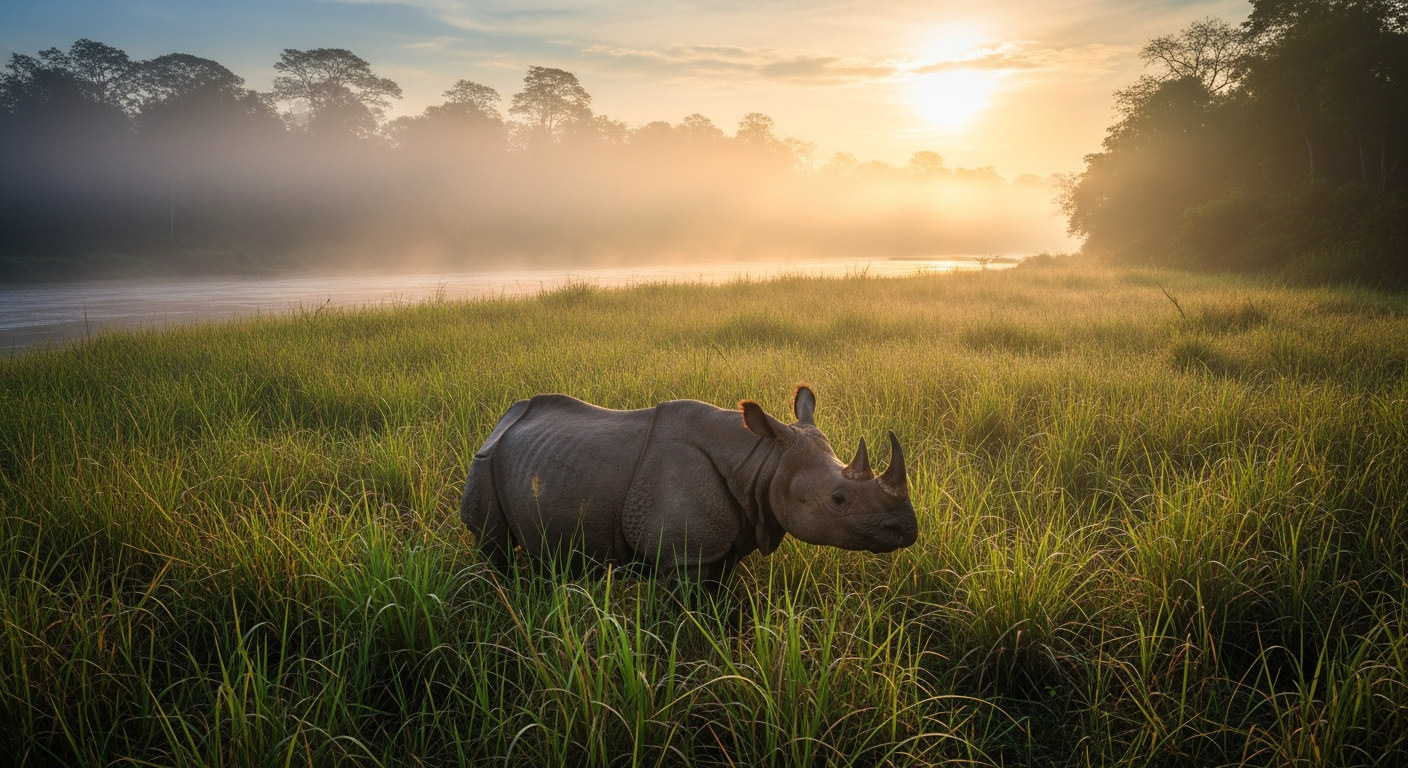
Expedition Overview
Chitwan National Park is Nepal's most accessible wildlife sanctuary — a UNESCO World Heritage Site in the subtropical Terai that protects one of the last viable populations of the greater one-horned rhinoceros and some 125 Bengal tigers. The park covers 952 square kilometres of sal forest, riverine grassland, and oxbow lake, and supports hundreds of bird species, sloth bears, leopards, gaurs, and four species of deer in addition to its famous megafauna.
The photography in Chitwan operates at two levels: wildlife photography from elephant back (which allows the camera to approach rhinos and deer at impractically close range), and documentary photography of the Tharu people — the indigenous community of the Terai plains whose fishing, weaving, and performance traditions survived the park's formation and remain vivid today. Professor Nasrul Eam has photographed Chitwan across six seasons and knows its light and animal patterns with the intimacy of a local naturalist.
Expedition Itinerary
Day 1: Arrival & Evening Rapti River
Drive or fly to Sauraha at the northern boundary of the park. Late afternoon at the Rapti River: rhinoceros crossing and bathing is common at this hour, gharial crocodiles on the sandbanks, kingfishers and bee-eaters everywhere.
The Goal of the Day: River-edge wildlife photography; working the golden hour at water.
Day 2: Elephant-Back Safari at Dawn
Pre-dawn departure on elephant back into the tall grassland. The rhinos — which can be approached to within 5 metres from elephant back without disturbance — are active at this hour. Deer, peacocks, and occasionally tiger sign.
The Goal of the Day: Close-range wildlife photography from an elevated moving platform.
Day 3: Canoe on the Rapti & Bird Photography
Silent dugout canoe drift along the river edge — the best position for birds. Common kingfisher, pied kingfisher, river tern, Asian openbill stork, and the extraordinary Indian roller are all reliably encountered.
The Goal of the Day: Bird photography from a silent, ground-level platform.
Day 4: Tharu Village & Return
A Tharu village visit with documentation of the stick dance performance, fishing with traditional conical bamboo traps, and the hand-block printed textiles that have made Tharu artisanship known across Nepal.
The Goal of the Day: Indigenous cultural documentation; performance and craft photography.
Book Your Expedition
Note: Final price may vary based on specific expedition details and customizations.
Expedition Leaders
Professor Nasrul Eam is a seasoned explorer and visual storyteller who has spent over two decades traversing Asia’s diverse landscapes and cultures. As Dean of the Department of Art and Photography at Light & Composition University, he leads immersive photography expeditions to regions like the Himalayas, Sundarbans, and Bali. These journeys blend cultural exploration with hands-on learning, culminating in a complete photography diploma. With a portfolio of over 50 publications—including The Quintessence of Photography and Illuminating Nature—his work captures the profound beauty of everyday life. His background in advertising, linguistics, and visual arts enriches his mentorship, guiding participants to uncover compelling narratives through their lenses. Professor Eam’s expeditions are transformative experiences, inspiring photographers to engage deeply with the world around them.
Travel Information
Sauraha is 5 hours by road from Kathmandu (scenic drive through the Prithvi Highway) or fly Kathmandu–Bharatpur (20 min) then 1 hour by road. Best season: October–March. Park is closed during monsoon (mid-June to mid-September).
What to Bring
• Telephoto zoom (300–600mm for birds and distant wildlife)
• 70–200mm for elephant-back rhinoceros work
• Khaki or neutral colours (wildlife approach)
• Insect repellent (malaria area — consult doctor)