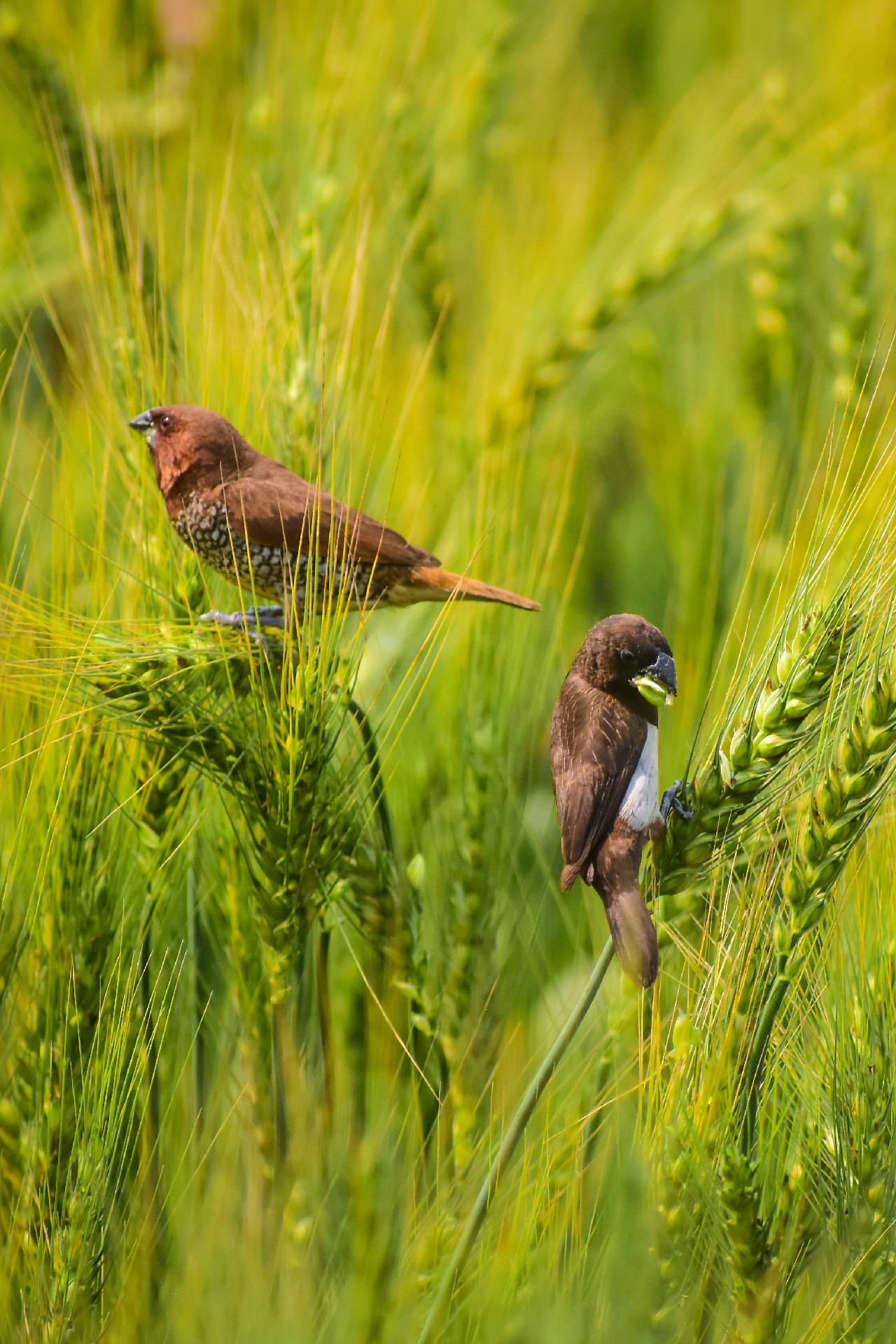
Munias in a Wheat Field by Nu Yai Sing Marma
In February 2025, I ventured out early in the morning to capture photographs on the Rajshahi University campus. Amidst the university's experimental wheat fields, I witnessed a rare sight—a flock of Scaly-breasted Munia and White-rumped Munia feeding on wheat seeds. Such a gathering of different munia species is uncommon, making this moment a remarkable experience. The scene beautifully highlighted the diversity and charm of nature
Nu Yai Sing Marma
Nu Yai Sing Marma is known as a tribal girl and a devoted photographer. A passion for photography was discovered during her university years, when it was felt that her hobby should be pursued seriously. Lifestyle, nature, and documentary photography are chosen as her main genres. Through her work, the culture and lifestyle of Bangladesh are portrayed, with special focus given to tribal communities. Many untold stories are captured and expressed through her lens. Each photograph is created to narrate a story, allowing traditions to be preserved and the diverse essence of her homeland to be shared with the world.
Resonance Score Breakdown
Transparency Note: The resonance score (5.7/20) is calculated based on social engagement metrics collected before the award announcement.
Expert Photography Reviews · 7
The Weight of Small Things
There is a hunger that belongs to the winter, a persistent need to find sustenance in the barren places. We often look for greatness in the grand gestures of the world, in the shifting of mountains or the turning of tides.
Read the reflection →The Weight of Small Things
I keep a small, dried wheat stalk tucked inside the pages of a book I rarely open. It is brittle now, the color of a fading sunset, and if I touch it too firmly, it threatens to turn into dust.
Read the reflection →Reviews & Comments
Share your thoughts about this award-winning photograph. Your reviews contribute to the community engagement score.
There’s a quiet, frantic energy in these Munias that I find deeply relatable. They’re busy, oblivious to the lens, and entirely themselves. While I usually look for the human connection—the way a subject meets my gaze—there’s a different kind of trust here. It’s the trust of the wild, allowing the photographer to exist in their space without scattering. It’s a lovely, fleeting moment. I’d love to sit in that field and just watch them breathe.
The shutter speed is fast enough, but the timing misses the physiological peak. You’ve caught the birds mid-motion, yet the wings are blurred in a way that obscures the muscle tension of the downstroke. I’ve spent my life chasing that singular, crisp millisecond where effort meets stillness. It’s frustrating; you’re a fraction of a second late. I wanted to see the exact moment of lift-off, but this frame just catches them drifting. It’s almost there.
Experimental wheat fields on a university campus aren’t just nature; they’re human-managed territory. When we frame these munias, are we celebrating biodiversity or merely aestheticizing the encroachment of agriculture? I find the sharp focus on the birds’ feathers undeniably beautiful, yet it makes me uneasy. Why do we insist on isolating these creatures from the human labor that sustains their food source? Whose landscape are we actually consuming here? It’s a pretty picture, but it’s incomplete.
The wheat stalks here don’t just hold grain; they hold a silence that feels almost predatory. Marma’s munias are caught in a fragile geometry, yet it’s the encroaching blur of the background that haunts me. I’ve spent hours staring at these feathered silhouettes, wondering if they know they’re being erased by the light. It’s unsettling. When the shadow doesn’t swallow the subject, it merely waits. That’s the true weight of this field—it’s a vanishing act.
You waited in that Rajshahi morning, and I can feel the stillness you held. It’s not just about the birds; it’s about the quiet patience required to let them exist near you. I’ve spent enough time in fields to know that kind of focus doesn’t come easy. You caught them in a moment of pure, unbothered life. And honestly? It makes me want to put my gear down and just watch the wheat sway.
Nature doesn’t pose for you. You’re either there when the wings blur or you’re just shooting empty stalks. Marma caught the chaos of these Munias perfectly. One tenth of a second later and the flock scatters, the frame collapses into nothing. I’ve spent hours waiting for birds to land, and seeing this, I actually felt my pulse jump. It’s raw, it’s fast, and it’s exactly why we carry cameras. You nailed the timing. Pure instinct.
The avian choreography here echoes the precision of Eliot Porter’s dye-transfer studies, yet it’s the chaotic, golden texture of the wheat that pulls me in. It’s rare to see such delicate subjects rendered with this grit. While the Nikon’s sensor struggles with the highlights, the composition’s tension feels fresh. I’ve spent decades cataloging nature photography, but the way these Munias break the frame’s stillness genuinely quickened my pulse. It’s a sharp, vital observation.