The Silent Watcher of the Forest by Nu Yai Sing Marma
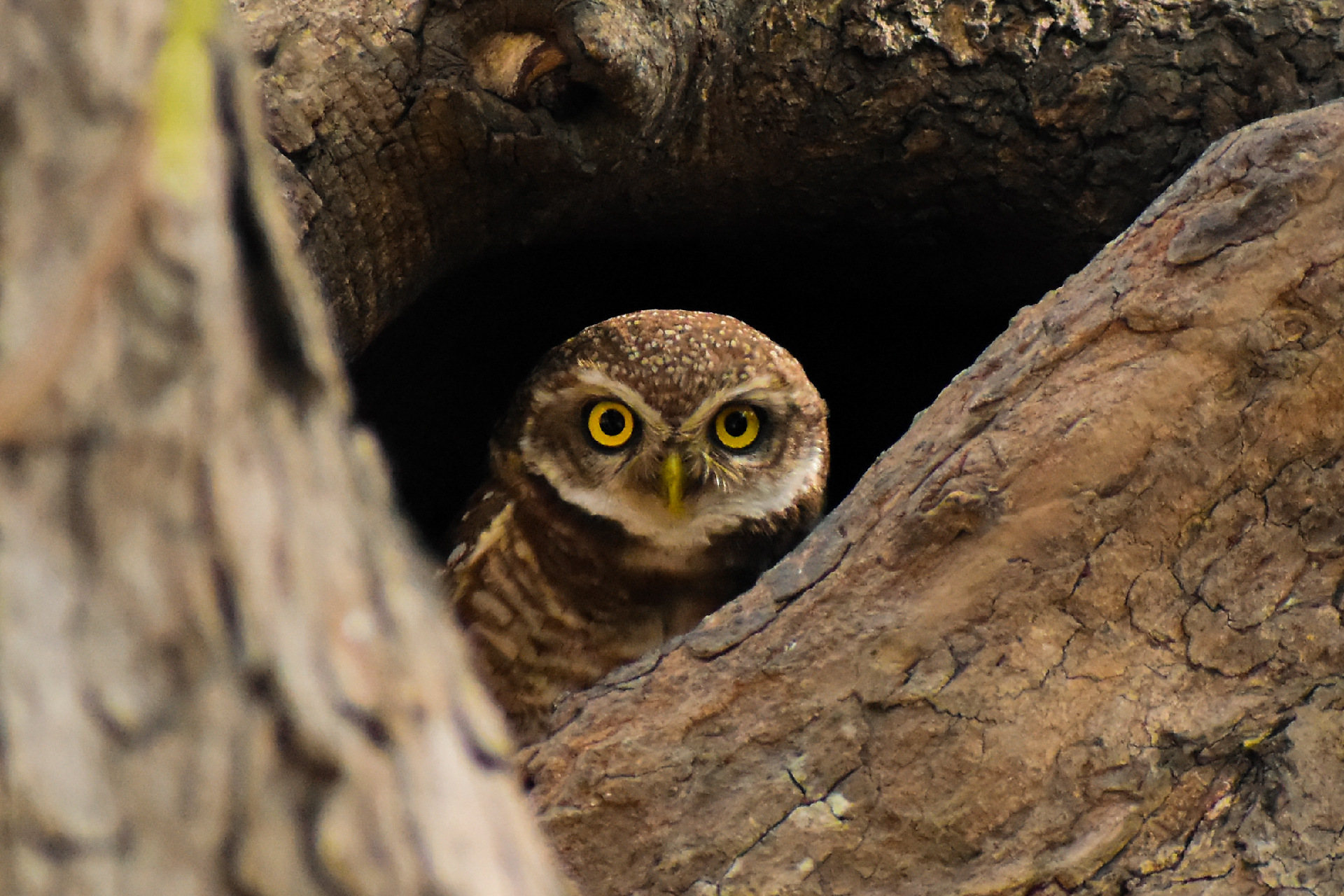
In January 2025, my friends and I went on a trip to a small village in Rajshahi. The area was surrounded by towering trees, estimated to be around 60–70 years old, and a large pond nearby.As we were walking around, we suddenly saw a small Spotted owl sitting outside a hole in a tree and staring at us. I quickly captured the moment with my camera before it took flight. As it soared away, we noticed three or four more owls flying overhead, creating a magical scene.
Nu Yai Sing Marma
Nu Yai Sing Marma is known as a tribal girl and a devoted photographer. A passion for photography was discovered during her university years, when it was felt that her hobby should be pursued seriously. Lifestyle, nature, and documentary photography are chosen as her main genres. Through her work, the culture and lifestyle of Bangladesh are portrayed, with special focus given to tribal communities. Many untold stories are captured and expressed through her lens. Each photograph is created to narrate a story, allowing traditions to be preserved and the diverse essence of her homeland to be shared with the world.
Resonance Score Breakdown
Transparency Note: The resonance score (5.6/20) is calculated based on social engagement metrics collected before the award announcement.
Expert Photography Reviews · 8
The Keeper of Secrets
We often mistake stillness for absence, assuming that if a thing is not moving, it is not living. But the forest knows better.
Read the reflection →The Eyes That Know
I remember sitting on a porch in the Blue Mountains, watching a kookaburra perched on a fence post. It didn’t move for twenty minutes. It didn’t seem to be waiting for anything in particular, yet its posture suggested it was holding the entire garden in its gaze.
Read the reflection →Reviews & Comments
Share your thoughts about this award-winning photograph. Your reviews contribute to the community engagement score.
Most wildlife shots are just snapshots of proximity, but this one captures a genuine standoff. The owl’s gaze isn’t just looking at the lens; it’s weighing the intruder. I’ve seen thousands of bird photos, yet the way the rough, weathered bark frames that piercing stare makes me feel like I’m the one being watched. It’s an honest, unvarnished encounter. In thirty years, we won’t remember the gear, but we’ll remember that unsettling, silent intelligence.
The owl’s plumage, a mottled tapestry of dried lichen and the bruised umber of a Morandi still life, dissolves into the forest’s deep, verdant gloom. It’s a haunting chromatic suspension, where the light doesn’t merely illuminate but clings to the feathers like damp moss. I’m breathless, truly, watching how those muted, earthy ochres vibrate against the shadows; it’s as if the bird itself is a secret whispered in the quiet, ancient language of bark.
That owl’s gaze pierces the lens, but who is truly watching whom? Marma captures a fleeting encounter in Rajshahi, yet I’m left wondering about the cost of this intrusion. Does the owl’s stillness signal comfort or a desperate freeze response to the sudden human presence? It’s a beautiful frame, but it makes me uneasy. We’ve turned a wild creature into a prop for our own curiosity. Is our desire for the shot worth the disturbance?
The rough, weathered bark of that ancient tree isn’t just a perch; it’s a textured history of the Rajshahi forest. The light catches the wood’s deep fissures, grounding the owl in a world far older than its own gaze. I’m truly moved by how the bird’s stillness mirrors the silent, towering giants surrounding it. It’s not merely a portrait of a creature; it’s a dialogue between a fleeting life and the enduring, quiet architecture of nature.
The owl’s placement within the aperture of the trunk creates a precise fulcrum. It’s a study in geometric containment. The verticality of the bark provides a rigid architecture that forces the eye toward the subject’s gaze. I’m genuinely unsettled by how the negative space around the tree trunk isolates the bird. It doesn’t rely on the surrounding forest for context. The frame holds because the subject refuses to bleed into the periphery. It’s structurally sound.
That owl’s gaze is a knife edge. You caught it just before the chaos of flight, and that’s where the magic lives. Cartier-Bresson would’ve loved the tension in those feathers. One tenth of a second later and the frame collapses into a blur of wings. I’m actually holding my breath looking at this. It’s raw, it’s sharp, and you were ready. You didn’t hesitate. That’s the difference between a snapshot and a moment that lasts.
The owl sits. It doesn’t look at the lens; it looks through the wood. The bark is texture. The shadow is depth. I’ve spent minutes staring at the negative space around that hollow. It’s heavy. It’s quiet. My breath catches. Nothing here is accidental. The empty corner is not empty. It’s a pause. A held note in a forest that’s already moved on. It’s rare to find such stillness in a frame.
1/800 at f/6.3, ISO 3200, 300mm. It’s a desperate scramble for shutter speed in failing light. The D5500 sensor struggles here; the noise floor is aggressive, eating the owl’s plumage detail. You’ve traded texture for a frozen wing beat. I’ve spent enough time in the field to know that panic-induced ISO spikes rarely pay off, yet the composition holds. You caught the gaze. It’s technically flawed, but the focus is sharp where it counts.