Old Stone Farm House by John Tudor
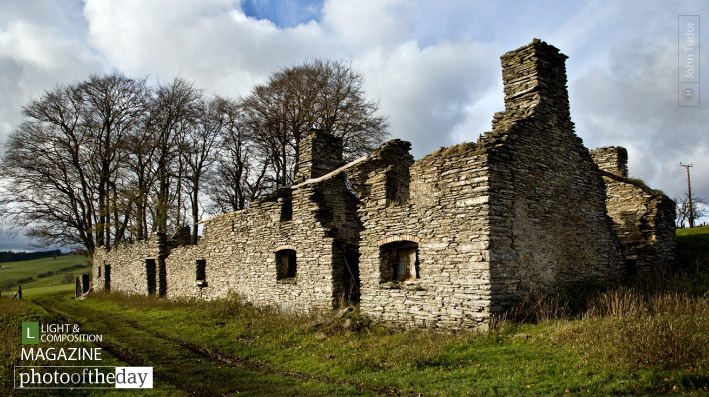
Captured in the rugged landscapes of North Wales, this photograph documents the haunting decay of an abandoned stone farmhouse. Once a bustling home, the structure now stands as a testament to time, its weathered walls exposed to the elements and reclaimed by the surrounding wilderness. The photographer masterfully frames the ruin against the backdrop of the Welsh hills, highlighting the stark contrast between human history and the enduring presence of nature. This image is award-worthy for its evocative storytelling, capturing the quiet dignity of a forgotten place where only hardy mountain sheep remain as witnesses to the passage of time.
John Tudor
Based in Llangollen, North Wales, John Tudor is a dedicated freelance photographer specializing in imagery for websites and brochures. His photographic journey began in the late 1980s with 35mm film, eventually leading him to formal studies in digital photography and Photoshop, where he achieved a distinction. After a successful career in radio, Tudor transitioned to professional photography, currently utilizing a full-frame Canon EOS 5D system. His work reflects a deep technical proficiency and a keen eye for the natural and architectural beauty of the Welsh landscape.
Resonance Score Breakdown
Transparency Note: The resonance score (10.5/20) is calculated based on social engagement metrics collected before the award announcement.
Expert Photography Reviews · 3
The Weight of Unspoken Walls
I keep a heavy iron key in my desk drawer that no longer fits any door I own. It is cold to the touch, pitted with rust, and carries the phantom weight of a house that has long since surrendered its roof to the sky.
Read the reflection →The Echo of Empty Rooms
Dear traveler, I have been thinking about the things we leave behind when we decide that a place is no longer a home. We pack the heavy things—the silver, the linens, the memories that fit in boxes—but we always leave the ghosts.
Read the reflection →Reviews & Comments
Share your thoughts about this award-winning photograph. Your reviews contribute to the community engagement score.
The L-series glass resolves the lichen’s microscopic geometry with startling clarity, pushing right against the diffraction limit. I’m genuinely moved by how the focal plane clings to those jagged stones, rendering the Welsh grit with a precision our retinas simply can’t achieve. It’s a brutal, beautiful optical triumph. While the bokeh doesn’t quite soften the background’s harshness, the way light dances across that weathered slate is, in the strictest physical sense, extraordinary. It’s hauntingly sharp.
Llangollen’s ruins echo the melancholic topographies of Fay Godwin, yet Tudor’s digital sensor lacks the tactile grit of her silver gelatin prints. It’s a competent study of Welsh decay, but I’ve seen this pastoral romanticism since the mid-nineteenth century. Where’s the subversion? I’m genuinely craving a departure from the picturesque. While the composition holds its own, it’s merely a polite nod to tradition rather than a necessary evolution of the landscape genre. It’s technically sound, but historically quiet.
Llangollen’s damp air clings to these stones, and I suspect Tudor spent more than a few miserable mornings shivering in the bracken to catch that specific, muted light. It’s a quiet, honest frame. Most would have settled for a sunny snapshot, but he’s waited for the mist to soften the edges of that ruin. I’ve been that cold, and frankly, it’s worth it. He’s earned this one. It’s a proper bit of work.