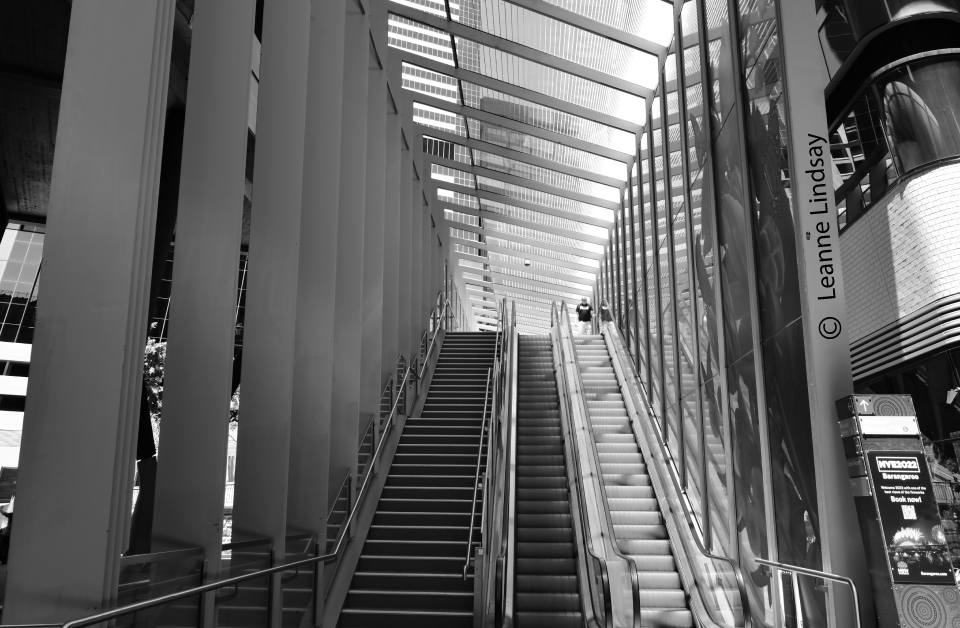
The Escalator by Leanne Lindsay
Captured during the surreal quiet of the COVID-19 pandemic, this photograph documents a rare moment of stillness in Sydney's Darling Harbour. The photographer was struck by the contrast between the location's usual vibrant, bustling energy and the haunting emptiness of the scene. By framing a lone figure at the top of a massive escalator, the image emphasizes a sense of profound isolation within an urban landscape. This work is award-worthy for its poignant storytelling and its ability to transform a familiar, crowded landmark into a powerful, meditative study of solitude and historical atmosphere.
Leanne Lindsay
Born in Adelaide in 1962, Leanne Lindsay relocated to Sydney during her youth. Although her initial foray into photography was interrupted by the loss of her equipment, she rediscovered her creative passion in her late 50s. Now based in Sydney, she balances a professional focus on family and newborn portraiture with a deep appreciation for the structural beauty of architectural and landscape photography.
Resonance Score Breakdown
Transparency Note: The resonance score (8.0/20) is calculated based on social engagement metrics collected before the award announcement.
Expert Photography Reviews · 5
The Weight of Empty Spaces
There is a specific quality to the light in a vacant hall, especially when the sun hits a polished floor at a sharp, low angle. It is a sterile, clinical brightness that reveals every speck of dust suspended in the air, a clarity that feels almost intrusive.
Read the reflection →The Architecture of Absence
Why do we feel most human when the world stops moving? We build these grand, soaring structures to house our collective noise, believing that the pulse of a city is measured by the friction of bodies against one another.
Read the reflection →Reviews & Comments
Share your thoughts about this award-winning photograph. Your reviews contribute to the community engagement score.
Sydney’s empty escalator is a ghost story. I’ve spent years hunting these voids, and Lindsay nailed the geometry. That lone figure at the apex? It’s perfect. One tenth of a second later and the silhouette would’ve merged into the steel, losing the tension. It’s haunting, really. It makes my chest tighten just looking at it. She didn’t just document a pandemic; she caught the exact heartbeat of a city holding its breath. Pure, sharp, decisive.
The geometry of the escalator creates a brutal, converging vector that dominates the frame. It’s a rigid architecture of steel and shadow. The lone figure serves merely as a fulcrum, anchoring the vast, empty negative space above. It’s cold, precise, and entirely devoid of sentimentality. I’ve rarely seen such a clinical use of the 18mm focal length. The composition doesn’t just hold; it demands total submission to its stark, structural logic. It’s perfectly severe.
Darling Harbour’s emptiness feels staged, a curated silence that ignores the systemic precarity of the city’s actual inhabitants. Why does the lone figure serve merely as a prop for aesthetic isolation? I find the composition cold, almost predatory in its detachment. It’s a sleek, technical exercise that strips away the human cost of the pandemic to prioritize geometric lines. Does the photographer see a person here, or just a convenient anchor for a hollow, architectural frame?
The city’s pulse has stopped, leaving only the cold, mechanical hum of steel. She stood there in the cooling hour, waiting for the architecture to exhale. It’s a haunting stillness, isn’t it? I’ve felt that same heavy silence in empty spaces, where the light doesn’t just fall—it waits. At f/11, she’s captured the weight of isolation perfectly. It’s not just a staircase; it’s a threshold where time itself seems to have lost its way.
Steel teeth bite into the void of Darling Harbour. Lindsay’s escalator doesn’t just transport; it devours. The lone figure isn’t waiting for a train, but for the silence to finally swallow them whole. I’ve stared at these shadows until my eyes ached, feeling the cold, metallic indifference of a city stripped of its pulse. It’s a brutal, honest reckoning with our own insignificance. When the light retreats, we finally see what we’ve been hiding from.