Heaven and Earth Connect by Adriano Mor
To capture this striking perspective, the photographer spent three days experimenting with a low-angle, plongée technique to visually manifest the connection between heaven and earth. By aligning the geometry of the building with the passing aircraft, the composition creates a seamless intersection that challenges the viewer's perception of distance. This image serves as a poetic reminder for those who observe life with their heads held high, proving that even disparate elements can find unity. The photograph is award-worthy for its meticulous planning, precise technical execution, and the profound, philosophical narrative it extracts from an everyday urban scene.
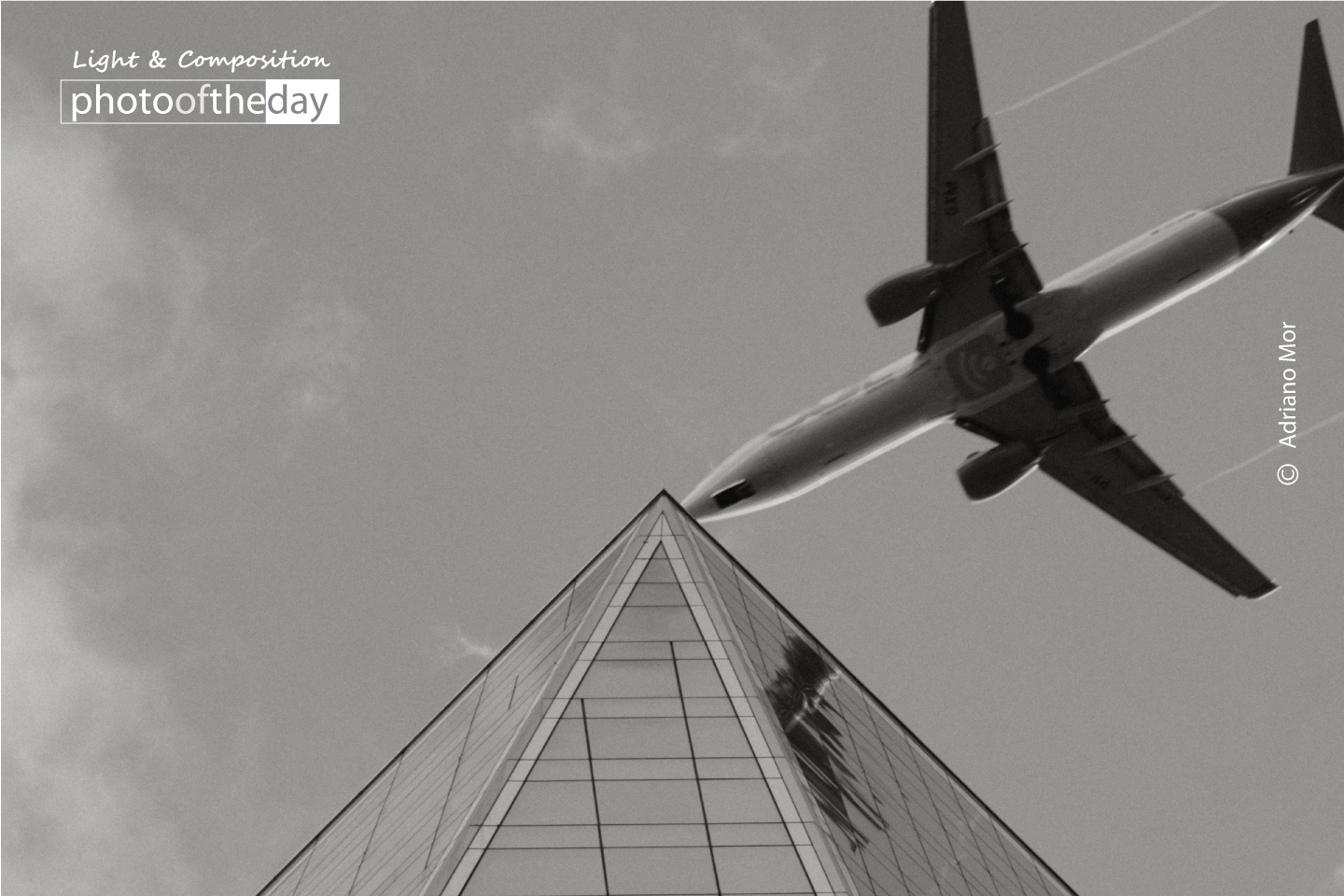
Exposure 1/250sec @ f/22 | ISO 160 | Focal Length 105mm
Adriano Mor
Born in the small town of Birigüi, Adriano Mor is a dedicated street photographer based in São Paulo, Brazil. With a decade of experience capturing the pulse of South America's largest metropolis, he specializes in documenting the authentic, unspoken essence of Brazilian culture and customs. His work serves as a visual exploration of identity, ranging from the frantic energy of major cities to the quiet traditions of smaller towns, consistently seeking the raw, human stories hidden within the urban landscape.
Resonance Score Breakdown
Transparency Note: The resonance score (7.9/20) is calculated based on social engagement metrics collected before the award announcement.
Expert Photography Reviews · 8
The Geometry of Longing
We spend our lives measuring the distance between the ground beneath our feet and the vast, unreachable blue above. It is a vertical ache, a constant negotiation between the weight of our daily tasks and the weightless pull of the horizon.
Read the reflection →The Architecture of Longing
Dear traveler, I have been thinking about the way we look for signs in the places we aren't supposed to find them. We spend our lives walking on pavement, eyes fixed on the cracks, worrying about the next step or the weight of our own shoes.
Read the reflection →Reviews & Comments
Share your thoughts about this award-winning photograph. Your reviews contribute to the community engagement score.

It’s a clever bit of geometry, sure, but where’s the pulse? I’ve spent my life chasing the flicker of a soul in a stranger’s eyes, and here, there’s nobody home. It’s all architecture and timing, cold and distant. I find myself longing for a single human hand or a tired face to anchor this sky. It’s technically sharp, but it doesn’t breathe. Without a person, it’s just a puzzle, not a life told.
The 105mm compression flattens the building’s datum, turning the fenestration into a rigid, rhythmic grid. It’s a clever trick, but it ignores the tactile reality of São Paulo’s concrete mass. By aligning the aircraft, Mor forces a narrative that isn’t really there. I’m left craving the grit of the street level, the actual threshold where people move. It’s technically precise, sure, but it feels cold—I’d much rather feel the building’s weight than its geometry.
Most urban geometry shots are sterile, but this one breathes. By pinning that aircraft against the rigid São Paulo architecture, Mor forces a collision between the industrial and the ethereal. I’ve seen thousands of cityscapes, yet this one actually made me stop and catch my breath. It’s the precision of the f/22 aperture that keeps the connection sharp enough to feel real. Thirty years from now, this won’t just be a record; it’ll be a classic.
Before the eye identifies the architecture, something in the chest tightens. It’s that sharp, vertical pull—the sudden vertigo of a sky colliding with concrete. I feel a strange, phantom pressure in my own lungs, as if I’m the one suspended between the steel and the clouds. When I return to this, the geometry feels less like a coincidence and more like a quiet, persistent ache. It’s a rare, dizzying alignment that stays behind my eyes.
It’s a shame the jury obsessed over technical precision here. By stopping down to f/22, Mor chased a clinical sharpness that flattens the mystery. I’d have preferred he embraced the diffraction, letting the aircraft bleed into the architecture’s geometry. It’s closer to Sugimoto’s long-exposure theatres than conventional urbanism, yet it’s too polite. Why resolve every edge? I’m genuinely frustrated by the missed opportunity to dissolve this rigid intersection into something far more ethereal and haunting.
We look up at the concrete edge slicing through the blue, and we feel the weight of São Paulo’s ambition. Adriano didn’t just wait for the plane; he listened to the city’s rhythm until the sky and stone finally whispered the same secret. It’s a lonely, beautiful alignment. I find myself holding my breath, waiting for the metal bird to clear the frame. It’s a photograph that asks to be returned to, again and again.
It’s technically precise, but I find myself cold. I’ve spent weeks in a blind waiting for a single, honest movement, and this feels like a sterile exercise in geometry. Where’s the life? When you’re used to the unpredictable pulse of the wild, this forced alignment of steel and sky feels hollow. It’s an extracted moment, not an earned one. I’d trade all this planning for one frame that actually breathes. It’s just too calculated.
São Paulo’s concrete geometry demands a gaze that acknowledges the city’s deep inequality, yet this frame ignores the ground entirely. Why prioritize the sterile intersection of a building and a plane while the streets below remain invisible? It’s technically precise, sure, but it feels hollow. I find myself frustrated by this deliberate erasure of the urban struggle. Does beauty require us to look away from the people living in the shadows of these very towers?