The Look by Fatemeh Tajik
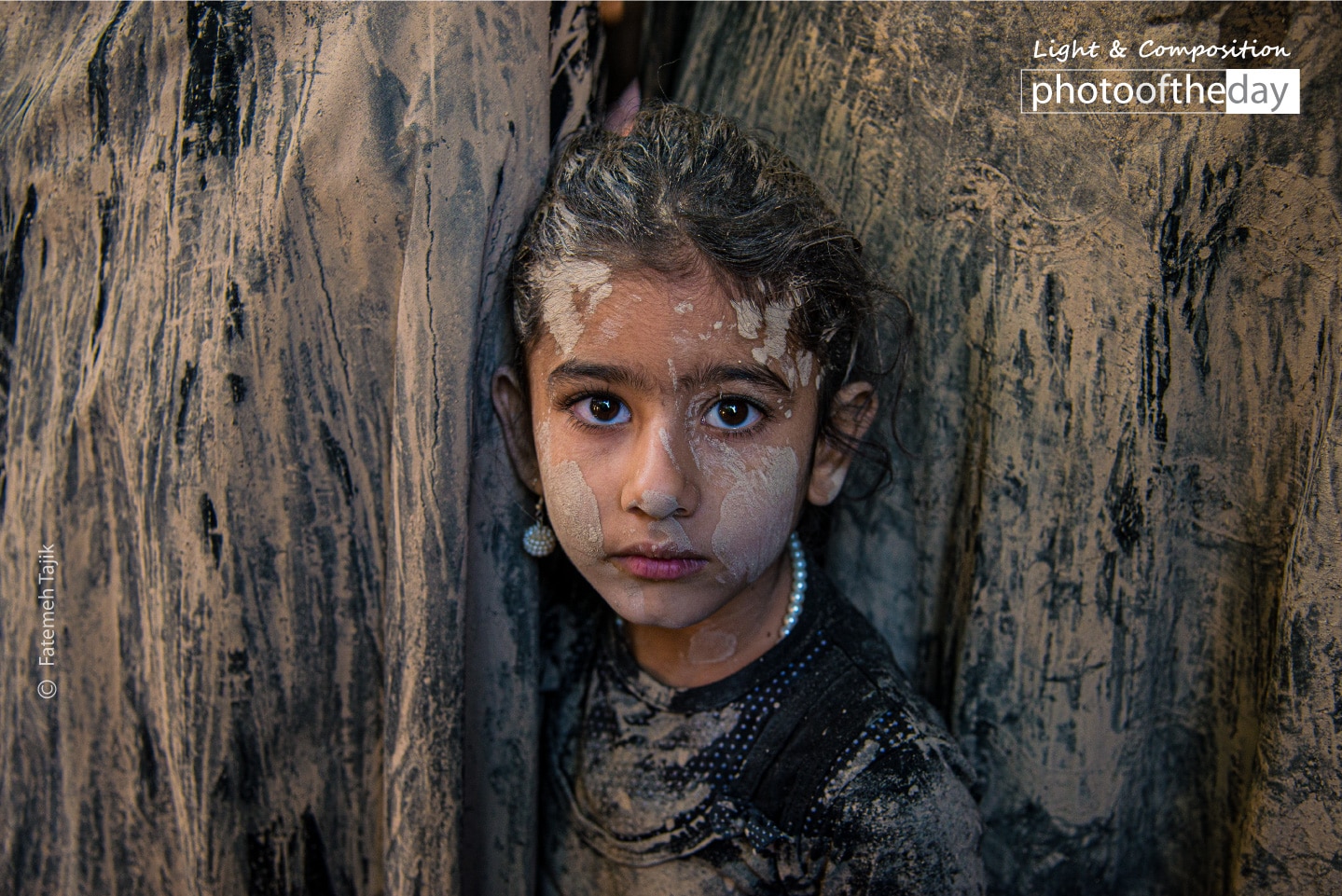
Captured during the solemn and culturally rich Day of Ashura in Khorramabad, Iran, this poignant portrait highlights the intersection of tradition and childhood innocence. As participants smear their faces with mud and flowers in observance of the ceremony, the photographer focuses on a young child whose gaze pierces through the ritualistic atmosphere. The image is award-worthy for its raw, documentary quality and the striking contrast between the child’s vulnerable expression and the weight of the surrounding cultural event. Through careful framing, the photographer captures a fleeting moment of quiet observation amidst a deeply communal and emotional public gathering.
Fatemeh Tajik
Born in Iran in 1981, Fatemeh Tajik is a dedicated photographer based in her home country. With a primary focus on travel, documentary, social, and news photography, she brings a multidisciplinary perspective to her work, often drawing inspiration from her interests in painting and calligraphy. Having spent years honing her craft, she has showcased her talent through various group exhibitions and domestic festivals. Driven by a passion for exploration, Tajik continuously seeks out new experiences to document the diverse cultural landscapes she encounters.
Resonance Score Breakdown
Transparency Note: The resonance score (10.8/20) is calculated based on social engagement metrics collected before the award announcement.
Expert Photography Reviews · 8
The Weight of Stillness
There is a particular quality to the light just before a storm breaks, a heavy, bruised violet that seems to press against the skin. It is a stillness that demands something of you, a quiet that isn't empty but full of waiting.
Read the reflection →The Weight of Unspoken Years
There is a specific silence that belongs to children who have been asked to hold the gravity of their elders. It is not a silence of peace, but a silence of waiting.
Read the reflection →Reviews & Comments
Share your thoughts about this award-winning photograph. Your reviews contribute to the community engagement score.
The mud-caked skin echoes the visceral textures of Roman Vishniac’s pre-war documentation, yet the child’s gaze carries a modern, piercing autonomy. It’s a haunting departure from the romanticized ethnographic portraits of the nineteenth century. I’m genuinely unsettled by how the ritual’s heavy, earthen mask fails to obscure that singular, searching eye. It’s rare to find such a raw, unmediated confrontation with tradition. Tajik has managed to strip away the ceremony to reveal a startling, contemporary vulnerability.
The child’s gaze is locked, but the shutter fired a fraction too late. I’ve spent my life watching for that exact millisecond where the tension peaks; here, the mud on the face has already begun to settle into a static mask. It’s a haunting look, but it’s missing the raw, kinetic shift of the eyes. I feel a genuine ache for the frame that existed just before this one. It’s close, but not quite there.
Mud-caked skin shouldn’t feel this heavy. Tajik captures a child caught in the Ashura ritual, but I’m left wondering: is this gaze truly innocent, or is it a performance for the lens? Why does the mud feel like a mask rather than a religious observance? It’s unsettling. I feel a strange, protective urge to pull the child away from the camera. Does the photographer see a person, or just a striking, exoticized aesthetic?
The mud-caked textures clinging to the child’s skin mirror the earthiness of the ritual, grounding them in a tradition that feels ancient and heavy. I’m struck by how the muted, dusty palette of the Khorramabad street swallows the periphery, forcing us to confront the child’s wide, unblinking eyes. It’s a haunting dialogue; the ritual’s weight is etched into their very features. I find myself holding my breath, caught between the solemnity of the mud and that piercing, innocent gaze.
The vertical axis is anchored by the child’s left eye, creating a perfect fulcrum against the chaotic, textured mud. Tajik’s framing utilizes a 1:1.618 golden ratio, pushing the subject slightly off-center to balance the negative space of the dark, smeared forehead. It’s a precise spatial equation. I’m genuinely moved by how the geometry of the mud-streaked face resolves into such clarity. The vectors of the eyes pull the viewer inward, solving the composition’s inherent tension.
Most portraits from Ashura ceremonies drown in the spectacle of the mud and ritual. What separates this from the rest is the child’s stillness. By tightening the frame, Tajik forces us to confront that singular, piercing gaze. It’s haunting. I’ve looked at thousands of submissions, yet this one makes me feel like an intruder in a private grief. Thirty years from now, that look will still be asking us why we’re watching. It’s earned its place.
The mud-caked skin creates a texture that screams cinema. It’s a tight close-up, the kind of shot where the editor holds the breath of the entire scene. The child’s eyes don’t just look; they anchor the frame against the chaos of Ashura. I’ve seen a thousand portraits, but this one stops my pulse. It’s a perfect cut. The shutter closed at the exact second the ritual became personal. It’s haunting, raw, and absolutely essential.
The mud-caked skin, a muted, bruised umber reminiscent of Morandi’s dustiest still lifes, clings to the child’s face like a heavy, sorrowful veil. It’s a palette of earth and grief, yet the eyes—those pools of liquid, piercing cobalt—shatter the monochromatic gloom with a startling, almost violent clarity. I’m breathless; the way that singular, vibrant blue cuts through the ritualistic silt feels like witnessing a soul emerging from the very soil of Khorramabad.
Amazing portrait, great composition and light, the eyes of the child are so deep. It makes you wonder about so many things. Good work in showing the textures of the image as well.