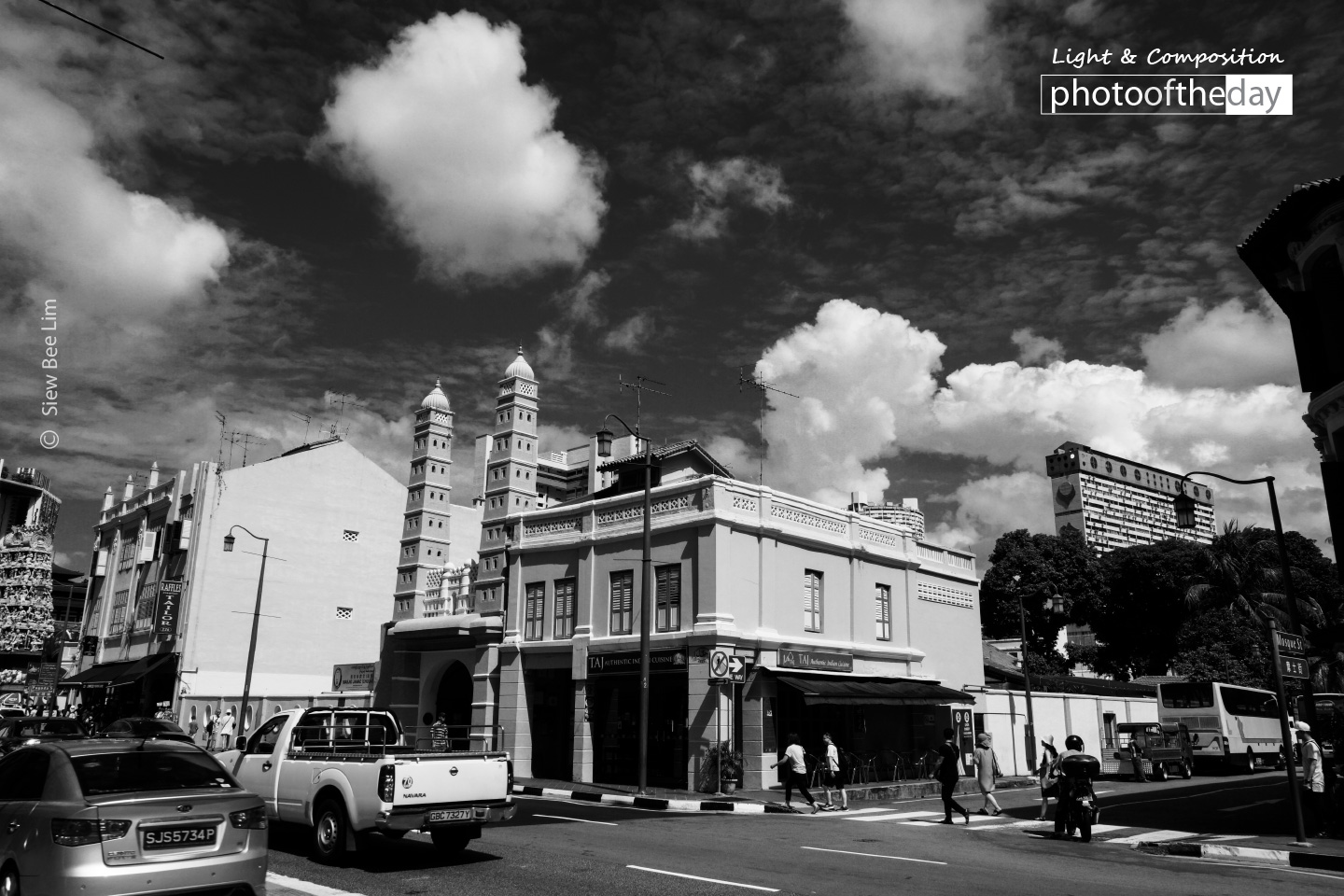
At Mosque Street by Siew Bee Lim
Captured at the vibrant junction of South Bridge Road and Mosque Street in Singapore, this architectural study highlights the interplay between urban structure and natural light. The photographer was drawn to the striking contrast between the low-hanging, brilliant white clouds and the stark white walls of the historic Chinatown buildings. Taken on a sweltering, sun-drenched day, the image captures the essence of the locale, where pedestrians seek shade under hats amidst the heat. The photograph is award-worthy for its precise composition and its ability to elevate a common street corner into a compelling narrative of light, shadow, and architectural form.
Siew Bee Lim
Born in Singapore in 1965, Siew Bee Lim rediscovered her passion for photography after a career as a programmer. Though she once explored the craft through early darkroom sessions, she is now dedicated to formalizing her artistic vision through the Light & Composition platform. Drawing inspiration from her lifelong appreciation for Chinese painting and literature, she seeks to overcome her self-described lack of traditional drawing skills by mastering the lens. Her work reflects a patient, evolving journey toward technical excellence and a deeper understanding of visual storytelling.
Resonance Score Breakdown
Transparency Note: The resonance score (4.0/20) is calculated based on social engagement metrics collected before the award announcement.
Expert Photography Reviews · 4
The Weight of White
In the heat of a high noon, the world loses its edges. Everything becomes bleached, scrubbed clean by a sun that demands total surrender.
Read the reflection →The Weight of White Walls
I spent twenty minutes this morning just trying to find a patch of shade while waiting for the bus. The sun was relentless, turning the pavement into something that felt like it was radiating heat back at me.
Read the reflection →Reviews & Comments
Share your thoughts about this award-winning photograph. Your reviews contribute to the community engagement score.
We look at Mosque Street and we don’t just see stone; we see the quiet rhythm of a life lived in the heat. The pedestrians, huddled under their hats, aren’t just architectural accents—they’re the heartbeat of this corner. I feel a sudden, sharp longing for that shade. Siew Bee Lim listened to the sun before clicking the shutter. It’s a portrait of a city that knows how to hold its breath while the world rushes by.
The vertical axis of the shophouse facade creates a rigid 1:2 ratio against the expansive, luminous sky. I’m struck by how the shadows on Mosque Street function as negative vectors, pulling the eye toward the vanishing point. It’s a perfectly solved spatial equation where the white walls act as a high-contrast anchor. I’ve rarely seen such precise geometry in street work; it’s genuinely thrilling to see how the architecture dictates the frame’s entire internal rhythm.
The micro-contrast across those white facades is remarkable. By stopping down, Lim has pushed past the diffraction limit, ensuring the focal plane remains razor-sharp against the harsh Singaporean glare. It’s a clinical execution of light, yet the way the shadows cling to the architecture feels almost tactile. I’m genuinely moved by how the lens resolves the heat haze; it’s as if I can feel the humidity radiating off the pavement. It’s a brilliant, precise optical achievement.
Sunlight here doesn’t illuminate; it interrogates. Siew Bee Lim forces the architecture into a brutal, blinding whiteness that leaves the shadows gasping for air. I’ve spent hours staring at those dark, narrow slivers beneath the eaves, feeling the suffocating heat of a Singaporean noon. It’s a claustrophobic beauty. When light becomes this aggressive, the shadows aren’t just absences—they’re the only places left where the soul can hide from the relentless, bleaching glare of the city.