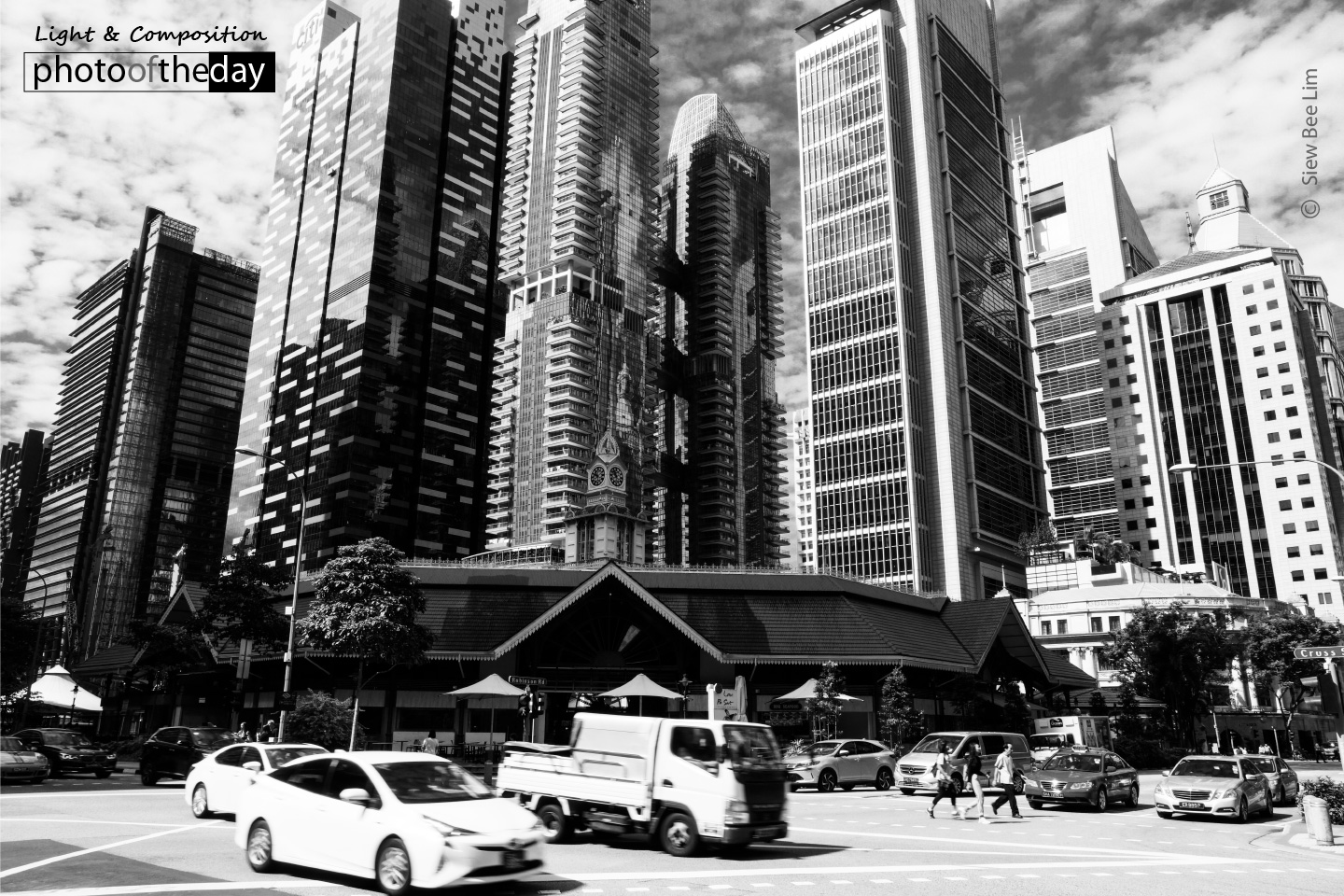
Lau Pa Sat by Siew Bee Lim
Captured on a vibrant, sunny day in Singapore, this photograph highlights the architectural contrast between the historic Lau Pa Sat market and the towering modern skyscrapers of the surrounding business district. The photographer skillfully frames the 1894 landmark, emphasizing its enduring presence amidst the rapid urban development of Shenton Way. By choosing a perspective that juxtaposes the ornate, heritage-rich structure against the sleek, glass-heavy silhouettes of contemporary architecture, the image serves as a poignant commentary on time and urban evolution. This thoughtful composition and clear documentation of Singapore’s architectural heritage make it a standout piece of photography.
Siew Bee Lim
Born in Singapore in 1965, Siew Bee Lim is a dedicated photographer who rediscovered her passion for the craft later in life. A professional programmer by trade, she balances her analytical background with a growing appreciation for visual arts and composition. Though she initially explored photography through traditional darkroom techniques early in her career, she is now committed to formalizing her skills through the Light & Composition platform. Her work reflects a patient, observant eye, shaped by a lifelong love of literature and a deep interest in the cultural history of her home city.
Resonance Score Breakdown
Transparency Note: The resonance score (11.8/20) is calculated based on social engagement metrics collected before the award announcement.
Expert Photography Reviews · 7
The Weight of What Remains
There is a specific silence that lives in the shadow of a skyscraper. It is not the absence of noise, but the absence of human scale. I remember the old bakery on the corner, the one with the uneven floorboards that groaned under the weight of a single customer.
Read the reflection →The Weight of Yesterday
In the city of my youth, there was a clock tower that everyone ignored. It stood at the intersection of two main streets, a relic of brick and iron that seemed to shrink a little further into the pavement every year.
Read the reflection →Reviews & Comments
Share your thoughts about this award-winning photograph. Your reviews contribute to the community engagement score.
Lau Pa Sat’s ornate ironwork deserves more than this clinical, sharp-edged documentation. It’s technically competent, sure, but it feels trapped by the tyranny of the f-stop. Why resolve every glass skyscraper when you could have blurred the modern chaos to let the history breathe? I’d have loved to see the motion of the city smear against that static heritage. It’s a missed opportunity to turn architectural contrast into a visceral, temporal friction. It’s just too safe.
We look at Lau Pa Sat and we don’t just see iron and glass; we see a conversation between generations. The market holds its breath, listening to the glass giants looming above. It’s a portrait of a city that hasn’t forgotten its ancestors. I feel a sudden, quiet ache for the stories buried beneath that modern steel. It’s a photograph that asks to be returned to, because it’s really a portrait of time itself.
Lau Pa Sat’s Victorian ironwork struggles against the crushing scale of Shenton Way’s glass curtains. It’s a classic collision of datum and density. I’m struck by how the harsh Singaporean sun flattens the market’s intricate fenestration, turning heritage into a mere silhouette against the void of the modern skyline. It’s a lonely, honest framing. I find myself wanting to step past the threshold, to feel the humidity and hear the market’s pulse beneath that cold, towering shadow.
f/8 at 1/250s, ISO 100, 24mm. A sensible baseline for architectural documentation. The aperture choice keeps the Victorian filigree sharp while the skyscrapers remain distinct. It’s a clean, clinical execution that avoids the usual chromatic aberration traps of high-contrast urban scenes. I’ve spent years looking at these market shots, and frankly, the lack of distortion here is refreshing. It’s technically sound. The numbers don’t lie; the photographer actually understood the light. It’s a rare, precise success.
Before the eye identifies the Victorian ironwork, a strange tension settles in the chest. It’s the friction between the ornate, grounded past and those cold, glass giants looming above. I feel a sudden, sharp loneliness looking at that market, like a memory being crowded out by a faster life. When I return to this, I don’t see architecture; I see the quiet, breathless struggle of a city trying to remember who it was before the steel arrived.
Most architectural shots of Singapore are just postcards, but this one hits differently. By anchoring the Victorian ironwork of Lau Pa Sat against the cold, reflective glass of Shenton Way, Siew Bee Lim captures a city caught in a tug-of-war. I’ve seen thousands of skyline shots, but the way the market’s clock tower refuses to be swallowed by the skyscrapers makes me feel a genuine, quiet relief. It’s a document that will actually matter in thirty years.
You’ve captured the weight of history pressing against those glass towers. It’s a sharp contrast, but I’m looking for the pulse of the place. Where are the people? I feel the heat of the Singapore sun on the Victorian ironwork, and it makes me thirsty for a cold drink inside. You’ve framed the architecture well, but don’t forget that buildings only matter because we use them. There’s something honest here, but let’s see the life next time.