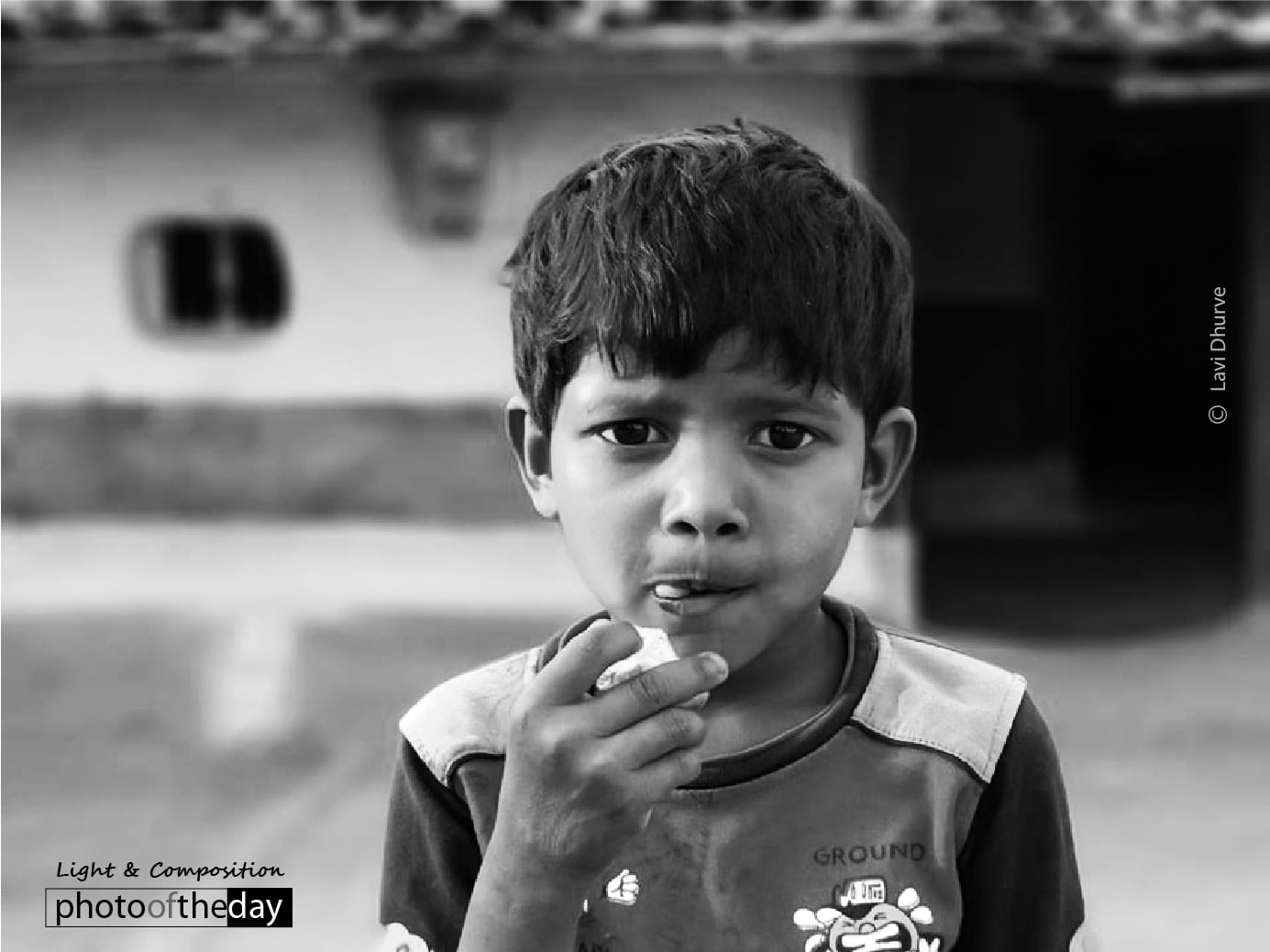
Let’s Eat by Lavi Dhurve
Captured in the soft, golden light of a late afternoon in Sarni, this portrait documents a candid moment of childhood innocence. As the photographer prepared for a journey to Indore, she encountered a young girl enjoying a guava, a simple scene that resonated with the beauty of everyday village life. By choosing to document this fleeting interaction, the photographer highlights the grace found in mundane experiences. The image is award-worthy for its authentic, unposed quality and the photographer's keen ability to find profound human connection within the quiet, rhythmic pace of rural Madhya Pradesh.
Lavi Dhurve
Hailing from a small village in Madhya Pradesh, the ‘Heart of India,’ Lavi Dhurve finds deep inspiration in the simplicity and beauty of rural life. Her work is a celebration of art, culture, and the human spirit, with a particular focus on capturing the essence of children and the natural splendor of sunrises and sunsets. Through her lens, she seeks to document the beauty of the world around her, transforming everyday encounters into evocative visual narratives that reflect her profound appreciation for her heritage and surroundings.
Resonance Score Breakdown
Transparency Note: The resonance score (11.1/20) is calculated based on social engagement metrics collected before the award announcement.
Expert Photography Reviews · 7
The Weight of a Simple Hunger
There is a specific silence that follows the end of a meal, a quiet space where the urgency of hunger has finally been quieted.
Read the reflection →The Sweetness of Now
I remember sitting on a low stone wall in a village outside of Lucca, watching a young boy struggle with a slice of watermelon that was far too large for his hands. He wasn't worried about the juice staining his shirt or the sticky mess on his chin.
Read the reflection →Reviews & Comments
Share your thoughts about this award-winning photograph. Your reviews contribute to the community engagement score.
That girl isn’t performing for a lens; she’s just living. You can see the trust in the way she holds that guava, completely unbothered by the camera’s presence. It’s a rare, quiet intimacy that most photographers miss because they’re too busy taking. I’ve spent years in villages like Sarni, and this face has a whole life in it. She’s given us a piece of her afternoon, and it’s a beautiful, honest gift.
The focal plane here is razor-thin, isolating the girl’s eyes with clinical precision. You can see the diffraction of light across the guava’s skin, where the lens resolves textures the naked eye would surely miss. It’s a beautiful interaction of optics and subject. I’m genuinely moved by how the bokeh, a function of a wide aperture, renders the Sarni background into a soft, golden blur. It’s rare to see such technical clarity hold so much raw, human warmth.
Golden light doesn’t absolve the photographer of the power imbalance inherent in this frame. Why is the girl’s hunger aestheticized as a moment of rural grace? I find the romanticization of her poverty deeply uncomfortable. Does she know she’s being consumed for a portfolio? The framing turns her into a prop for a traveler’s narrative. It’s a pretty picture, sure, but who actually benefits from this fleeting interaction? I’m left wondering if she ever finished that guava.
You caught her right in the middle of a bite, and that’s where the truth lives. It’s not about the golden light; it’s about the juice on her chin and the way she’s looking past you, completely unbothered by the lens. I’ve spent years chasing moments like this, and I felt a genuine pang of hunger for that simplicity. You waited for the real life to happen. That’s how you make a portrait matter.
The jury’s obsession with clarity here feels stifling. Why demand a crisp portrait when the subject’s movement suggests a restless, hungry energy? I’m genuinely moved by the blur around the guava; it’s an intentional erasure of detail that feels closer to a painterly gesture than a snapshot. By refusing to resolve the girl’s frantic motion, the photographer captures the fleeting nature of childhood itself. It’s far more honest than a perfectly sharp, static, and ultimately boring portrait.
The golden hour here isn’t a celebration; it’s a shroud. As the girl bites into the guava, the encroaching darkness behind her doesn’t just frame the subject—it consumes the context of her hunger. I’m unsettled by how the shadows swallow the edges of her face, turning a simple meal into a quiet, existential struggle. It’s not innocence I see, but the weight of a world that doesn’t care if she’s finished eating.
Most portraits of childhood rely on forced smiles, but this one captures a rare, unguarded hunger. It’s the way she grips that guava—unselfconscious and entirely present—that anchors the frame. I’ve seen thousands of rural portraits, yet this one lingers because it doesn’t romanticize poverty; it simply respects a moment of pure, singular joy. It makes me miss the simplicity of my own youth. In thirty years, this honesty will still feel vital.