One Purple Flower by Siew Bee Lim
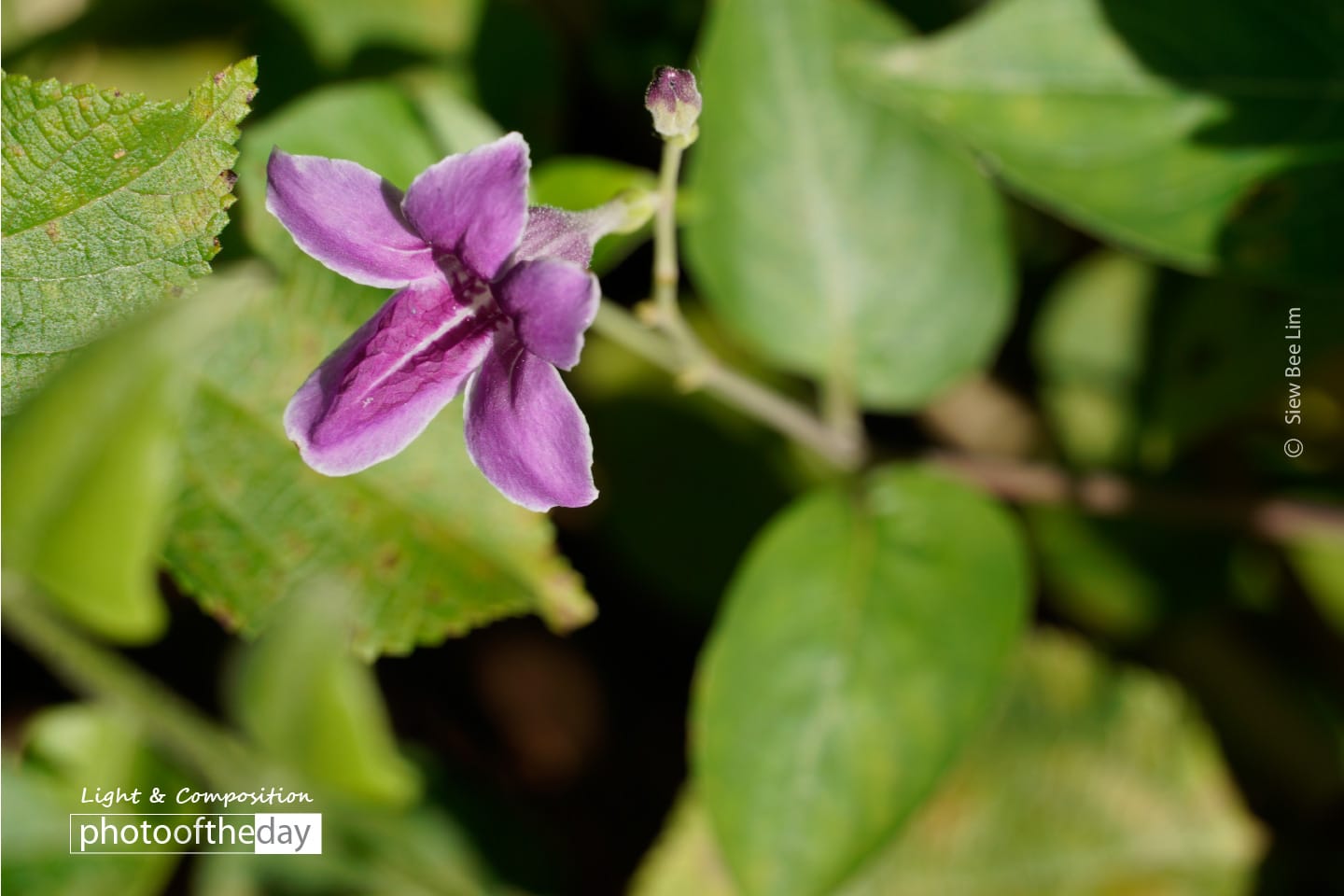
Captured during a serene early morning in a local Singaporean park, this image highlights a single, resilient purple flower amidst recently trimmed shrubs. The photographer utilized the soft, diffused light of dawn to accentuate the delicate textures and vibrant tones of the bloom, which stood as a solitary survivor after a seasonal decline in the garden's population. This photograph is award-worthy for its poignant simplicity and the photographer's keen eye for finding beauty in isolation, transforming a fleeting moment of nature into a timeless, evocative study of form and color.
Siew Bee Lim
Born in Singapore in 1965, Siew Bee Lim is a dedicated photographer who balances her professional background in programming with a deep-seated passion for visual storytelling. Though she initially explored photography as a young adult, her journey has evolved into a formal pursuit of artistic excellence through the Light & Composition platform. Drawing inspiration from her lifelong appreciation for Chinese painting and literature, she seeks to refine her technical execution and artistic vision, proving that a commitment to creative growth is a lifelong endeavor.
Resonance Score Breakdown
Transparency Note: The resonance score (11.8/20) is calculated based on social engagement metrics collected before the award announcement.
Expert Photography Reviews · 6
The Courage to Stand Alone
I walked past the community garden this morning and noticed that the landscapers had been through. Everything was clipped back, neat, and uniform. It felt a bit sterile, honestly.
Read the reflection →The Architecture of Resilience
Cities are often designed for efficiency, for the smooth flow of capital and the predictable movement of bodies. We pave over the wild, trim the edges, and impose a rigid geometry that suggests everything is under control.
Read the reflection →Reviews & Comments
Share your thoughts about this award-winning photograph. Your reviews contribute to the community engagement score.
It’s a tidy bit of work, though one wonders if the dew was already there or if the photographer had to coax it. I’ve spent enough damp mornings in the undergrowth to know that solitary bloom didn’t just present itself. It’s a quiet, stubborn thing. I find myself wanting to know if she returned the next day to check on it. That’s the sort of commitment that actually earns a frame. Not bad at all.
Singapore’s manicured parks aren’t wild; they’re curated environments. Why does this solitary purple flower feel like a performance of resilience rather than a natural occurrence? It’s technically precise, yet I’m left cold by the forced isolation. Did the gardener’s shears dictate this narrative of survival? I find myself wanting to see the mess left behind, not just this sanitized, lonely bloom. Whose aesthetic order are we celebrating here, and why does it feel so lonely?
Before the eye identifies the bloom, a sudden stillness settles in the chest. It’s the color that hits first—that bruised, defiant violet pulling at the periphery of my vision. I’ve returned to this frame three times today, and each time, my pulse slows to match that quiet, morning light. It doesn’t just document a survivor; it forces a strange, hollow ache in my throat. I find myself breathing with it, holding on to that fragile, solitary stem.
Architecture is usually about the permanence of mass, but here, the scale shifts entirely. By isolating this bloom, Lim ignores the datum of the surrounding shrubs, stripping away the context of the garden’s structure. It’s a quiet study of void and color, yet I find myself craving the threshold—the space between the flower and the path. It’s beautiful, sure, but it’s a lonely fragment of a larger, unseen site that I’m desperate to inhabit.
The frame operates on a strict diagonal tension, pulling the eye from the lower-left negative space toward the purple bloom’s central mass. It’s a precise 1:3 ratio of vibrant saturation against the muted, chaotic geometry of the trimmed shrubs. I’m genuinely moved by how the flower anchors the entire composition, solving the spatial imbalance of the surrounding foliage. It’s a clean, elegant equation; the math here doesn’t just hold the frame together, it makes it sing.
There’s a quiet dignity in this solitary bloom, but I find myself searching for a pulse. I’ve spent my life looking for the messy, lived-in truth of a human face, and here, the distance feels clinical. It’s technically precise, sure, but it doesn’t breathe. I miss the tension of a subject who knows they’re being seen. It’s a pretty study of a flower, but it doesn’t tell me a single thing about the world.