Bamboo Orchid by Siew Bee Lim
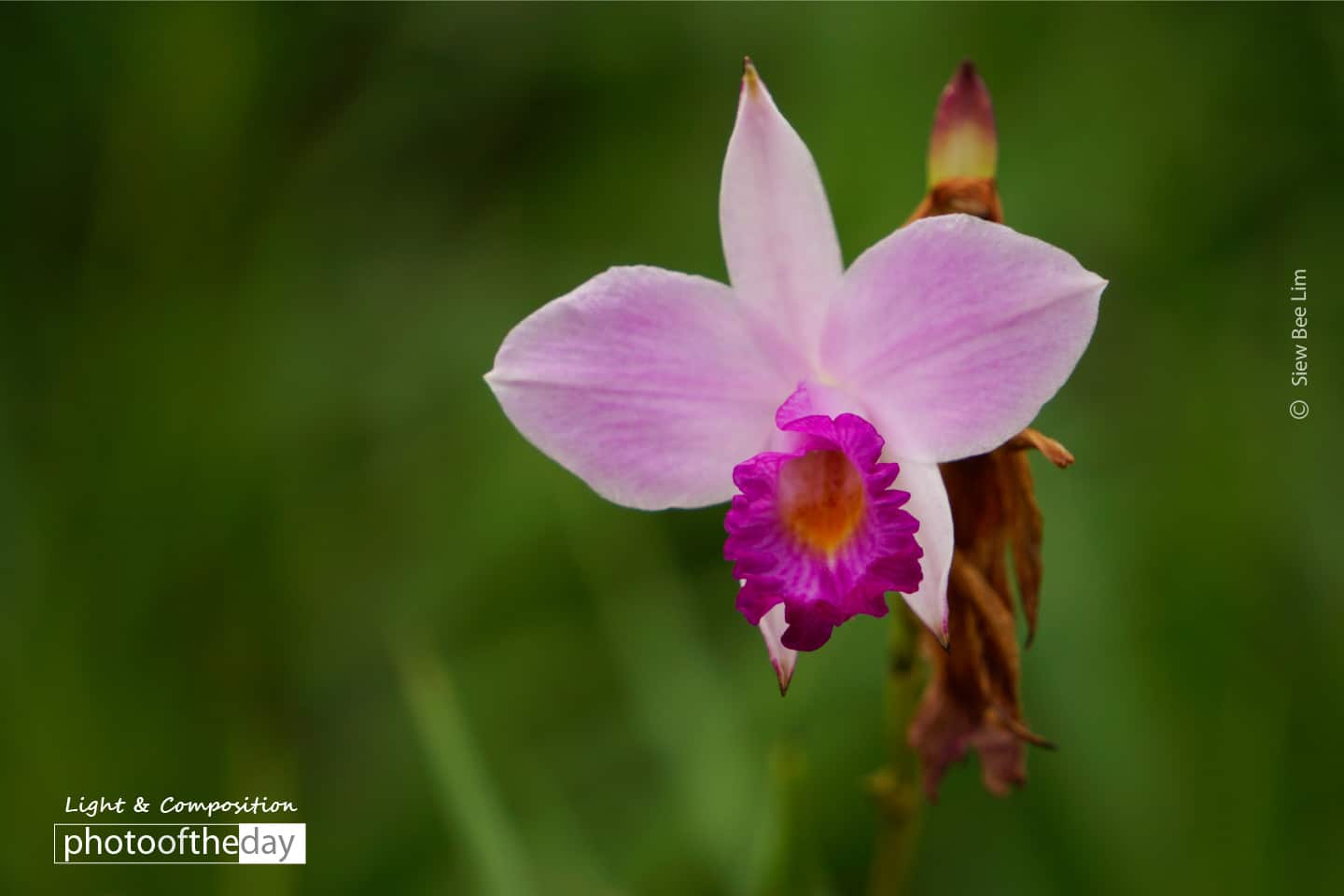
Captured during the soft, diffused light of an early morning at the Singapore Botanic Gardens, this image of an Arundina Graminifolia highlights the delicate elegance of the Bamboo Orchid. By choosing to photograph when the sun was gentle, the photographer ensured that the flower’s intricate textures and vibrant tones were preserved without harsh shadows. The composition emphasizes the orchid’s natural grace, transforming a common garden plant into a striking subject. This work is award-worthy for its technical clarity and the photographer's ability to find profound beauty in the quiet, overlooked details of the natural world.
Siew Bee Lim
Born in Singapore in 1965, Siew Bee Lim is a dedicated photographer who balances her professional background as a programmer with a growing passion for the visual arts. Though she initially explored photography as a hobby during the era of darkroom film development, she has recently returned to the craft with a renewed commitment to formal learning. Drawing inspiration from her lifelong appreciation for Chinese painting and literature, she seeks to cultivate her artistic eye and technical proficiency through the Light & Composition platform.
Resonance Score Breakdown
Transparency Note: The resonance score (11.8/20) is calculated based on social engagement metrics collected before the award announcement.
Expert Photography Reviews · 7
The Weight of Petals
I keep a pressed violet inside a heavy dictionary, its color long ago surrendered to the pages. It is brittle now, a ghost of a bloom that once held the weight of a summer afternoon.
Read the reflection →The Weight of Petals
There is a specific silence that follows the falling of a bloom. It is not the silence of a room where someone has left, but the silence of a life that has finished its singular, quiet task.
Read the reflection →Reviews & Comments
Share your thoughts about this award-winning photograph. Your reviews contribute to the community engagement score.
Botanical studies have long been a trap of mere documentation, echoing the clinical precision of Anna Atkins’s cyanotypes. Lim’s orchid avoids that sterility, yet it doesn’t quite escape the shadow of Karl Blossfeldt’s rigid, sculptural formalism. I’m genuinely moved by the way the light catches the labellum, suggesting a tactile depth I haven’t seen in such common flora. It’s a quiet, elegant conversation with the past, even if it’s still searching for its own singular, defiant voice.
The orchid’s petals, a bruised violet bleeding into the pale, chalky white of a Morandi still life, possess a fragility that’s almost heartbreaking. One finds the light here isn’t merely illumination; it’s a soft, humid breath clinging to the bamboo stalks, rendering the greens with the muted, melancholic depth of a Turner fog. It’s a quiet, chromatic ache that I’ve felt lingering in my own chest, a rare, hushed symphony of botanical grace.
Soft light doesn’t make a photograph neutral. Siew Bee Lim isolates this Arundina Graminifolia, but why strip away the context of the Singapore Botanic Gardens? It’s a pristine, clinical gaze that renders the orchid a mere object of aesthetic consumption. I find myself craving the dirt, the gardeners, or the humidity that actually sustains this life. Does beauty require this level of erasure? It’s technically sharp, sure, but it feels like a polite silence where a conversation should be.
The orchid’s stem establishes a sharp vertical axis, bisecting the frame into a 1:2 ratio of negative space. I’m captivated by how the petals’ radial symmetry resolves the tension against the diagonal thrust of the leaves. It’s a precise geometric equilibrium. The soft light prevents the highlights from overwhelming the structural integrity of the bloom. It’s rare to see such a complex botanical form solved with this much mathematical restraint. I’ve rarely felt such calm.
The orchid leans into the void. It’s a quiet tension. I’ve spent minutes watching the curve of the stem against the blur of the garden. Nothing here is accidental. The empty corner is not empty. It’s a breath held in the morning air. I feel a sudden, sharp ache for this stillness. It doesn’t demand attention. It simply exists. The space around the petal is where the real work happens. It’s enough.
Before the eye identifies the orchid, a sudden stillness settles in the chest. The petals’ soft, diffused light triggers a parasympathetic response, slowing my pulse to match the morning quiet. It’s an intimate, fragile geometry. I’ve returned to this print three times today; each time, the violet veins feel more like a pulse than a plant. It doesn’t demand attention, yet it lingers in my peripheral vision, a quiet ghost of Singapore’s humidity.
The focal plane here is razor-thin, perfectly isolating the Arundina’s labellum. By avoiding the diffraction limit, Lim has rendered the cellular structure with startling fidelity. I’m genuinely moved by how the soft, morning light avoids chromatic aberration at the petal edges, maintaining pure color fidelity. It’s a rare moment where the lens doesn’t just capture a flower; it resolves the very biology of the plant. I’ve rarely seen such precise control over bokeh as a function of aperture.