Sweet Potatoes with Parsley by Rasha Rashad
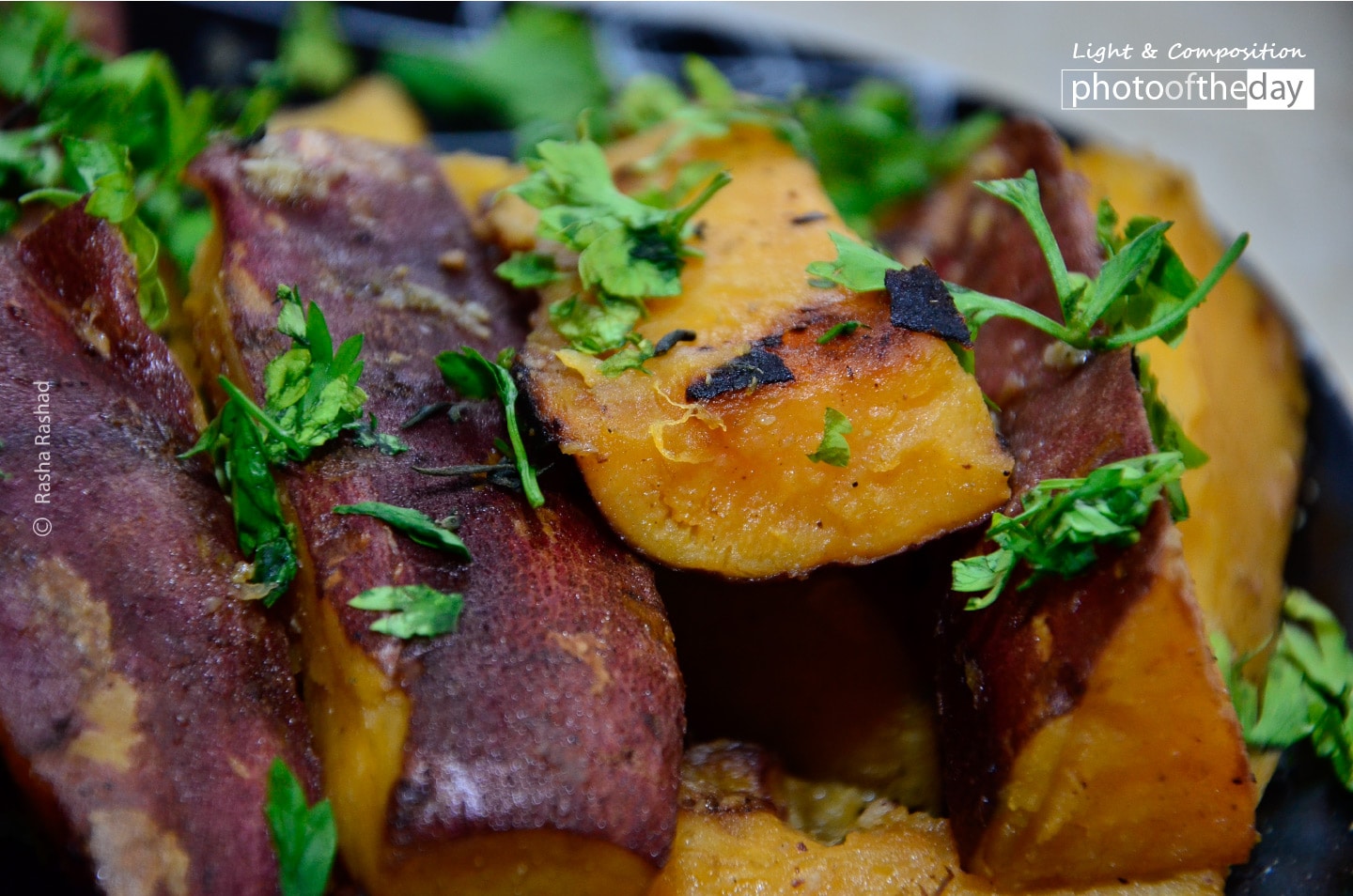
This compelling food photograph captures roasted sweet potatoes, seasoned and garnished with fresh parsley, arranged to emphasize their rich texture and intricate details. The photographer utilized a combination of artificial flash and ambient kitchen lighting, supported by a reflector, to sculpt the subject and highlight its appetizing qualities. By focusing on the deliberate stacking of the ingredients, the image transforms a simple home-cooked meal into a sophisticated culinary study. This work is award-worthy for its masterful control of light and composition, which elevates everyday nourishment into a visually arresting piece of art.
Rasha Rashad
Hailing from Alexandria, Egypt, Rasha Rashad is a dedicated explorer and visual storyteller who transitioned from a corporate career to pursue photography full-time. Her work is deeply influenced by a love for literature, classic cinema, and the diverse cultures she encounters during her travels. Specializing in both street and food photography, Rashad brings a keen, observant eye to her subjects, consistently seeking to capture the authentic essence of the world around her through her lens.
Resonance Score Breakdown
Transparency Note: The resonance score (11.8/20) is calculated based on social engagement metrics collected before the award announcement.
Expert Photography Reviews · 4
The Geography of the Table
We often mistake the kitchen for a private sanctuary, a place removed from the friction of the city. Yet, every meal is a map of access, labor, and history. What we choose to eat, and how we present it, is a performance of our place in the social hierarchy.
Read the reflection →The Virtue of the Ordinary
Seneca once reminded his friend Lucilius that we are often distracted by the pursuit of grand, distant things, while the true substance of life is found in the simple, daily acts of sustenance.
Read the reflection →Reviews & Comments
Share your thoughts about this award-winning photograph. Your reviews contribute to the community engagement score.
The ochre of these roasted tubers, a shade reminiscent of Morandi’s dustiest clay vessels, vibrates against the sharp, verdant shock of parsley, creating a chromatic tension that’s frankly intoxicating. It’s a quiet, domestic alchemy where the artificial light doesn’t merely illuminate but caresses the caramelized edges, pulling them into a warmth that makes one’s mouth water. I’ve rarely seen such humble sustenance elevated through a palette that feels both ancient and startlingly, vibrantly alive.
Roasted tubers shouldn’t carry such existential weight, yet here they are, anchored in a darkness that feels almost tectonic. The parsley isn’t just a garnish; it’s a fragile defiance against the encroaching void. I’ve stared at these charred edges until my eyes ached, feeling the gravity of a meal that refuses to be merely consumed. It’s a somber, heavy study. When light hits these potatoes, it doesn’t reveal food—it reveals the inevitable decay of all things.
The stacking of the tubers creates a rigid, vertical axis that anchors the frame. It’s a calculated geometry. The parsley disrupts the monotony, providing necessary spatial tension against the dense, roasted mass. The light doesn’t just illuminate; it defines the edges with clinical precision. I’ve grown tired of messy food shots, but this structure holds. It’s a disciplined study of form. The composition succeeds because it refuses to be anything other than a precise, architectural arrangement.
Steam rises in my mind, even if it’s frozen here. The light hits those charred edges with the precision of a key light on a lead actor. It’s a tight, claustrophobic close-up that refuses to cut away. I’ve spent hours in kitchens, but I’ve never seen parsley look this cinematic. The texture is so tactile I can almost taste the heat. It’s the frame the editor keeps because it tells the whole story.