Striking a Pose by Claudio Bacinello
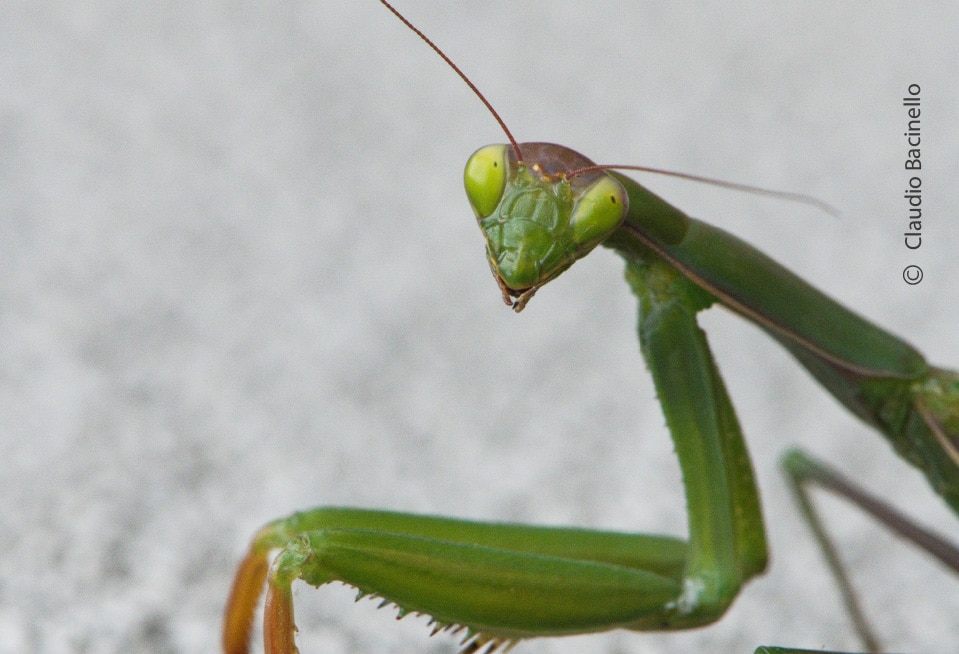
While testing a new camera body in his local neighborhood, Claudio Bacinello encountered a praying mantis basking in the summer sun. Drawn to the creature's stillness, he utilized a macro lens to capture a series of intimate portraits. The resulting image is defined by the insect's striking head tilt and the uncanny sense of direct eye contact, which creates a profound connection between the viewer and the subject. This photograph stands out for its technical precision and the photographer's ability to transform a fleeting moment in a suburban setting into a compelling, award-worthy study of nature's intricate details.
Claudio Bacinello
Born in Italy, Claudio Bacinello is a seasoned photographer currently based in Thornhill, Canada, where he pursues his lifelong passion for the craft. With a career spanning three decades, he has mastered diverse disciplines ranging from corporate and wedding photography to travel and wildlife. His work, which has gained global recognition, reflects a deep commitment to storytelling and is frequently sought after for fine art collections. Bacinello continues to explore the world, capturing nature and wildlife with a particular focus on the landscapes of Africa and South America.
Resonance Score Breakdown
Transparency Note: The resonance score (12.1/20) is calculated based on social engagement metrics collected before the award announcement.
Expert Photography Reviews · 8
The Quiet Observer
I was weeding the garden this morning, pulling at stubborn roots, when I felt someone watching me. I froze, expecting a neighbor or maybe a stray cat, but there was no one. Just the tall grass swaying and the hum of the afternoon heat.
Read the reflection →The Weight of a Gaze
There is a specific silence that follows the departure of a guest. It is not merely the absence of conversation, but the lingering pressure of a presence that has suddenly evaporated.
Read the reflection →Reviews & Comments
Share your thoughts about this award-winning photograph. Your reviews contribute to the community engagement score.
Most macro shots of insects are clinical, cold, and forgettable. What separates this from the thousands of bug portraits I’ve reviewed is the mantis’s deliberate head tilt. It’s unnerving. It forces a gaze that feels sentient, not merely biological. I’ll admit, it made me shiver. In thirty years, we won’t care about the camera body used, but we’ll still be unsettled by that direct, predatory eye contact. That’s why it earned its place here.
The focal plane here is razor-thin, perfectly isolating the mantis’s compound eye. Bacinello’s aperture choice avoids the diffraction limit, keeping those hexagonal ommatidia sharp enough to reveal the internal structure of the pseudopupil. It’s a rare, clinical intimacy. When I look at that tilted head, I’m genuinely unsettled by how much the insect seems to be calculating my own presence. It’s not just a macro shot; it’s a high-resolution confrontation with a truly alien intelligence.
Macro photography often risks falling into the clinical sterility of early scientific plates, yet Bacinello avoids this trap. The mantis’s gaze echoes the unsettling, anthropomorphic intensity found in early 20th-century surrealist portraits. It’s a rare, startling moment of genuine connection that makes me catch my breath. While the technical execution is sharp, it’s the creature’s deliberate, almost theatrical tilt that elevates this beyond mere suburban documentation. It’s a haunting, singular dialogue between lens and chitin.
Before the eye identifies the insect, something in the chest tightens. It’s that sudden, predatory stillness. When I look at Bacinello’s mantis, my pulse quickens, caught in the gravity of those alien, unblinking eyes. It’s an uncanny confrontation that forces a held-breath moment. I’ve returned to this frame three times today; each time, the creature’s tilt feels more like a question I can’t answer. It’s unsettling, really—the way it tracks me long after I’ve looked away.
We look at this mantis and we’re caught off guard. It’s not just a bug in a Thornhill garden; it’s a presence. Claudio clearly stopped to listen to the stillness of this creature before he clicked the shutter. That tilted head feels like a question posed to us. I’ve spent my life studying human faces, yet this tiny, alien gaze humbles me. It’s a portrait that asks to be returned to, again and again.
The mantis occupies the frame with calculated arrogance. Its head tilt creates a precarious fulcrum, balancing the composition against the blurred, verdant negative space. The macro lens forces a confrontation, yet the structure remains rigid. It’s a clinical study of geometry disguised as nature. I’ve grown weary of such literal subjects, but the tension here holds. The eye is refused a soft landing, pinned instead by the insect’s gaze. It’s a disciplined, sharp-edged success.
Most people walk past a mantis without a glance. Bacinello didn’t. He saw the tilt, the alien gaze, and he locked it in. It’s that split second of stillness that kills me; if he’d waited, the creature would’ve vanished into the brush. It’s not just a macro shot; it’s a street encounter with a tiny, prehistoric stranger. One tenth of a second later and the connection breaks. He caught the pulse of the garden perfectly.
The mantis tilts. It’s watching me. I feel a sudden, sharp stillness in my chest. The background isn’t just blur; it’s a soft, green void. It holds the creature in place. Nothing here is accidental. The empty corner is not empty. It’s a breath held between two worlds. I’ve spent minutes staring at that singular, jagged limb. It doesn’t need the rest of the garden. It has enough. Silence.