The Migratory Pacific Golden Plover by Saniar Rahman Rahul
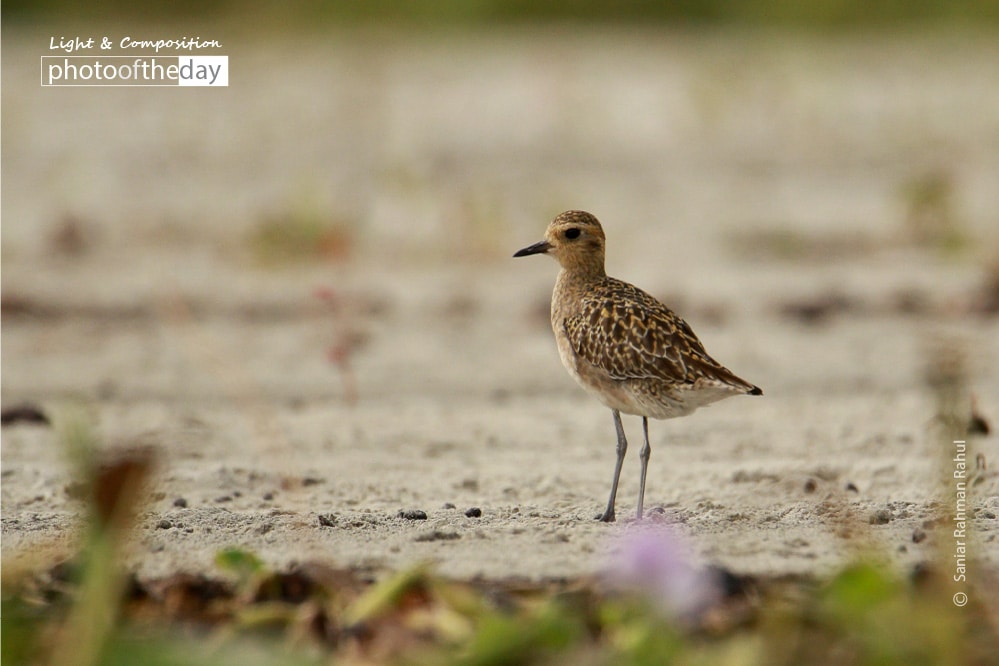
Captured in the open landscapes of Kalapara, this photograph highlights the Pacific Golden Plover, a resilient migratory bird that traverses vast distances between Arctic breeding grounds and South Asian wintering sites. The photographer utilized a long telephoto lens to isolate the plover against its natural environment, freezing the subject in sharp detail with a high shutter speed. This image is award-worthy for its technical precision and the intimate perspective it offers of a species known for its remarkable endurance, showcasing the bird's intricate plumage and alert posture within its dry, open habitat.
Saniar Rahman Rahul
Based in Dhaka, Bangladesh, Saniar Rahman Rahul is an accomplished Art Director at Grey Worldwide with a deep-rooted passion for visual storytelling. His photographic journey began in childhood, inspired by his father, and was later refined through his extensive professional background in graphic design and advertising. Rahul’s work reflects a keen eye for detail and a commitment to capturing the natural world, earning him recognition as a distinguished talent within the international photography community.
Resonance Score Breakdown
Transparency Note: The resonance score (11.2/20) is calculated based on social engagement metrics collected before the award announcement.
Expert Photography Reviews · 6
The Weight of Distance
To travel is to leave a part of yourself behind, scattered like seeds in the wind. We measure our lives in the spaces between places, in the exhaustion of the wings and the ache of the long, cold transit.
Read the reflection →The Geography of Belonging
We often speak of the city as a fixed map of concrete and steel, yet the true map is drawn by those who move through it. There is a profound tension between the permanent resident and the transient visitor.
Read the reflection →Reviews & Comments
Share your thoughts about this award-winning photograph. Your reviews contribute to the community engagement score.
The plover’s isolation in Kalapara isn’t merely a technical feat; it’s a confrontation with the void. By stripping away the horizon, Rahul forces us to confront the bird’s fragile existence against an indifferent, bleached earth. I’ve stared at this frame for an hour, and it’s the lack of deep shadow that haunts me. It’s too bright, too exposed. It doesn’t let the creature hide. It’s a lonely, shivering truth that refuses to offer us any comfort.
The landscape here lacks a datum, a horizon line that anchors the bird to a structural reality. It’s an endless, void-like expanse where the plover exists in total isolation. I find myself longing for a threshold, some architectural element to define the scale of this dry, featureless ground. Without a sense of solid against void, the bird feels untethered. It’s technically sharp, sure, but it’s a lonely, floating fragment of a much larger, unseen space.
At 600mm, the focal plane is razor-thin, yet Rahul has locked onto the plover’s eye with surgical precision. The f/6.3 aperture renders the background bokeh as a soft, painterly wash, isolating the bird’s intricate plumage. I’m genuinely moved by how the diffraction of light across those feathers reveals textures our eyes usually miss. It’s a rare moment where the lens’s resolution perfectly matches the subject’s fragile, migratory endurance. It’s simply beautiful physics in motion.
The plover occupies the lower-left quadrant, creating a perfect 1:3 vertical tension against the vast, negative space of the mudflat. Rahul’s geometry relies on the bird’s sharp, diagonal posture to anchor the frame’s otherwise horizontal drift. It’s a clean, solved equation of mass versus void. I’m genuinely struck by how the subtle texture of the mud balances the bird’s intricate plumage. It’s rare to see such a precise spatial equilibrium in wildlife work. Truly, a beautiful calculation.
You’ve captured a quiet, lonely endurance here. I look at that plover standing in the dry, cracked earth of Kalapara and I don’t just see a bird; I see the weight of a journey I can’t even fathom. You waited for that alert posture, and it’s that tension that gets me. It’s not just a sharp shot. There’s a restlessness in its eye that feels deeply human. You caught the exhaustion of the traveler. Well done.
Most wildlife shots are just taxidermy with a pulse, but this one sticks. I’ve seen thousands of birds frozen at 1/2500sec, yet Rahul’s plover holds a rare, weary dignity. The dry, muted earth tones don’t just frame the bird; they tell the story of a ten-thousand-mile journey. It’s the bird’s sharp, singular focus that gets me—it looks like it’s still calculating the wind. Thirty years from now, we’ll still be looking for that kind of grit.