Deep into the Core by Joaquín Alonso Arellano Ramírez
Captured with a newly acquired macro lens, this photograph explores the intricate color patterns and delicate textures of a flower. The photographer ventured into the field specifically to test the capabilities of the new equipment, resulting in an immediate and striking discovery of detail. An unexpected guest—a small bug—added an unplanned layer of life to the composition, enhancing the natural narrative. This image is award-worthy for its sharp focus, vibrant color palette, and the serendipitous harmony between the floral subject and the incidental wildlife, showcasing the photographer's keen eye for the beauty found in the minute details of the natural world.
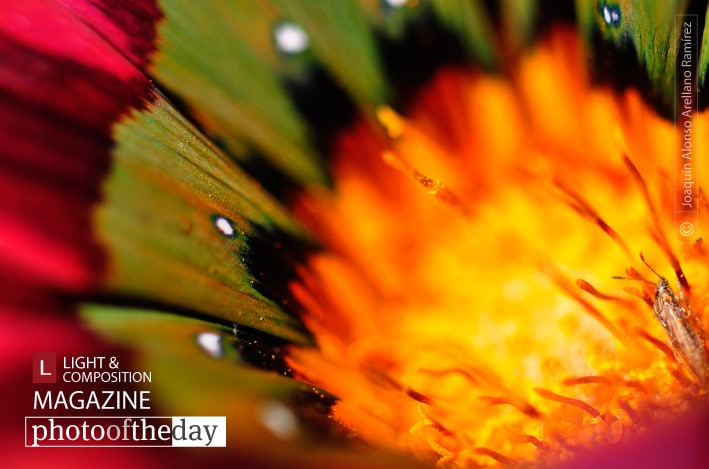
Exposure 1/800sec @ f/4.8 | ISO 200 | Focal Length 105mm
Joaquín Alonso Arellano Ramírez
Based in Monterrey, Nuevo Leon, Mexico, Joaquín Alonso Arellano Ramírez is a dedicated amateur photographer with a profound passion for nature and macro imagery. He consistently seeks to refine his craft by experimenting with diverse techniques and equipment, always striving to learn something new through his lens. His work is defined by a deep appreciation for the natural world, which he captures using a versatile range of Nikon gear to highlight the hidden complexities of his subjects.
Resonance Score Breakdown
Transparency Note: The resonance score (13.2/20) is calculated based on social engagement metrics collected before the award announcement.
Expert Photography Reviews · 6
The Architecture of the Small
We spend our lives looking at the horizon, convinced that the truth of the world is written in the grand sweep of landscapes or the distant arc of the stars.
Read the reflection →The Hum of Hidden Things
The smell of damp earth after a sudden rain always brings me back to the garden of my childhood. It is a thick, sweet scent, like crushed stems and wet velvet.
Read the reflection →Reviews & Comments
Share your thoughts about this award-winning photograph. Your reviews contribute to the community engagement score.
The ochre heart of this bloom vibrates with the intensity of a late Turner sunset, bleeding into petals of bruised violet that recall the quiet, dusty stillness of a Morandi still life. It’s a chromatic fever dream, really; I’ve found myself breathless before the way that tiny, iridescent beetle anchors the composition, its metallic sheen cutting through the floral warmth like a sharp, cold needle of light. It’s simply exquisite, don’t you think?
It’s easy to overlook the quiet hum of a flower’s center, but Joaquín found it. He stood there, likely breathless, as the light caught the delicate, velvet folds of the petals. That tiny, incidental guest—the bug—feels like a secret shared between the lens and the earth. I’ve spent hours waiting for such stillness in the wild; it’s a rare, holy kind of patience. My heart actually skipped a beat seeing that vibrant, hidden world.
Most macro work is just technical vanity, but this holds up. Of the thousands of floral close-ups I’ve reviewed, most fail because they lack a pulse. Here, the bug isn’t just a prop; it’s the anchor that stops the eye from drifting off the petal’s saturated edge. I’ll admit, the sheer precision of that focus makes me lean in closer every time. It’s a small, quiet victory that will still feel alive in thirty years.
The frame’s geometry is compromised by the insect’s placement. It’s an intrusion, not a contribution. While the macro lens achieves clinical sharpness, the floral architecture lacks a singular fulcrum. The eye wanders, searching for a structural anchor that doesn’t exist. I’m genuinely irritated by the lack of discipline here. The negative space is wasted, failing to balance the vibrant, chaotic tonality. It’s a technical exercise that forgets the fundamental necessity of a coherent, rigid visual order.
The macro lens promises clarity, yet here, the shadows hold the true weight. That tiny insect isn’t just a guest; it’s a trespasser in a velvet abyss. I find myself shivering at the way the darkness swallows the petals’ edges, refusing to let them breathe. It’s a claustrophobic beauty, isn’t it? When the light dies into the core, we aren’t looking at a flower anymore. We’re staring into the cold, silent mechanics of existence itself.
New gear often produces sterile results, yet here we have a pleasant surprise. It’s clear the photographer didn’t just stumble upon this; they’ve spent time leaning into the flora. That incidental bug isn’t just luck—it’s a reward for staying still long enough to become part of the scenery. I’ve spent many damp mornings waiting for such cooperation. It’s a sharp, honest bit of work. One suspects they’ve finally learned that patience beats a new lens.