Traditional Bowls by Afnan Naser Chowdhury
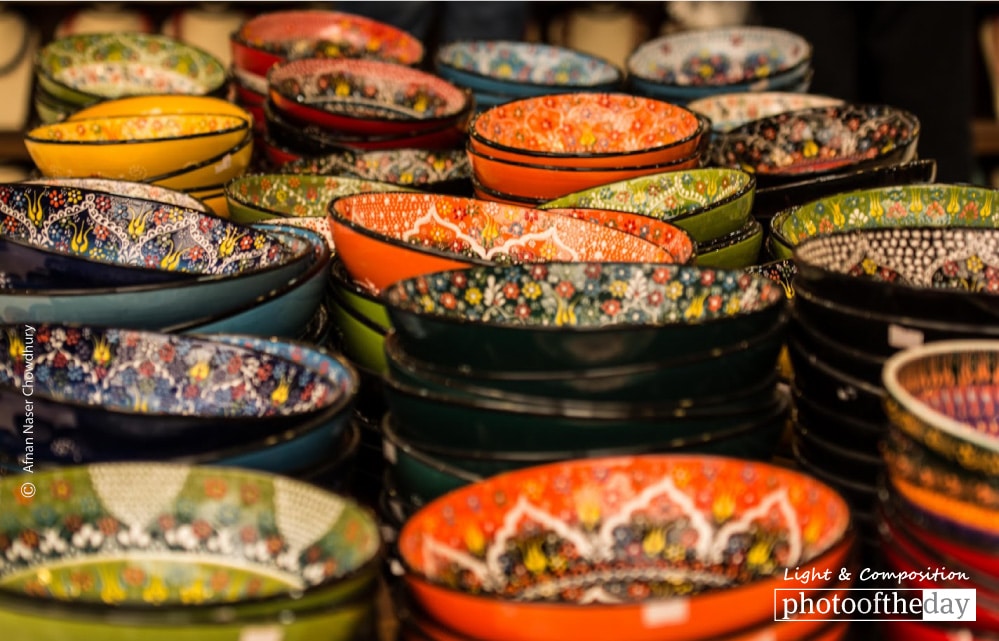
Captured during a journey through Jordan, this photograph highlights the exquisite craftsmanship of traditional ceramic bowls. The photographer seized the moment to document these cultural artifacts while traveling toward the historic Al-Aqsa Mosque. By utilizing a shallow depth of field at 70mm, the image isolates the intricate patterns and textures of the pottery, drawing the viewer into the artistry of Jordanian ceramicists. This piece is award-worthy for its ability to transform a simple, everyday object into a compelling narrative of regional heritage, demonstrating a refined eye for detail and a deep appreciation for the beauty found in traditional craftsmanship.
Afnan Naser Chowdhury
Based in Virginia, USA, Afnan Naser Chowdhury developed a profound passion for photography while pursuing his Bachelor’s degree at North South University. His creative vision is deeply rooted in a lifelong fascination with nature and painting, which informs his meticulous approach to visual storytelling. Beyond his photographic pursuits, he maintains a keen interest in technology and mobile innovation, often engaging with the broader creative community to share his evolving perspective on the world through his lens.
Resonance Score Breakdown
Transparency Note: The resonance score (11.1/20) is calculated based on social engagement metrics collected before the award announcement.
Expert Photography Reviews · 5
The Vessel of Memory
When a river carves its path through limestone, it does not merely move water; it collects the history of the watershed, carrying silt and minerals that have been weathered over millennia.
Read the reflection →The Weight of Earth
There is a specific coolness to unglazed clay that pulls the heat right out of your fingertips. I remember the grit of it, a fine, powdery dust that settles into the creases of your skin, smelling faintly of rain on dry stone.
Read the reflection →Reviews & Comments
Share your thoughts about this award-winning photograph. Your reviews contribute to the community engagement score.
The ochre of these bowls, reminiscent of a sun-baked Morandi still life, vibrates against the cool, shadowed cobalt of the background, creating a tension that’s almost tactile. It’s a symphony of earthen pigments that makes my heart ache for the dust of Amman. One finds the light here doesn’t merely illuminate; it caresses the glazed curves, turning simple clay into a luminous, resonant event that lingers in the mind long after the gaze has drifted away.
The blur behind the clay pulls at my chest. It’s a quiet ache. Chowdhury doesn’t crowd the frame. He lets the ceramic patterns breathe. The soft focus isn’t just a technical choice. It’s a boundary. It keeps the world at a distance so we can finally see the glaze. Nothing here is accidental. The empty corner is not empty. It’s the space where the history of Amman rests. I’ve found peace in this stillness.
The shallow depth of field at f/2.8 echoes the clinical isolation of Blossfeldt’s botanical studies, yet here it’s applied to the tactile geometry of Jordanian ceramics. It’s a quiet, rhythmic study of pattern that avoids the tired tropes of travel photography. I’ve spent decades looking at such objects, but the way Chowdhury captures the glaze’s refraction genuinely caught me off guard. It’s a sophisticated dialogue between ancient craft and the modern sensor’s precise, unforgiving clarity.
Before the eye identifies the ceramic curves, a sudden stillness settles in the chest. The shallow depth of field forces a singular, rhythmic focus, mimicking the way we fixate on small comforts when traveling. I’ve felt this specific, quiet ache before—the weight of a bowl in a stranger’s hand. It’s a tactile memory that lingers. When I return to these patterns, they’ve softened, becoming less about Jordan and more about the fragility of our own daily rituals.
1/25sec at f/2.8, 70mm. Handheld at that shutter speed? It’s a gamble that barely paid off. The shallow depth of field isolates the ceramic patterns, but the focus plane is razor-thin. It’s technically precarious. I’ve spent years staring at sensor noise and motion blur, and frankly, the sharpness here makes me nervous. Still, the decision to isolate the texture at f/2.8 was correct. It forces the eye to respect the craft. It’s precise work.