School Bag Smile by Ryszard Wierzbicki
Captured in the outskirts of Luang Prabang, Laos, this portrait reflects a poignant encounter during a December journey. The photographer was struck by the contrast between the material poverty of the local children and their profound, infectious joy. By focusing on a young girl carrying her school bag, the image captures a moment of pure, unadulterated happiness that transcends cultural and economic boundaries. The photograph is award-worthy for its ability to distill a complex human emotion into a single, intimate frame, highlighting the resilience and radiant spirit of childhood in the face of adversity.
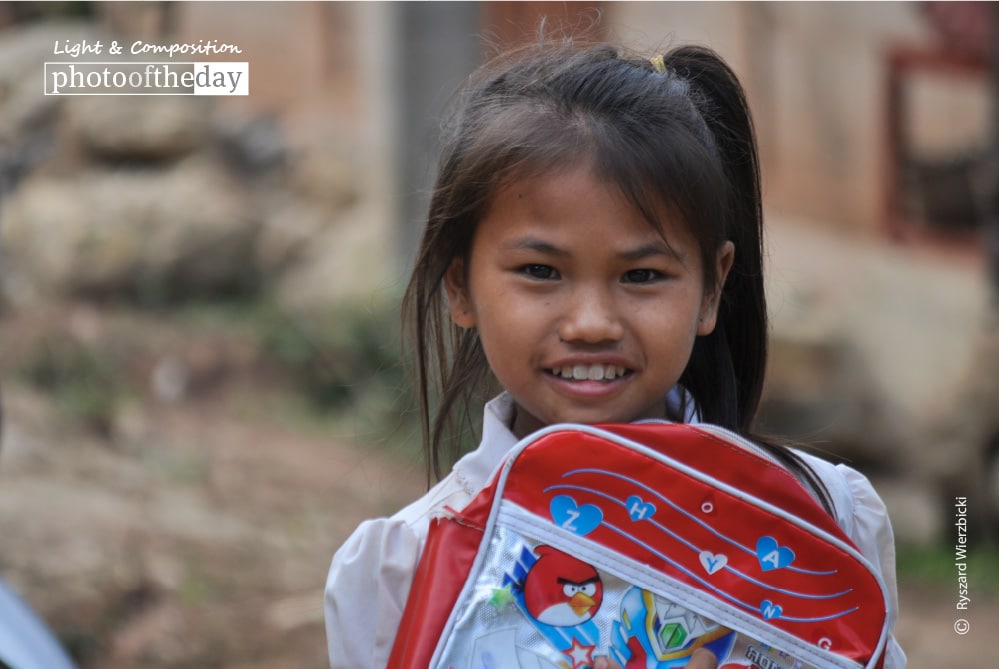
Exposure 1/500sec @ f/5.6 | ISO 250 | Focal Length 190.3mm
Ryszard Wierzbicki
Born in 1963, Ryszard Wierzbicki is a Polish-born photographer and educator currently based in Swindon, United Kingdom. After a diverse career spanning social sciences, child care, and marketing, he transitioned into a life dedicated to global exploration, scuba diving, and photography. His work is deeply influenced by his travels across South-East Asia and his commitment to humanitarian causes, including volunteering for orphanages. Through his platforms, Instant Travelling and World Around, he shares his passion for documenting the human experience and the natural world.
Resonance Score Breakdown
Transparency Note: The resonance score (11.5/20) is calculated based on social engagement metrics collected before the award announcement.
Expert Photography Reviews · 6
The Resilience of Seedlings
In the high alpine meadows, certain wildflowers germinate in the thin, nutrient-poor soil immediately after the snowmelt, often pushing through the frozen crust while the air is still biting.
Read the reflection →The Weight of Lightness
There is a curious physics to childhood, a way in which the heavy burdens of the world seem to lose their gravity when carried by the young.
Read the reflection →Reviews & Comments
Share your thoughts about this award-winning photograph. Your reviews contribute to the community engagement score.
We look at this girl’s smile and we’re reminded that joy doesn’t need a reason. In the outskirts of Luang Prabang, Wierzbicki didn’t just point a lens; he clearly sat with her. You can see it in the way her eyes crinkle, unguarded and bright. It’s a quiet, honest conversation captured in light. I’ve looked at this a dozen times, and honestly, it makes my own heart feel a little lighter. It’s a photograph that asks to be returned to.
1/500sec at f/5.6, 190.3mm. A telephoto compression that isolates the subject, yet f/5.6 on a DX sensor leaves the background distractingly busy. It’s a safe choice, but it lacks the surgical precision I’d prefer for a portrait. The shutter speed is adequate, though the focus is soft. I’ve seen sharper eyes on cheaper glass. It’s technically mediocre, yet that genuine, unforced smile actually caught me off guard. It’s a rare, honest moment.
Wierzbicki’s frame is technically safe, yet it’s the lack of friction that bothers me. At 190mm, the compression flattens the girl’s joy into a predictable, sharp portrait. I’d trade that clinical focus for a deliberate blur to capture the kinetic energy of her movement. Why resolve every strand of hair when the emotion is so fleeting? It’s a missed opportunity to push beyond the postcard. I’m left craving a more visceral, experimental disruption of this stillness.
The ochre dust of Luang Prabang clings to the girl’s skin, a warm, earthy pigment reminiscent of a Morandi still life, yet it’s the startling, electric blue of her school bag that truly arrests one’s gaze. It’s a sharp, discordant note of modernity against the muted, sun-drenched landscape, and honestly, it makes my heart ache with its sheer, unpretentious vitality. One finds here a chromatic tension that feels like a sudden, breathless intake of summer air.
The girl’s smile is undeniably bright, but I’m left uneasy by the curator’s focus on her poverty. Why must we define her joy through the lens of her lack? The telephoto compression flattens the background, isolating her as an exoticized object of resilience. Does this framing serve her, or does it merely comfort the viewer? I feel a sharp pang of guilt looking at this. Who gave us permission to consume her happiness so cheaply?
The blurred, rhythmic timber slats behind her act as a datum, grounding the girl in a vernacular structure that’s barely there. It’s a fleeting threshold between the void of the background and her vibrant presence. I’m struck by how the light catches the texture of her bag, emphasizing the material reality of her daily journey. It’s not just a portrait; it’s a spatial sequence where the architecture recedes, letting her joy define the volume.