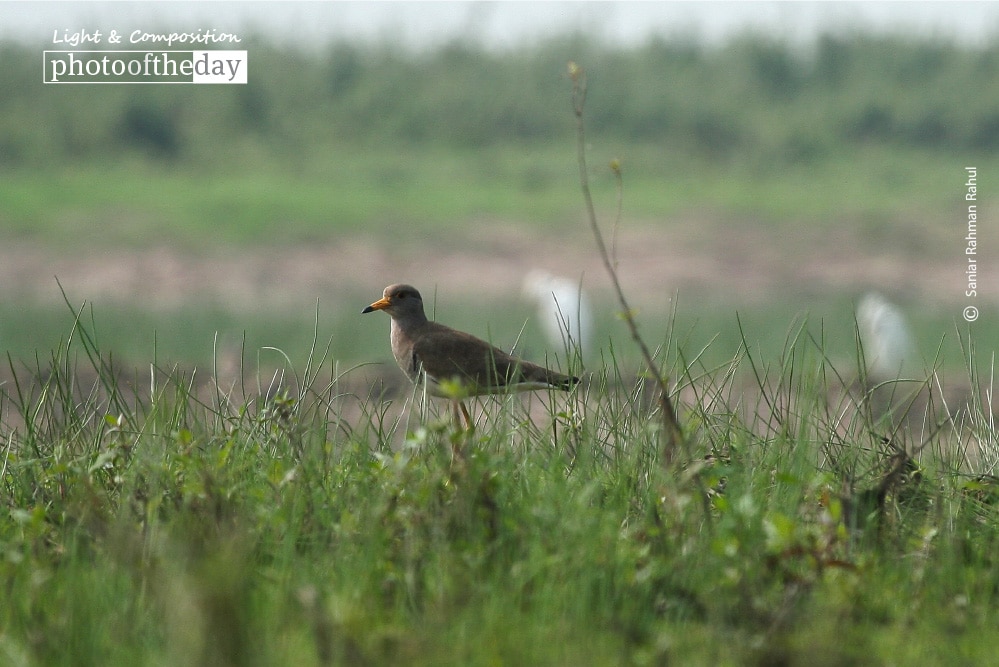
Grey-headed Lapwing by Saniar Rahman Rahul
Captured in the wetlands between Sunamganj and Tangua, Bangladesh, this striking image of a Grey-headed Lapwing showcases the bird in its natural wintering habitat. The photographer expertly isolates the subject against the soft, diffused light of the region, emphasizing the bird's distinct plumage and alert posture. This photograph is award-worthy for its technical precision and the patience required to document such a migratory species in the wild. By capturing the lapwing in a moment of quiet stillness, the image serves as a compelling testament to the rich biodiversity of the Sylhet Division and the photographer's keen eye for wildlife portraiture.
Saniar Rahman Rahul
Based in Dhaka, Bangladesh, Saniar Rahman Rahul is a distinguished creative professional who balances a successful career in advertising with a deep passion for photography. His interest in the lens was sparked during his childhood in Iraq, and he later refined his artistic sensibilities through years of experience in graphic design and pre-press media. Currently serving as an Art Director at Grey Worldwide, Rahul brings a sophisticated eye for composition and visual storytelling to his wildlife photography, consistently capturing the natural beauty of his homeland with technical excellence.
Resonance Score Breakdown
Transparency Note: The resonance score (1.2/20) is calculated based on social engagement metrics collected before the award announcement.
Expert Photography Reviews · 4
The Architecture of Stillness
In the quiet corners of a library, there is a specific kind of silence that feels heavy, as if it were holding the weight of all the unread pages surrounding it. We often mistake stillness for an absence of action, a pause between breaths, or a failure to move forward.
Read the reflection →The Unclaimed Horizon
We often mistake the edges of our maps for the end of the world. We draw lines on paper, declaring where the city stops and the wild begins, assuming that nature is something we visit rather than something we inhabit.
Read the reflection →Reviews & Comments
Share your thoughts about this award-winning photograph. Your reviews contribute to the community engagement score.
Before the eye identifies the lapwing, a sudden stillness anchors the chest. The bird’s alert, amber-eyed gaze triggers a primal, sympathetic activation in me; I find myself holding my breath, mirroring its fragile, winter-hushed posture. It’s a quiet, lonely tension. When I return to this frame a year later, the soft, diffused light of the Sunamganj wetlands still feels like a cold draft against my skin. It’s a haunting, beautiful ache of isolation.
The bird occupies the lower-left quadrant, creating a perfect 1:2 vertical tension against the expansive, blurred negative space above. Rahul’s composition relies on a sharp diagonal vector formed by the lapwing’s posture, balancing the bird’s mass against the soft, out-of-focus horizon. It’s a beautifully solved spatial equation. I’m genuinely struck by how the muted color palette reinforces the geometric isolation. It doesn’t just document wildlife; it maps the precise coordinates of stillness within a vast, fluid environment.
Rahul’s Lapwing echoes the clinical precision of early ornithological plates, yet it avoids the taxidermic stiffness of nineteenth-century field studies. The soft, diffused light across the plumage recalls the tonal delicacy of Eliot Porter’s dye-transfer prints, though here it’s sharpened by modern sensor clarity. I’m genuinely struck by the bird’s alert, almost defiant posture against the muted wetlands. It’s a quiet, rigorous dialogue with the history of natural history, proving that even well-trodden subjects can still feel vital.
The focal plane here is razor-thin, perfectly isolating the lapwing’s eye from the chaotic bokeh of the Sunamganj wetlands. At this magnification, the lens resolves the iridescent sheen on the wing coverts with startling clarity, pushing right against the diffraction limit. It’s a rare, clinical beauty. I’ve spent hours staring at these feathers; the way the light refracts across those fine barbs is, in the strictest physical sense, extraordinary. It’s truly a breathtaking piece of optics.