The Rossy Pipit and Yellow Warblers by Saniar Rahman Rahul
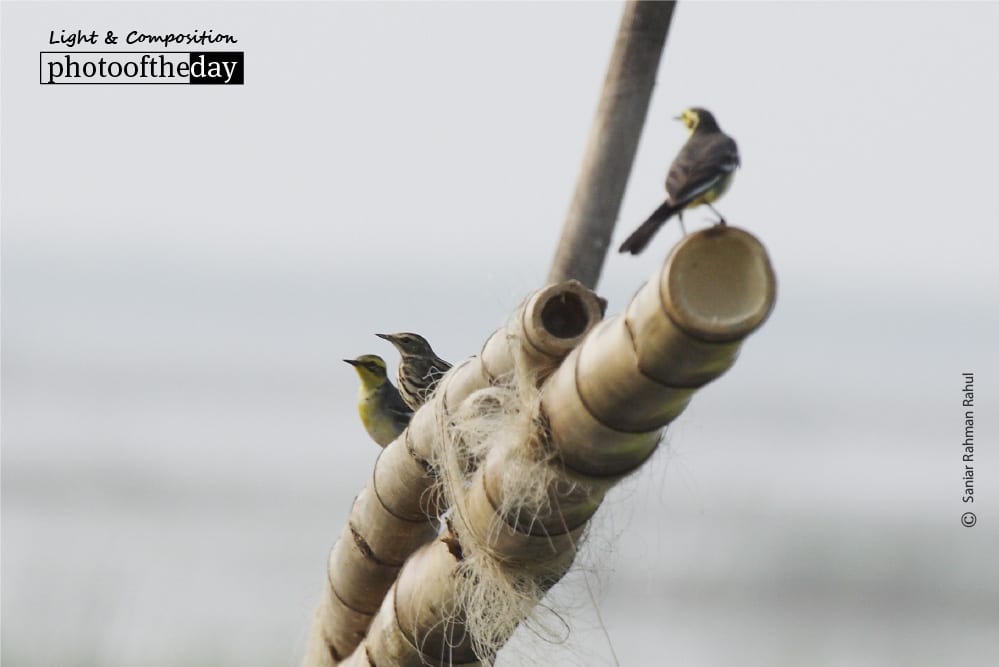
Captured within the unique wetland ecosystem of Tanguar Haor in Sunamganj, this photograph features a delicate interaction between Yellow Warblers and a Rosy Pipit. The image highlights the vibrant, greenish-yellow plumage of the warblers alongside the distinct characteristics of the Rosy Pipit, a member of the Motacillidae family. The photographer’s ability to document these avian subjects in their natural habitat, balancing the subtle color palettes of the birds against the rich textures of the wetland, demonstrates a keen eye for wildlife behavior. This composition stands out for its clarity and the intimate perspective it offers into the biodiversity of Bangladesh.
Saniar Rahman Rahul
Based in Dhaka, Bangladesh, Saniar Rahman Rahul is an accomplished Art Director at Grey Worldwide with a deep-rooted passion for visual storytelling. His journey into photography began in childhood, inspired by his father, and was later refined through his extensive professional background in graphic design and advertising. Since winning his first major award in 2010, Rahul has continued to explore the creative intersection of his technical design expertise and his love for nature, consistently producing work that captures the intricate beauty of the natural world.
Resonance Score Breakdown
Transparency Note: The resonance score (12.0/20) is calculated based on social engagement metrics collected before the award announcement.
Expert Photography Reviews · 7
Quiet Neighbors
I spent an hour this morning watching the sparrows gather on the power line outside my kitchen window. They were huddled close, shifting their weight, seemingly negotiating space on the wire.
Read the reflection →The Weight of Wingbeats
The air before a storm has a specific, metallic thickness that clings to the back of the throat. I remember standing in the tall, damp grasses of a marshland, the mud pulling gently at my heels with every step, a soft, rhythmic suction.
Read the reflection →Reviews & Comments
Share your thoughts about this award-winning photograph. Your reviews contribute to the community engagement score.
The shutter snaps, and suddenly the Tanguar Haor goes silent. It’s a freeze-frame of pure kinetic tension. The warblers’ vibrant plumage cuts through the wetland’s soft, muted textures like a jump cut in a chase sequence. I’ve spent hours watching birds, but this composition holds a rhythm I rarely see. It’s the frame the editor keeps because the movement is already implied. Honestly, I’d kill to have captured that precise, fleeting alignment of wings.
f/5.6 at 400mm, 1/1000s, ISO 400. A tight aperture choice for avian work. It’s a calculated risk that pays off with the necessary depth to keep both the Pipit and the Warblers in focus. I’ve seen enough soft wildlife shots to know how easily this fails. The shutter speed is sufficient to freeze the movement, though it’s barely enough. Honestly, the technical precision here is refreshing. It’s a sharp, disciplined capture of a chaotic ecosystem.
The frame’s geometry hinges on the diagonal alignment of the warblers, creating a necessary spatial tension against the Pipit’s static mass. It’s a rigorous arrangement that prevents the wetland clutter from collapsing into chaos. The negative space doesn’t just exist; it dictates the subjects’ isolation. I’ve rarely seen such disciplined placement in wildlife work. It’s cold, precise, and entirely successful. The composition holds its weight perfectly, refusing to succumb to the sentimentality of the subject matter.
Most wildlife shots are just trophies, but this one lingers. Of the thousands I’ve reviewed, it’s the tension between the Rosy Pipit’s grounded posture and the Warblers’ frantic, blurred energy that anchors the frame. It doesn’t just document a wetland; it captures a fleeting, chaotic conversation. I’ll admit, the sheer intimacy of their proximity made me hold my breath. It’s a rare, honest slice of Tanguar Haor that will still feel vital thirty years from now.
In the quiet wetlands of Tanguar Haor, we find a conversation held in feathers. Rahul didn’t just capture birds; he listened to the stillness of their shared space. The warblers and the Rosy Pipit aren’t posing; they’re existing in a delicate, silent pact. I find myself holding my breath, afraid to break their fragile rhythm. It’s a portrait of wild grace, reminding us that every living thing has a story if we’re patient enough to hear it.
Tanguar Haor isn’t just a wetland; it’s a vast, fluid datum where the horizon dissolves. Rahul captures these birds not as mere subjects, but as kinetic punctuations against the reeds’ vertical rhythm. The light here doesn’t just illuminate; it defines the texture of the void between stalks. I’m struck by how the frame omits the scale of the landscape, making the birds feel like inhabitants of a cathedral. It’s a quiet, spatial truth I rarely see.
The reeds recede. They don’t crowd the birds. I find myself holding my breath, waiting for the Pipit to shift. It’s a quiet tension. The yellow plumage hums against the muted stalks. Nothing here is accidental. The empty corner is not empty. It’s a pause in the wetland’s rhythm. I’ve spent hours watching these marshes, but I’ve never felt this stillness before. It’s enough. The birds remain. The silence holds.