Making an Exit by Claudio Bacinello
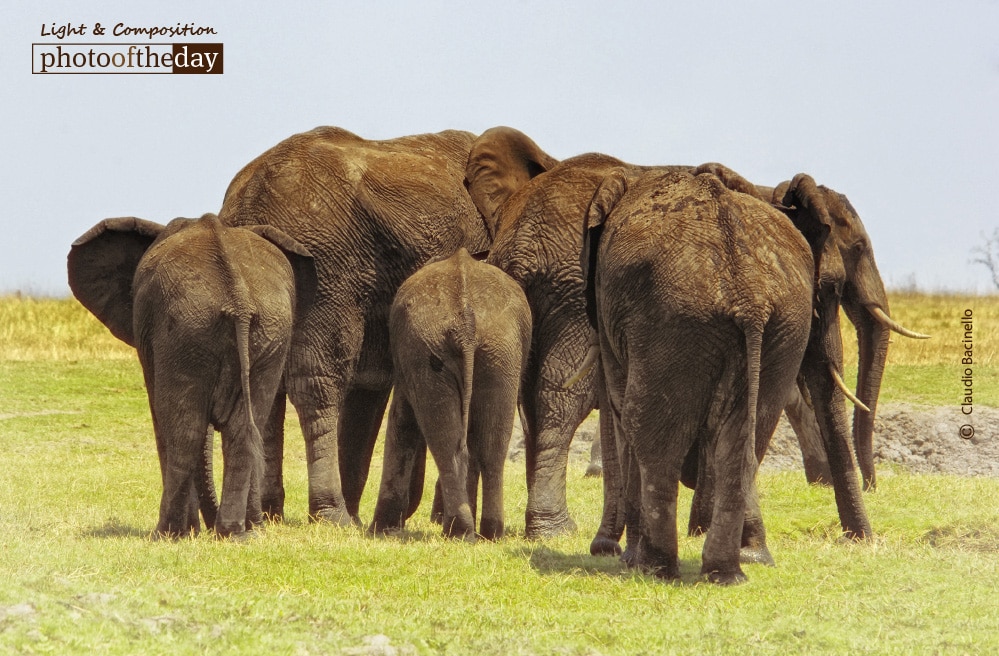
Captured along the serene banks of the Chobe River in Botswana, this photograph documents a poignant moment of wildlife behavior. While observing a herd of elephants cooling themselves in the water, the photographer noticed a smaller group turning away in unison. This synchronized departure offered a unique perspective on the majestic animals, emphasizing their rhythmic movement and collective nature. By focusing on the rear view of the elephants as they retreat, the image transforms a simple daily routine into a compelling narrative of transition, earning recognition for its thoughtful composition and the quiet, observant storytelling that defines exceptional wildlife photography.
Claudio Bacinello
Born in Italy, Claudio Bacinello is a seasoned photographer currently based in Thornhill, Canada. With a distinguished career spanning three decades, he has mastered diverse disciplines ranging from corporate and portraiture to his current focus on wildlife, nature, and travel photography. His global expeditions, particularly throughout Africa and South America, fuel his extensive stock library and fine art collections, which are featured in private and corporate spaces worldwide.
Resonance Score Breakdown
Transparency Note: The resonance score (12.1/20) is calculated based on social engagement metrics collected before the award announcement.
Expert Photography Reviews · 5
The Grace of Moving On
I spent an hour this morning trying to decide if I should keep an old sweater that has a hole in the sleeve. It was a gift from someone I haven't spoken to in years.
Read the reflection →The Weight of Leaving
The smell of wet earth always brings me back to the riverbank, to the heavy, damp scent of silt clinging to my skin after a long day of wading. There is a specific rhythm to moving through thick water, a resistance that forces your muscles to remember their own strength.
Read the reflection →Reviews & Comments
Share your thoughts about this award-winning photograph. Your reviews contribute to the community engagement score.
Turning our backs on the Chobe River, we’re left with nothing but gray, wrinkled hides. Why does Bacinello insist on this anonymity? By stripping these elephants of their faces, he reduces sentient beings to mere aesthetic shapes in a landscape. It’s a cold, detached gaze that prioritizes composition over connection. I find myself feeling strangely hollow looking at these retreating giants. Does the photographer even care who these animals are, or are they just props for his frame?
The focal plane clings to the elephants’ textured hides, where the lens resolves micro-contrast against the Chobe’s diffuse, backlit water. It’s a masterclass in managing diffraction limits; the light scattering off those coarse, grey surfaces creates a tactile depth I’ve rarely seen captured so cleanly. When I look at the way the bokeh softens the river’s edge, I’m genuinely moved. It’s not just a retreat; it’s a precise optical study of mass moving through light.
Most wildlife photography is a tedious exercise in taxidermy, obsessed with counting eyelashes. Bacinello’s choice to focus on the retreating backs of these elephants is a refreshing subversion of that obsession. It’s closer to the rhythmic abstraction of Muybridge than a standard nature documentary. I’m genuinely moved by the decision to leave the faces unresolved. Why demand clarity when the mystery of their departure is far more evocative? It’s a quiet, deliberate rejection of the expected.
The rhythmic alignment of the elephants’ mass creates a compelling spatial tension against the Chobe’s horizon. It’s a study in geometric repetition. The negative space above the subjects anchors the frame, preventing the composition from collapsing into mere sentiment. I’m genuinely struck by the deliberate exclusion of the water’s edge. It forces the eye to track the retreating forms. The frame holds because the structural discipline doesn’t falter. It’s a rare, cold precision in wildlife documentation.
You waited for the herd to turn, and that patience paid off. Most people would have chased the faces, but you caught the rhythm of their departure instead. It’s a quiet, heavy exit. Looking at those retreating forms, I felt a sudden, sharp pang of loneliness—the kind you get when you realize you’re watching something leave. And that’s the truth of it. You didn’t just document wildlife; you captured the weight of a goodbye.