A Common Kestrel Hovering by Saniar Rahman Rahul
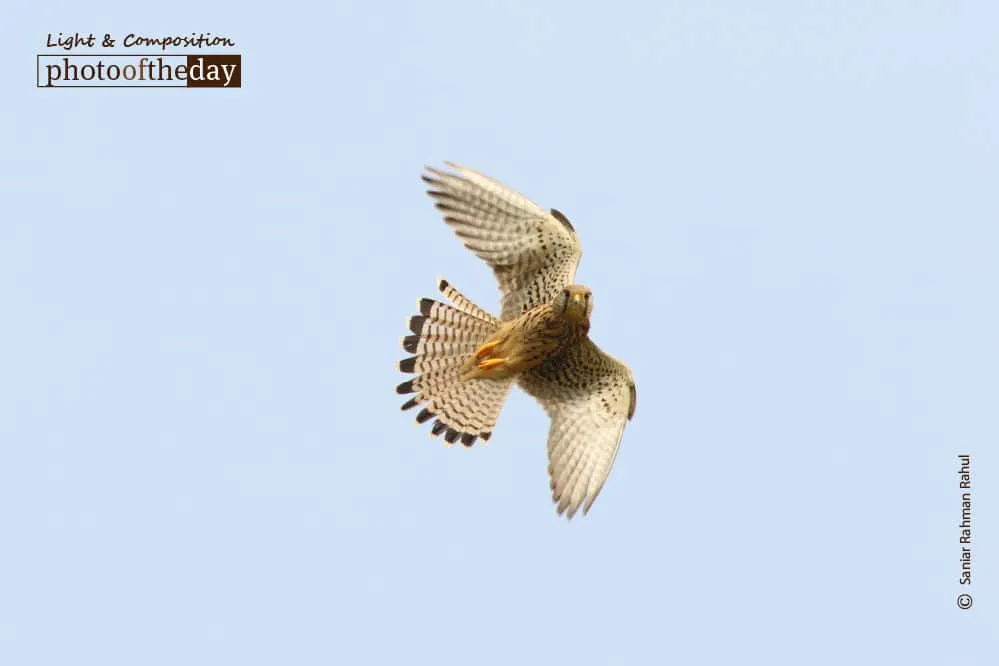
Captured in the wetlands of Purbachal, this striking image showcases a Common Kestrel in its natural element. The photographer masterfully documents the bird’s characteristic hovering behavior, a precise hunting technique performed ten to twenty meters above the ground. By freezing the kestrel mid-air against the backdrop of the Shitalakhya and Balu rivers, the image highlights the raptor's keen eyesight and predatory focus. This photograph is award-worthy for its technical clarity and the patience required to capture such a fleeting, high-speed moment in the wild, offering a compelling glimpse into the life of a falconidae species.
Saniar Rahman Rahul
Based in Dhaka, Bangladesh, Saniar Rahman Rahul developed an early fascination with photography while watching his father capture images during his childhood in Iraq. A seasoned professional in the creative industry, he transitioned from a background in pre-press printing and graphic design to become an accomplished Art Director at Grey Worldwide. His photographic journey, reignited in 1997, reflects a sophisticated eye for composition and detail, earning him early recognition as a winner of the Photo of the Month Award in 2010.
Resonance Score Breakdown
Transparency Note: The resonance score (11.6/20) is calculated based on social engagement metrics collected before the award announcement.
Expert Photography Reviews · 7
The Weight of Stillness
There is a particular kind of hunger that does not ask for bread. It is the hunger of the watcher, the one who waits for the wind to settle so the world might reveal its true shape. We spend our lives moving, rushing toward the next hour, the next room, the next certainty.
Read the reflection →The Art of Holding Still
I once spent an afternoon in a field in Norfolk with an old man named Arthur who spent his retirement watching birds of prey. He told me that the secret wasn't in the movement, but in the suspension.
Read the reflection →Reviews & Comments
Share your thoughts about this award-winning photograph. Your reviews contribute to the community engagement score.
Hovering isn’t a pose; it’s a desperate, caloric struggle against the wind. Most would have packed up when the light turned flat over the Purbachal wetlands, but Rahul clearly didn’t. I’ve spent enough hours in damp hides to know the ache in his shoulders while tracking that kestrel’s frantic wingbeats. It’s a sharp, honest bit of work. He didn’t just find this bird; he earned the right to watch it hunt. A proper, cold-blooded effort.
Most wildlife shots are just technical exercises, but this kestrel is different. I’ve seen thousands of raptors frozen in mid-air, yet few capture that singular, predatory intensity in the eyes. It’s the way the wings blur just enough to suggest the violence of the hover against the stillness of the Purbachal wetlands. It makes me hold my breath. In thirty years, we’ll still value this for its raw, unflinching honesty about the hunt.
1/2500s at f/5.6, ISO 400, 400mm. A high shutter speed was mandatory to arrest the kestrel’s wing beat. The aperture choice is efficient; it isolates the subject while maintaining enough depth to keep the primary feathers sharp. I’ve spent hours in those wetlands, and the heat haze usually ruins the micro-contrast. Rahul managed to avoid that trap. It’s a clean, clinical execution. The technical discipline here is exactly what the subject demanded.
The wetlands of Purbachal don’t give up their secrets easily. Saniar stood in the humid, heavy air, waiting for the kestrel to suspend itself against the vast, indifferent sky. It’s a moment of pure, suspended tension. I find my own breath hitching when I look at those wings, frozen in such absolute stillness. He didn’t just capture a bird; he listened to the silence of the hunt. It’s a rare, quiet grace, perfectly held.
Purbachal’s wetlands aren’t just a backdrop; they’re the datum against which this kestrel defines its own spatial volume. Architecture is usually about static mass, but here, the bird’s hovering creates a temporary, kinetic threshold in the air. It’s a strange, beautiful tension—the raptor’s focus against the horizontal sprawl of the river. I’ve spent my life studying buildings, yet this fleeting geometry of wing and void makes me feel like I’m finally seeing the landscape breathe.
The sky isn’t a backdrop. It’s a weight. The kestrel hangs there, suspended in a stillness that defies the wind. I’ve spent minutes just watching the gray void around those wings. It’s terrifying, really. The bird doesn’t own the frame; the emptiness does. Nothing here is accidental. The empty corner is not empty. It’s a breath held in the wetlands. I feel my own pulse slow down. It’s a rare, quiet violence.
You waited for that hover, didn’t you? I’ve spent enough time in the field to know that kind of stillness isn’t luck; it’s a quiet conversation between you and the bird. Looking at this, I feel the tension in those wings against the Dhaka sky. It’s not just a sharp shot of a raptor. It’s the weight of your patience. And honestly, that’s the only thing that makes a photograph matter. You were truly there.