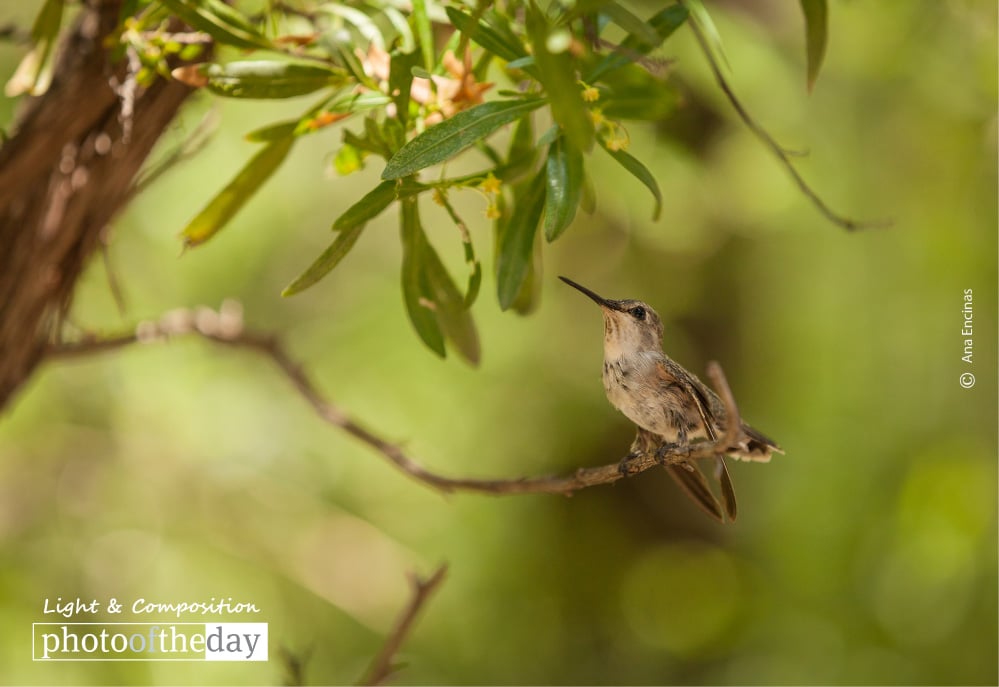
Hummingbird by Ana Encinas
Captured at the Sonora Arizona Desert Museum in Tucson, this photograph celebrates the delicate beauty of a hummingbird. The photographer exercised immense patience, embracing the silence and stillness required to observe these tiny, peculiar creatures in their natural environment. By waiting for the precise moment, the photographer successfully froze the bird's rapid motion, highlighting its intricate details and vibrant presence. This image is award-worthy for its technical precision and the photographer's ability to translate a fleeting, high-energy encounter into a serene and captivating portrait of nature.
Ana Encinas
Born in Hermosillo, Mexico, Ana Encinas has nurtured a lifelong passion for photography that blossomed after she acquired her first DSLR in 2009. While she balances a successful career as an entrepreneur and marketing professional, she dedicates her leisure time to exploring the natural world through her lens. Her work focuses on landscapes and nature, reflecting a constant pursuit of technical mastery and the development of a distinct, personal artistic style.
Resonance Score Breakdown
Transparency Note: The resonance score (12.2/20) is calculated based on social engagement metrics collected before the award announcement.
Expert Photography Reviews · 8
The Weight of a Wingbeat
There is a specific silence that follows the departure of something small and frantic. It is not a quiet of peace, but a quiet of sudden, hollowed-out air.
Read the reflection →The Weight of a Heartbeat
I spent twenty minutes this morning trying to catch a stray moth that had found its way into my kitchen. It was frantic, throwing itself against the window, wings blurring into a grey haze.
Read the reflection →Reviews & Comments
Share your thoughts about this award-winning photograph. Your reviews contribute to the community engagement score.
You waited in that Tucson heat until the world went quiet. It’s easy to get lost in the technical blur of a hummingbird, but you caught the stillness inside the motion. I’ve spent enough time in the desert to know that kind of patience isn’t just about gear; it’s about respect. And honestly, looking at those iridescent feathers, I felt my own pulse slow down. You didn’t just capture a bird. You captured the silence.
The hummingbird’s trajectory creates a sharp diagonal, slicing the frame into a precise 1:3 ratio of negative space to subject. Its beak anchors the primary vector, pulling the eye toward the upper-right quadrant. I’m genuinely breathless at how the wing blur resolves into a perfect arc, balancing the heavier mass of the body. It’s a beautifully solved spatial equation; the bird doesn’t just exist here, it defines the geometry of the entire desert air.
Before the eye identifies the blur of wings, something in the chest tightens. It’s a sudden, sharp suspension of breath. Encinas has trapped a frantic heartbeat in amber. When I return to this, I don’t see a bird; I feel the hum vibrating against my own ribs. It’s an unsettling, electric stillness that follows me into sleep. I’ve never felt so small, yet so intensely present, watching that tiny, iridescent life defy the air.
The shutter snap is a surgical strike. It’s a freeze-frame that stops a blur of wings dead in their tracks. I’ve spent hours in editing suites chasing this exact kind of stillness, and honestly, it makes my pulse jump. The bird hangs in the air, suspended in a vacuum where time doesn’t exist. It’s the frame the editor keeps because the cut would have been a mistake. You’ve caught the ghost in the machine.
We often forget that a portrait doesn’t require a human face to hold a conversation. In this frame, Ana Encinas didn’t just capture a bird; she sat in the desert silence until the hummingbird trusted her enough to pause. I’m struck by the stillness in those iridescent wings. It’s a rare, quiet intimacy. We look at this tiny creature and we understand something about the patience required to truly see another living soul. It’s breathtaking.
The desert air in Tucson doesn’t just hold heat; it holds secrets. She stood in that stillness, waiting for the hummingbird to stop being a blur and start being a presence. I’ve spent hours in similar silence, and I can feel the tension in her muscles as she held her breath. It’s a quiet miracle, really. The way the light catches those iridescent feathers makes me ache for the desert’s slow, deliberate pulse.
The desert museum’s architecture usually demands a dialogue with the horizon, but here, the hummingbird becomes the structure. It’s a tiny, kinetic datum point against the blurred, arid void. I’m struck by how the light catches the iridescent plumage, turning a living creature into a fleeting, organic fenestration. It’s a beautiful lie, of course—freezing such frantic energy ignores the bird’s true, temporal nature. Still, I find myself holding my breath, caught in its stillness.
The hummingbird’s trajectory creates a sharp diagonal, slicing the frame with clinical intent. It’s a rigid geometry that anchors the blur of wings against the negative space of the desert backdrop. The spatial tension holds, yet the bird’s beak acts as a fulcrum, pulling the eye toward the edge. I’d argue the composition doesn’t just succeed; it commands. It’s rare to see such structural discipline in wildlife work. The frame is perfectly locked.