Red Grapes by Andres Felipe Bermudez Mesa
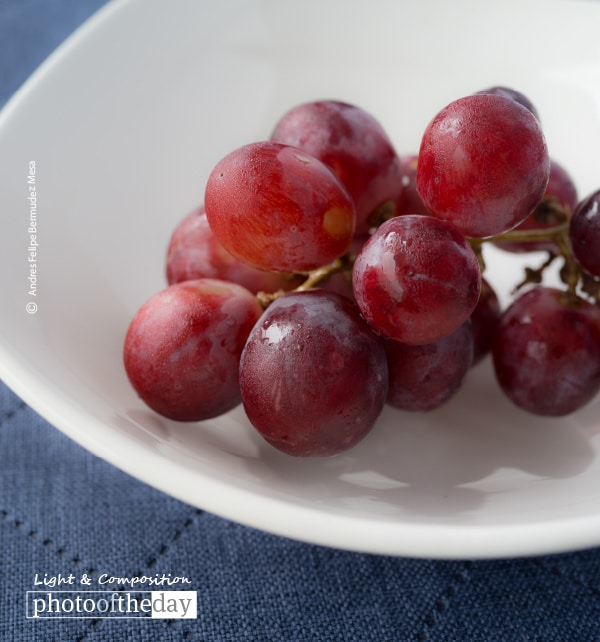
In this evocative food study, Andres Felipe Bermudez Mesa captures the vibrant, natural essence of red grapes. Taken in the quiet moments before a meal, the photograph highlights the fruit's rich texture and color under soft, natural light. The photographer’s creative decision to focus on simplicity elevates a common kitchen staple into a compelling visual narrative, emphasizing the beauty of everyday ingredients. This image is award-worthy for its clean composition and the photographer's ability to transform a simple culinary subject into a sophisticated, high-clarity piece of art that celebrates the intersection of nutrition and aesthetics.
Andres Felipe Bermudez Mesa
Born in Colombia, Andres Felipe Bermudez Mesa is a Medellín-based photographer who views himself as a citizen of the world. With a background in engineering, he transitioned his professional focus toward photography to make a more meaningful contribution to society. His work is defined by a commitment to simplicity, with a specialized focus on food and portraiture that reflects his deep, long-standing passion for the craft.
Resonance Score Breakdown
Transparency Note: The resonance score (12.2/20) is calculated based on social engagement metrics collected before the award announcement.
Expert Photography Reviews · 8
The Weight of the Harvest
There is a quiet gravity in the things we consume. We take them from the earth, wash away the dust, and place them on the table as if they were always meant to be there.
Read the reflection →The Weight of Small Things
I spent twenty minutes at the grocery store today just standing in the produce aisle. I was looking for a specific kind of apple, but I found myself distracted by a bowl of fruit sitting on a nearby display.
Read the reflection →Reviews & Comments
Share your thoughts about this award-winning photograph. Your reviews contribute to the community engagement score.
The cluster functions as a dense, spherical mass anchored in the lower-left quadrant, creating a satisfying 1:2 ratio against the negative space. Bermudez Mesa’s geometry relies on the tension between the organic, irregular spheres and the rigid, horizontal plane of the surface. I’m genuinely captivated by how the light maps the curvature of each grape, turning simple fruit into a complex exercise in volume. It’s a perfectly solved spatial equation that balances weight with delicate, luminous precision.
We look at these grapes and we don’t just see fruit; we see the quiet patience of a Medellín kitchen. Andres listened to the stillness before the meal, capturing the way light clings to the skins like a memory. It’s intimate, almost like a portrait of a family waiting to be fed. I find myself wanting to reach out and touch them. It’s a photograph that asks to be returned to, time and time again.
You’ve captured these grapes with a quiet, steady hand. It’s clean, sure, but I’m looking for the person who sat down to eat them. I’ve spent my life chasing the messiness of humanity, and this feels a bit too polished, too removed from the kitchen’s heat. And yet, the light hitting that skin makes me thirsty. You’ve got a sharp eye for texture. I just wish you’d let the human story breathe a little more.
These grapes aren’t just fruit; they’re a study in mass and void. The way light rakes across their skins, defining volume through subtle gradients, reminds me of how sun hits a curved concrete facade at dusk. It’s a quiet, structural rhythm. I’m struck by the tension between the organic spheres and the flat datum of the surface beneath. It’s a simple, honest geometry. I’d love to see this same sensitivity applied to the architecture of Medellín.
The focal plane here is razor-thin, barely kissing the grape’s waxy bloom. I’m mesmerized by how the lens resolves those microscopic dust particles; it’s a masterclass in managing diffraction at such close quarters. The chromatic aberration is nonexistent, leaving the deep crimson hues perfectly rendered. It’s rare to see such optical discipline in food studies. Honestly, I’ve spent ten minutes just staring at the light refracting through that translucent skin. It’s physically, undeniably beautiful.
f/2.8 at 100mm, 1/125s, ISO 400. A shallow plane of focus isolates the grapes, but the depth is too thin. It’s a gamble that doesn’t quite pay off; the rear fruit dissolves into an unearned blur. I’ve seen enough food studies to know when a photographer is hiding behind bokeh. It’s technically lazy. The light is soft, sure, but the lack of edge definition makes me want to reach out and sharpen it myself.
Before the eye identifies the grapes, a sudden stillness settles in the chest. It’s the weight of the fruit, the way the light clings to those waxy skins like a held breath. I’ve found myself craving the tart snap of them, a visceral, salivary response to the color. When I return to this, the quiet doesn’t fade; it deepens. It’s a rare, grounded comfort that lingers in the mind long after the gallery lights dim.
These grapes possess the bruised, velvet violet of a Morandi still life, their skins holding the dusty, muted bloom of a late Medellín afternoon. It’s a quiet, chromatic ache that I find utterly intoxicating, as if the light itself were ripening against the fruit. One doesn’t merely see these spheres; one feels the cool, succulent weight of them, their deep, wine-stained shadows whispering of a harvest that’s surrendered its brilliance to the soft, lingering grace of dusk.