The Highest by Rodrigo Luft
Capturing the sheer scale of one of Latin America's tallest structures, the photographer utilizes a wide-angle perspective to emphasize the building's imposing height against the urban landscape of Balneário Camboriú. By choosing a 10mm focal length, the image creates a dramatic, soaring composition that draws the viewer's eye upward, highlighting the architectural ambition of the site. This photograph is award-worthy for its masterful use of geometry and perspective, transforming a massive construction into a compelling visual narrative that balances technical precision with a bold, modern aesthetic.
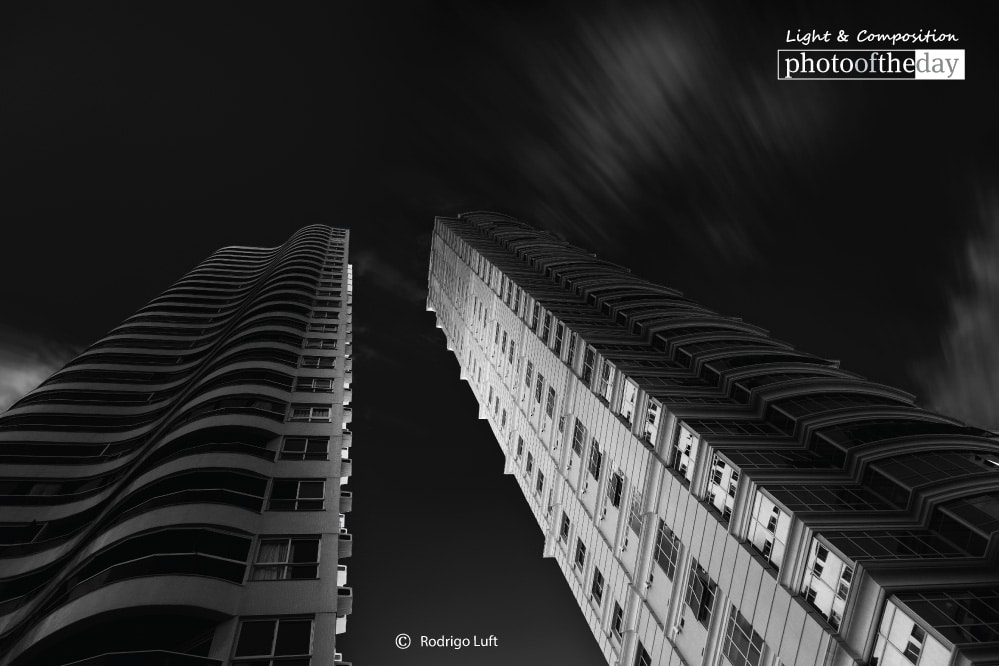
Exposure 1/1250sec @ f/3.5 | ISO 280 | Focal Length 10mm
Rodrigo Luft
Born in the south of Brazil, Rodrigo Luft is a dedicated photographer based in Porto Alegre who explores the intersection of landscapes, architecture, and abstract forms. His work, which frequently transitions between striking black-and-white compositions and vibrant color palettes, has earned international recognition, including a 2013 exhibition at the 'History of Creative' showcase in New York. While photography remains his primary creative outlet, Luft continues to refine his unique visual language, sharing his evolving portfolio through platforms like 500px and Flickr.
Resonance Score Breakdown
Transparency Note: The resonance score (12.2/20) is calculated based on social engagement metrics collected before the award announcement.
Expert Photography Reviews · 5
The Weight of Ambition
I remember standing in the lobby of a hotel in Chicago, looking up at the ceiling until my neck ached. A man standing next to me, a window washer by trade, noticed my gaze and laughed.
Read the reflection →The Weight of Upward
We build to forget the ground. There is a hunger in the vertical, a desire to scrape the belly of the sky until it bleeds light. We stack stone and steel, floor upon floor, as if height could grant us a different kind of silence.
Read the reflection →Reviews & Comments
Share your thoughts about this award-winning photograph. Your reviews contribute to the community engagement score.
At 10mm, the Nikon’s rectilinear projection stretches the architecture into a vertiginous arc. It’s a brutal test of the lens’s edge-to-edge sharpness, and frankly, the chromatic aberration at the extreme periphery is a fascinating byproduct of such aggressive wide-angle refraction. I’m genuinely breathless watching how the glass resolves those distant, soaring lines against the sky. It’s not just a building; it’s a physical manifestation of light bending to meet the impossible geometry of human ambition.
The vertical axis dominates here, forcing a convergence that turns the building into a sharp, piercing vector. At 10mm, the distortion creates a radical 4:1 ratio between the structure’s height and the surrounding urban sprawl. I’m genuinely dizzy tracing those converging lines toward the zenith. It’s a brutal, elegant solution to the problem of scale. By pinning the mass to the frame’s edge, Luft’s geometry doesn’t just suggest height; it mathematically demands it. It’s perfectly solved.
At 10mm, the distortion is aggressive, turning the skyscraper into a jagged splinter against the sky. It’s a classic architectural lie; it prioritizes vertical drama over the actual datum of the street. I find the sheer, cold indifference of the fenestration unsettling. It’s impressive, sure, but it’s stripped of the human scale that makes a building breathe. I’d trade this dizzying perspective for just one frame that shows how the light actually hits the threshold.
The sky’s bruised, desaturated cerulean bleeds into the concrete’s clinical, chalky pallor, creating a tension that reminds me of Morandi’s quietest still lifes. It’s a cold, vertical ascent where the light doesn’t warm the stone but rather strips it bare, leaving one breathless at the sheer, icy indifference of the palette. I’m genuinely unsettled by how the grey swallows the horizon; it’s a haunting, monochromatic ache that feels like a winter morning in Brazil.
Verticality here isn’t just ambition; it’s an erasure of the horizon. Luft forces us to crane our necks until the sky feels like a threat. I’m unsettled by how the glass swallows the light, leaving the shadows to do the heavy lifting of defining the structure’s cold, unyielding spine. It’s a brutal geometry. When I look at these jagged edges, I don’t see progress. I see a silence that refuses to let us breathe.