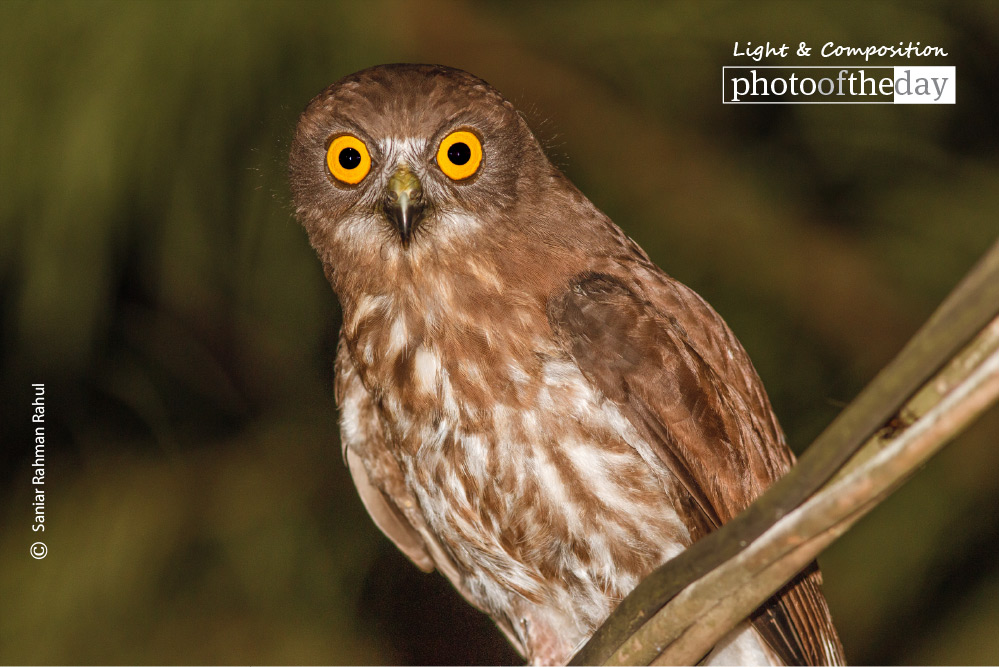
Brown Hawk Owl by Saniar Rahman Rahul
Captured within the lush landscapes of Kaptai National Park, this striking portrait of a Brown Hawk Owl showcases the bird in its natural element. The photographer seized the moment as the owl emerged to hunt for insects, highlighting its distinctive hawk-like silhouette and piercing yellow eyes. The image is a masterclass in wildlife observation, balancing the intricate details of the owl’s dark brown plumage and barred tail against the soft, natural backdrop. Its award-worthy quality lies in the precise timing and the intimate connection established between the observer and this elusive nocturnal predator.
Saniar Rahman Rahul
Based in Dhaka, Bangladesh, Saniar Rahman Rahul is a seasoned creative professional whose passion for photography was ignited during his childhood in Iraq while observing his father’s work. After establishing a successful career in graphic design and advertising, he rediscovered photography as a vital creative outlet in 1997. Currently serving as an Art Director at Grey Worldwide, Rahul brings a sophisticated eye for composition and visual storytelling to his wildlife photography, consistently earning recognition for his ability to capture the essence of the natural world.
Resonance Score Breakdown
Transparency Note: The resonance score (12.3/20) is calculated based on social engagement metrics collected before the award announcement.
Expert Photography Reviews · 6
The Weight of a Gaze
In the quiet hours before the world fully wakes, there is a specific kind of stillness that demands to be noticed. It is not the absence of sound, but rather a thickening of the air, as if the atmosphere itself is holding its breath.
Read the reflection →The Weight of the Watch
To wait is to become part of the landscape. In the deep woods, time does not move in a straight line; it circles, like a bird catching a thermal. We are taught to measure our lives by the ticking of clocks, but the forest knows a different rhythm.
Read the reflection →Reviews & Comments
Share your thoughts about this award-winning photograph. Your reviews contribute to the community engagement score.
Most wildlife shots are just trophies, but this owl’s gaze stops me cold. It’s the way the sharp, amber eyes cut through the soft, muted chaos of the Kaptai foliage that makes it endure. I’ve seen thousands of raptor portraits, yet this one avoids the usual clinical sterility. It’s not just a bird; it’s a presence. Thirty years from now, that piercing, intelligent stare will still feel like it’s hunting something in the room.
Those piercing eyes, the colour of sun-bleached straw, ignite the muted, umber depths of the plumage like a sudden candle in a Morandi still life. It’s a haunting, tonal symphony where the owl’s barred feathers dissolve into the forest’s velvet shadows. I’m breathless at how the light clings to those golden irises, creating a tension that feels almost sacred. One finds the palette isn’t merely descriptive; it’s a visceral, rhythmic pulse of the wild.
The vertical alignment of the owl’s gaze creates a rigid fulcrum against the chaotic bokeh of the forest. It’s a disciplined study in spatial tension. The plumage’s dark mass anchors the frame, preventing the composition from drifting into the soft periphery. I’ve rarely seen such structural economy in wildlife work. The eye isn’t allowed to wander; it’s trapped by the sharp, yellow geometry. It’s cold, it’s precise, and frankly, it’s entirely necessary.
The focal plane here is razor-thin, perfectly isolating the owl’s nictitating membranes and the intricate, barred plumage. At this aperture, the bokeh renders the forest floor into a soft, chromatic wash, preventing any diffraction limit from softening those piercing yellow irises. I’m genuinely moved by how the lens resolves the fine, downy texture around the beak; it’s a rare, tactile intimacy. It’s not just a bird, but a triumph of glass capturing what my own eyes would surely miss.
The owl’s perch acts as a structural datum, a rigid line against the chaotic, verdant void of the forest. It’s a fascinating study in fenestration; those piercing, circular eyes function like apertures, regulating the light of the entire frame. I’m struck by how the bird’s plumage mimics the texture of weathered timber. It’s a quiet, spatial tension I rarely see in wildlife work. Honestly, I’d love to see the architect who designed that branch.
The jury’s obsession with the owl’s sharp, piercing eyes feels predictably safe. I’m far more interested in the motion blur of the wings. It’s a shame the shutter speed wasn’t pushed further to dissolve the bird into pure kinetic energy. Why resolve every feather when you could capture the ghost of the hunt? I’d trade that clinical clarity for a smear of brown against the green. It’s almost there, but it’s still too polite.