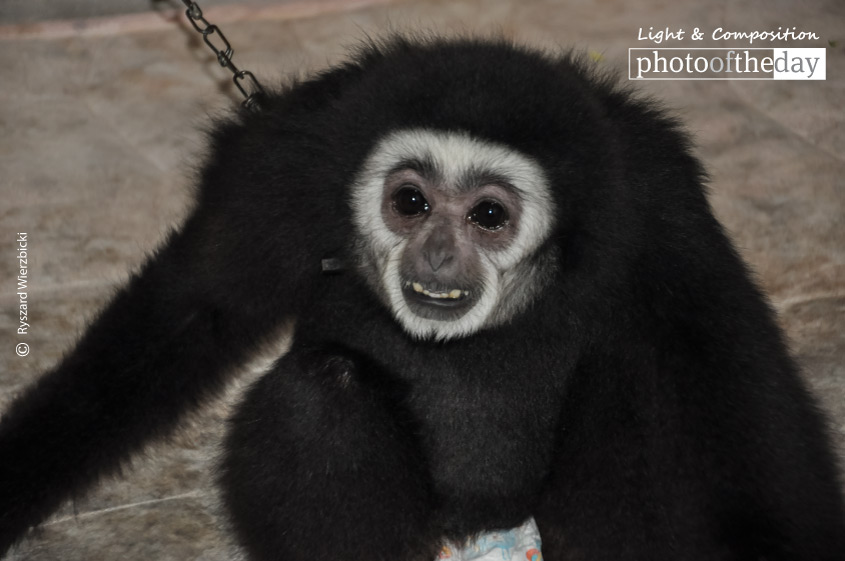
Gibon by Ryszard Wierzbicki
In the vibrant Baan Tai district of Koh Phangan, Ryszard Wierzbicki captures a unique local character known as Gibon, a resident whose living space is uniquely integrated into a popular street restaurant. The photographer was drawn to the intersection of local life and tourism, documenting the informal landmark that has become a hub for backpackers. By utilizing a wide-angle perspective, Wierzbicki frames the scene to emphasize both the subject and the bustling environment. The image is award-worthy for its authentic storytelling, successfully capturing a fleeting, culturally rich moment that defines the spirit of the island's community.
Ryszard Wierzbicki
Born in 1963 and a graduate of the University of Gdańsk, Ryszard Wierzbicki transitioned from a career in social sciences and marketing to become a dedicated traveler and photographer after relocating to the United Kingdom in 2006. His work is deeply influenced by his extensive explorations of South-East Asia and his commitment to charitable causes, such as his volunteer work with Thai and Burmese orphans. As a PADI scuba instructor and the founder of the travel forums Instant Travelling and World Around, Wierzbicki combines his technical expertise with a profound curiosity for the world, documenting diverse cultures through a lens of empathy and adventure.
Resonance Score Breakdown
Transparency Note: The resonance score (12.3/20) is calculated based on social engagement metrics collected before the award announcement.
Expert Photography Reviews · 5
The Unscripted Guest
I remember a small roadside stall in a town whose name I’ve long forgotten, where the owner kept a pet monkey tied to a wooden post near the noodle station.
Read the reflection →The Weight of Stillness
The smell of damp earth after a sudden monsoon rain always brings me back to the feeling of being small, tucked away in a corner where the air is thick with humidity and the scent of overripe fruit.
Read the reflection →Reviews & Comments
Share your thoughts about this award-winning photograph. Your reviews contribute to the community engagement score.
A 27mm lens in a bustling Thai restaurant suggests a photographer who didn’t mind getting uncomfortably close to the subject. It’s a messy, honest frame. One wonders how many bowls of noodles Wierzbicki endured before the locals stopped treating him like an intruder. I’ve spent enough time in humid, crowded corners to know that level of integration isn’t accidental. It’s earned. He didn’t just find this; he sat with it until the scene finally exhaled.
The ochre of the sun-drenched plaster, reminiscent of a weathered Morandi still life, collides with the sharp, electric cyan of the plastic seating, creating a dissonance that’s almost painful to behold. It’s a humid, chromatic fever dream that makes my heart ache for the salt-thickened air of the Gulf. One finds the shadows aren’t merely absent light, but deep, bruised violets that anchor the chaos, grounding the scene in a visceral, tropical truth.
At f/14, the Nikon D90 pushes toward the diffraction limit, yet Wierzbicki’s 27mm focal plane remains remarkably crisp across the restaurant’s chaotic depth. I’m genuinely moved by how the light renders the textures of Gibon’s space; it’s a tactile precision that human eyes simply can’t resolve in real time. The wide-angle distortion doesn’t hinder the narrative—it anchors it. It’s rare to see such technical discipline applied to the messy, vibrant reality of Baan Tai. Truly, it’s beautiful.
The light here isn’t just illumination; it’s a heavy, humid presence pressing against the street. Ryszard waited for the moment when the bustle of Baan Tai softened into a quiet, shared existence. I find myself holding my breath, feeling the heat radiating off the pavement. He didn’t just frame a subject; he listened to the rhythm of this island life. It’s a rare, honest stillness that only comes when you’ve truly stopped to watch the world breathe.
Light here doesn’t illuminate; it interrogates. Wierzbicki’s wide lens forces the Gibon into a claustrophobic dialogue with the neon chaos of Baan Tai. I’m unsettled by how the shadows swallow the edges of his makeshift sanctuary, turning a restaurant into a cage of existential friction. It’s not a portrait of a man, but of the encroaching void. When I look at those dark corners, I feel the crushing weight of a life lived entirely in the public eye.