Tears by Ryszard Wierzbicki
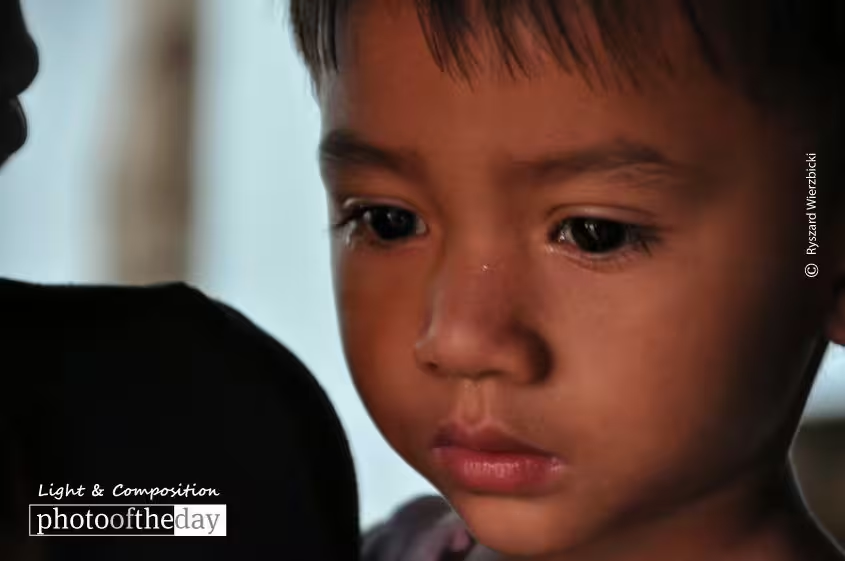
Captured in the rural landscapes of Siem Reap, Cambodia, in 2014, this poignant portrait depicts a mother and her weeping child. The image serves as a profound meditation on the ethical boundaries of documentary photography, challenging the viewer to consider the tension between detached observation and human intervention. By focusing on the raw vulnerability of the child’s tears, the photographer invites a deeper reflection on global suffering and the capacity for compassion. This work is award-worthy for its ability to transform a fleeting, emotionally charged moment into a universal statement on the human condition and the photographer's role in documenting it.
Ryszard Wierzbicki
Born in 1963 and a graduate of the University of Gdańsk, Ryszard Wierzbicki transitioned from a career in social sciences and marketing to become a dedicated photographer and traveler. After relocating to the United Kingdom in 2006, he began documenting his extensive travels through South-East Asia, often volunteering with charitable organizations for orphans. Now based in Swindon, he balances his professional life as a marketing advisor with his passion for photography and scuba diving, frequently sharing his experiences through his travel and photography forums, Instant Travelling and World Around.
Resonance Score Breakdown
Transparency Note: The resonance score (12.3/20) is calculated based on social engagement metrics collected before the award announcement.
Expert Photography Reviews · 5
The Weight of a Moment
I was standing in the grocery store aisle this morning when a little boy dropped his ice cream cone. It wasn't a big tragedy, just a scoop of vanilla melting into the linoleum, but the way his face crumpled was absolute. For a second, the whole store felt quiet.
Read the reflection →The Salt of Being
There is a quiet language in the falling of a drop. We often mistake the shedding of water for a sign of defeat, yet it is perhaps the most honest expression of our connection to the earth.
Read the reflection →Reviews & Comments
Share your thoughts about this award-winning photograph. Your reviews contribute to the community engagement score.

At f/6 on a 155mm focal length, the depth of field is razor-thin, isolating the child’s tear with clinical precision. The Nikon D90’s sensor struggles at ISO 1600, yet the resulting luminance noise mimics the texture of skin, softening the diffraction limit’s harshness. It’s a haunting optical balance. I’m genuinely moved by how the light refracts through that single drop; it’s a tiny, liquid lens capturing a world of sorrow I can’t help but feel.
1/100sec at f/6, ISO 1600, 155mm. The Nikon D90 sensor struggles here; the noise floor is intrusive, muddying the child’s skin tones. At 155mm, the compression is aggressive, yet the f/6 aperture fails to isolate the subjects from the chaotic background. It’s a technical compromise that weakens the narrative. I’ve seen enough of these high-ISO, noisy portraits to know when the gear wasn’t up to the task. The intent’s clear, but the execution’s flawed.
You didn’t look away, and that’s the hardest part of the job. I’ve been in those rural corners of Siem Reap; it’s easy to feel like an intruder when the suffering is this raw. But you stayed. I feel a tightness in my chest looking at that child’s face. You didn’t just capture a tear; you captured the weight of a mother’s helplessness. There’s something honest happening here. You were there, and you felt it.
The light in Siem Reap doesn’t just fall; it clings to the skin. I’ve stood in such heat, where the air feels heavy with unspoken grief. Watching this child’s tears, I feel a sudden, sharp ache in my own chest—a reminder that we are merely guests in these lives. Ryszard didn’t rush this. He waited until the sorrow became a landscape of its own, quiet and vast. It’s a heavy, sacred stillness I recognize.
Shadow isn’t merely the absence of light here; it’s the weight of the mother’s silence pressing against the child’s grief. Wierzbicki doesn’t just capture tears; he traps them in a dark, suffocating geometry. I’ve stared at this frame for an hour, and it’s the encroaching blackness that truly hurts. It doesn’t invite empathy; it demands a reckoning with our own voyeuristic distance. When the light fails to reach their eyes, we finally see the truth.