Langza Village by Nakul Sharma
Captured at the breathtaking altitude of 4,300 meters, this photograph immortalizes the rugged beauty of Langza Village in the Spiti Valley. The photographer utilized a 165mm focal length to compress the vast, dramatic landscape, emphasizing the textures of the high-altitude terrain where barley fields meet ancient fossils. By carefully balancing the exposure at f/14, the image achieves remarkable depth and clarity, showcasing the stark, primeval atmosphere of the Himalayas. This piece is award-worthy for its ability to convey the profound isolation and majestic scale of one of India's most remote and culturally significant regions.
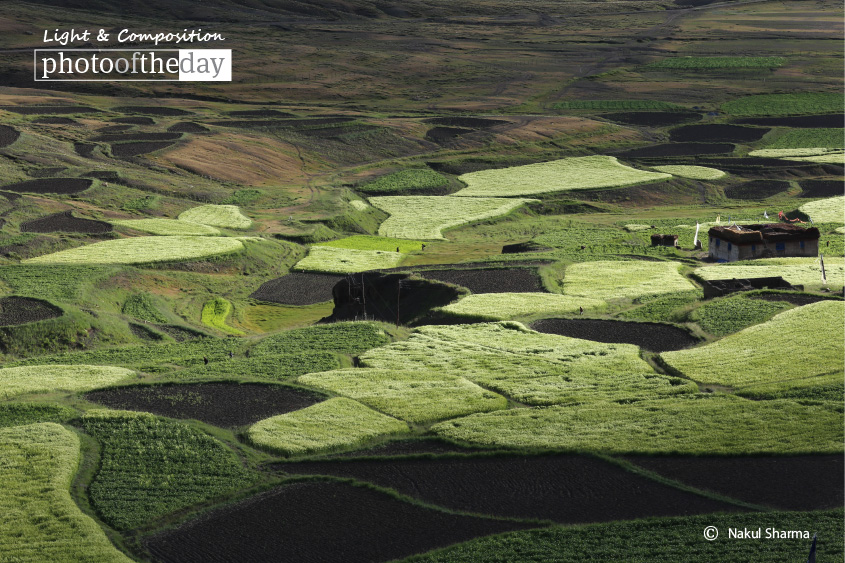
Exposure 1/200sec @ f/14 | ISO 640 | Focal Length 165mm
Nakul Sharma
Born and raised in Delhi, Nakul Sharma is a dedicated traveler and professional photographer who has been documenting the world's most adventurous landscapes since 2009. Currently based in Faridabad, Haryana, he balances his creative pursuits with his work as a freelance tour leader for prominent travel agencies across India. His photography is deeply influenced by his extensive travels, reflecting a profound commitment to capturing the cultural richness and raw, natural beauty of the remote regions he explores.
Resonance Score Breakdown
Transparency Note: The resonance score (13.9/20) is calculated based on social engagement metrics collected before the award announcement.
Expert Photography Reviews · 5
The Breath of High Places
There is a specific silence that lives only above the clouds, where the air is thin enough to let the soul stretch its limbs. Down here, we are crowded by the noise of our own making, by the frantic ticking of clocks and the heavy gravity of expectations.
Read the reflection →Where the Air Gets Thin
I spent this morning trying to organize my bookshelf, pulling out old journals I haven't touched in years. I found a pressed flower from a hike I took when I was twenty, and for a second, I could almost feel the thin, sharp air of the mountains in my lungs again.
Read the reflection →Reviews & Comments
Share your thoughts about this award-winning photograph. Your reviews contribute to the community engagement score.
At 4,300 meters, the light doesn’t just illuminate; it interrogates the earth. Sharma’s compression of the Spiti Valley forces the fossils and barley into a claustrophobic dialogue with the void. It’s a brutal, honest geometry. I’ve stared at these shadows for an hour, and they don’t offer comfort—they demand an accounting of our own insignificance. It’s haunting, really. When the mountains press this hard against the lens, you realize the darkness is the only thing holding it together.
Before the eye identifies the barley fields, something in the chest tightens. It’s the thin, sharp air of Spiti, translated into a physical ache. The compression of the 165mm lens forces a claustrophobic intimacy with the fossils, making me feel small, almost fragile. When I return to this, I don’t see a landscape; I feel the silence of 4,300 meters. It’s a quiet, heavy isolation that follows me home, lingering like the cold against my skin.
At f/14, the diffraction limit begins to soften the micro-contrast of those high-altitude barley stalks, yet the 165mm compression creates a fascinating, flattened topography. It’s a delicate balance; the lens resolves the rugged terrain with clinical precision, though I’d have preferred a wider aperture to isolate the village’s texture. Still, the way the light clings to the fossils at 4,300 meters is haunting. It’s physically breathtaking, and I find myself shivering just looking at it.
The 165mm compression forces a rigid, stacked geometry, flattening the Spiti terrain into a series of parallel horizontal strata. It’s a masterclass in spatial layering. The village sits precisely at the intersection of the lower third’s vertical axis, anchoring the composition against the mountain’s looming mass. I’m genuinely breathless at how the f/14 depth-of-field resolves those jagged ridges into a perfect, repeating fractal pattern. It’s a cold, calculated equation that somehow feels deeply, hauntingly alive.
At 4,300 meters, the silence isn’t empty; it’s a conversation between the earth and the sky. We look at Nakul’s frame and feel the weight of those ancient fossils beneath the barley. It’s a portrait of a village that’s forgotten how to be loud. I find myself shivering, not from the altitude, but from the profound solitude held in these textures. It’s a photograph that asks to be returned to, again and again.