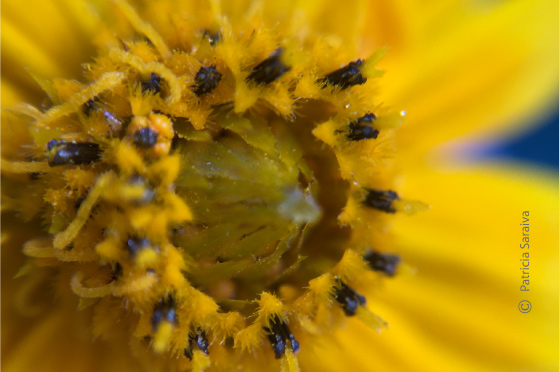
Beauty of the Flower by Patricia Saraiva
Captured with an iPhone 6 and an Olloclip macro lens, this image reveals the intricate, hidden beauty of the natural world. The photographer embraced the challenge of mobile macro photography, focusing on the delicate textures and vibrant details often overlooked by the naked eye. By isolating the flower's form, the composition highlights a raw, organic elegance that feels both intimate and expansive. This award-winning shot demonstrates a keen eye for detail, proving that profound artistic expression can be achieved through accessible technology when paired with a patient, observant perspective.
Patricia Saraiva
Born in Apucarana, Brazil, in 1969, Patricia Saraiva is a dedicated plastic surgeon whose passion for photography blossomed while documenting the growth of her two children. Her artistic journey evolved from casual family snapshots to professional recognition, including her notable 2011 exhibition, 'Barcelona Balconies,' and contributions to definitive works on Baroque art. Now based in Belo Horizonte, she seamlessly integrates her medical career with a persistent creative drive, utilizing both professional cameras and mobile devices to capture the fleeting beauty of her surroundings for a global audience.
Resonance Score Breakdown
Transparency Note: The resonance score (12.4/20) is calculated based on social engagement metrics collected before the award announcement.
Expert Photography Reviews · 7
The Architecture of Silence
If we were to peel back the layers of a single moment, would we find a beginning, or merely the echo of something that has always been?
Read the reflection →The Quiet Unfolding
There is a rhythm to the way a petal opens, a slow, deliberate surrender to the light that asks for no witness. We often walk past the small, intricate architectures of the earth, convinced that significance only lives in the grand or the loud.
Read the reflection →Reviews & Comments
Share your thoughts about this award-winning photograph. Your reviews contribute to the community engagement score.

Before the eye identifies the petal, something in the chest softens. It’s a quiet, cellular recognition of growth. Saraiva’s macro lens forces a surrender to the intricate, velvet geometry of the bloom. I find my own breath syncing with its stillness. When I return to this a year later, the vibrant color doesn’t fade; it settles into my memory like a cool, damp morning. It’s a rare, visceral anchor in a world that’s usually moving too fast.
The petal curves. It’s a soft, deliberate arc against the void. I’ve spent minutes watching the light settle on those veins. It’s quiet here. The background doesn’t intrude; it holds the subject. I feel a sudden, sharp ache for the simplicity of this bloom. Nothing here is accidental. The empty corner is not empty. It’s a breath held in the dark. Saraiva knows the weight of what isn’t there. It’s enough.
Most macro shots are just technical exercises in focus stacking, but Saraiva’s work avoids that clinical trap. By using an iPhone, she captures a tactile, raw intimacy that feels refreshingly human. I’ve seen thousands of flower studies, yet the way the light catches these specific, fragile veins makes me want to reach out and touch the screen. It’s not just a record of a bloom; it’s a quiet, enduring reminder that beauty doesn’t require expensive glass.
It’s a macro sequence frozen in a heartbeat. The light hits those petals like a soft key light on a lead actress, revealing textures that usually vanish in the blur of motion. I’ve spent hours in editing suites, but I’d never cut this. It’s the frame the editor keeps because it holds the entire narrative of growth. It’s intimate, quiet, and honestly, it makes me want to stop rushing and just breathe for once.
At f/2.2, the focal plane is razor-thin, forcing the Olloclip to resolve textures the human eye simply ignores. I’m genuinely moved by how the sensor handles these micro-refractions; it’s a triumph of mobile optics. While diffraction limits usually soften these tiny apertures, the clarity here is startling. It’s not just a flower; it’s a precise mapping of organic geometry. I’ve rarely seen such raw, crystalline detail captured with such humble, accessible glass. It’s absolutely breathtaking.
The frame doesn’t collapse under the weight of its own detail. It’s a rigid geometry of petals, where the macro lens forces a necessary claustrophobia. The spatial tension is held by the central fulcrum, refusing the viewer any soft exit. It’s clinical, almost surgical in its isolation. I’ve grown weary of floral sentimentality, yet this structure demands my respect. The composition holds because it doesn’t apologize for its own cold, calculated precision. It’s sharp.
The radial symmetry here is a masterclass in organic distribution. By centering the stamen, Saraiva anchors the frame, forcing the petals into a precise Fibonacci-like spiral that dictates the viewer’s eye path. It’s a perfect spatial equation where the negative space in the lower-left quadrant balances the dense, textured core. I’m genuinely struck by how the Olloclip’s distortion actually enhances the geometric tension. It’s not just a flower; it’s a solved problem of circular equilibrium.