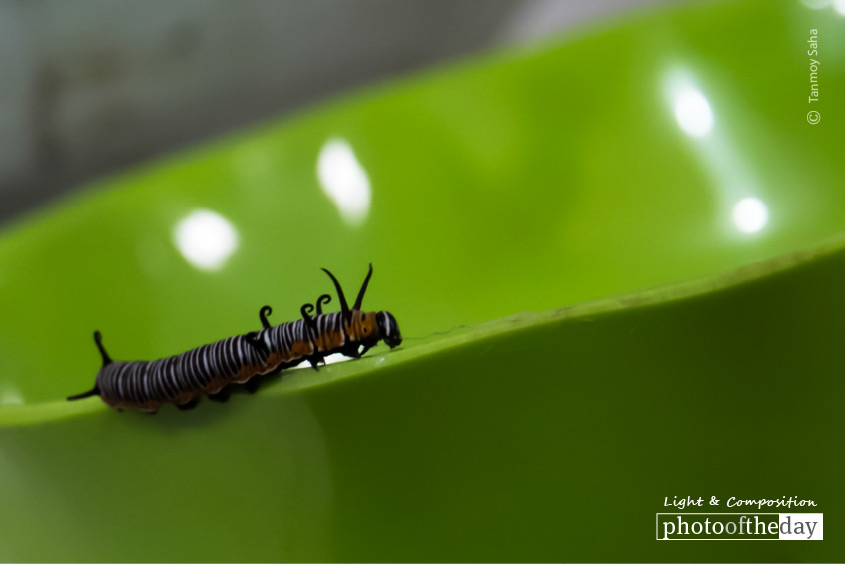
The Early Stage of a Butterfly by Tanmoy Saha
Captured within the lush environment of a butterfly park in Gazipur, Bangladesh, this image documents the delicate, early stages of a butterfly's life cycle. The photographer utilized a macro-focused approach, carefully balancing the available light to highlight the intricate textures of the subject. By isolating this fragile moment, the image invites viewers to appreciate the profound beauty found in nature's smallest transformations. The composition is particularly award-worthy for its technical precision and the intimate perspective it offers, turning a fleeting biological event into a compelling, high-clarity visual narrative that underscores the wonder of the natural world.
Tanmoy Saha
Based in Dhaka, Bangladesh, Tanmoy Saha is a dedicated photographer who began his creative journey in 2007. An Electronics and Telecommunication Engineering graduate, he balances his technical background with a passion for portraits, landscapes, and wildlife. His formal training includes courses at the Dhaka University Photography Society and Pathshala, and his work has been featured in prestigious exhibitions at the National Art Gallery in Bangladesh. Through his lens, Saha consistently seeks to capture the nuanced beauty of the natural world.
Resonance Score Breakdown
Transparency Note: The resonance score (12.4/20) is calculated based on social engagement metrics collected before the award announcement.
Expert Photography Reviews · 5
The Quiet Architecture of Becoming
I remember sitting on the porch in Gazipur, watching a local gardener tend to his rows of jasmine. He moved with a deliberate, almost agonizing slowness, as if he were afraid that a sudden gesture might disrupt the very air he was working in.
Read the reflection →The Architecture of Becoming
In the quiet corners of a garden, there is a kind of labor that goes entirely unnoticed. We are obsessed with the finished product—the wings, the flight, the sudden flash of color against a summer sky—but we rarely pause to consider the architecture of the waiting.
Read the reflection →Reviews & Comments
Share your thoughts about this award-winning photograph. Your reviews contribute to the community engagement score.

It’s a quiet, breathless take. The shutter speed at 1/20sec is a gamble that pays off, letting the light soften the subject’s fragile, alien texture. I’ve spent hours in edit suites hunting for this exact stillness. It’s the frame the editor keeps because it’s where the story finally stops moving. Honestly, it makes me want to hold my breath too. Saha didn’t just document a life cycle; he caught the precise moment the film refused to roll.
A single leaf. The creature rests. It’s a quiet geometry of green and shadow. I’ve spent minutes looking, and I still feel the stillness in my own lungs. The blur behind the subject isn’t just depth of field; it’s the breath of the park. Nothing here is accidental. The empty corner is not empty. It’s the space where the transformation happens. I don’t need to see the rest of the world. This is enough.
The larva’s curvature creates a perfect logarithmic spiral, anchoring the frame’s lower-left quadrant. It’s a masterclass in spatial tension; the diagonal vector of the stem bisects the negative space, balancing the subject’s mass against the blurred background. I’m genuinely mesmerized by how the segment ratios mirror the golden section. It’s not just biology; it’s a solved equation of growth. When geometry aligns this precisely, the fragility of the subject becomes an inevitable, calculated truth.
The frame’s geometry hinges on the larva’s diagonal trajectory. It’s a calculated disruption of the leaf’s horizontal plane, creating a necessary spatial tension. The negative space isn’t merely empty; it’s a deliberate buffer that prevents the subject from collapsing into the background. I’ve grown tired of macro work that relies on sentiment, but this structure holds. The weight is balanced with clinical precision. It doesn’t just document a life cycle; it demands a rigorous, disciplined gaze.
Most macro shots of larvae are clinical, cold, and forgettable. What separates this from the field is the way the light catches the translucent, bristled skin, turning a biological specimen into something almost ethereal. I’ve seen thousands of insect studies, but this one makes me hold my breath. It’s the deliberate focus on the creature’s vulnerability against the blurred green backdrop that ensures it’ll still matter in thirty years. It’s a rare, quiet triumph of patience.