The Mushroom by Ahmed Sabbir
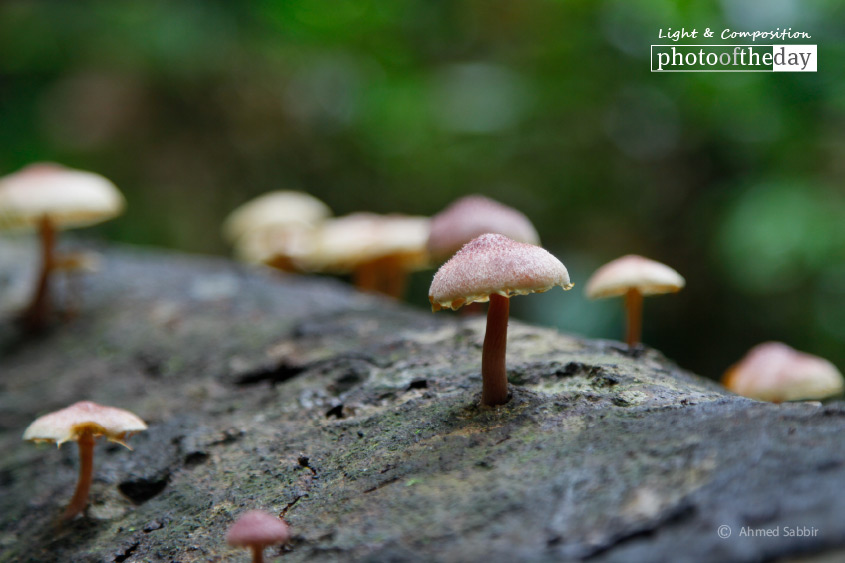
Captured within the lush, verdant depths of the Lawachora Forest in Sreemangal, this photograph highlights the intricate beauty of nature found in the smallest details. While trekking through the reserve, the photographer discovered a cluster of mushrooms thriving upon the surface of a decaying tree, creating a striking contrast between life and decomposition. The image is award-worthy for its delicate focus and the photographer's ability to transform a quiet, overlooked moment in the forest into a compelling study of texture and form, inviting viewers to appreciate the subtle wonders of the natural world.
Ahmed Sabbir
Based in Dhaka, Bangladesh, Ahmed Sabbir is a dedicated travel photographer who balances his professional life as a musician with a profound passion for exploring the natural world. His work is driven by a deep-seated belief that travel and the observation of diverse cultures and landscapes are essential to living life to the fullest. Through his lens, he seeks to document the quiet beauty of his country, capturing evocative images that reflect his appreciation for the planet's hidden wonders and the human experience.
Resonance Score Breakdown
Transparency Note: The resonance score (12.4/20) is calculated based on social engagement metrics collected before the award announcement.
Expert Photography Reviews · 3
The Quiet Work of Return
There is a gentle wisdom in the way the forest handles its own passing. Nothing is ever truly lost; it simply changes its shape, softening into the earth to feed the next cycle of growth.
Read the reflection →What Remains After
The forest floor does not hurry. It waits for the wood to soften, for the structure of the tree to surrender its shape to the damp earth. We often look for the grand, the towering, the things that demand our eyes.
Read the reflection →Reviews & Comments
Share your thoughts about this award-winning photograph. Your reviews contribute to the community engagement score.
The mushroom’s cap creates a near-perfect golden spiral, anchoring the frame’s lower-right quadrant. Sabbir’s geometry relies on the vertical axis of the decaying bark, which bisects the composition into a 1:3 ratio of light to shadow. It’s a precise spatial equation. I’m genuinely struck by how the radial symmetry of the gills disrupts the chaotic, organic texture of the wood. It’s not just nature; it’s a solved problem of balance, and honestly, it’s quite beautiful.
The frame’s architecture relies on the central cluster’s weight against the decaying bark’s chaotic texture. It’s a precarious balance. The focal plane is razor-thin, forcing the eye to navigate the mushroom’s gills without distraction. I’d prefer a tighter crop to eliminate the peripheral noise, yet the spatial tension holds. It’s a rare moment where the subject’s fragility doesn’t collapse into sentimentality. The structure remains rigid. It’s a disciplined study of organic geometry.
Decay meets growth on damp bark. The frame doesn’t crowd the subject. It breathes. I’ve spent minutes staring at the soft blur behind the gills. It’s quiet. A stillness I rarely find in the city. The forest floor isn’t just background; it’s the silence that lets the life emerge. Nothing here is accidental. The empty corner is not empty. It’s the weight of the forest. I feel my own pulse slow down.