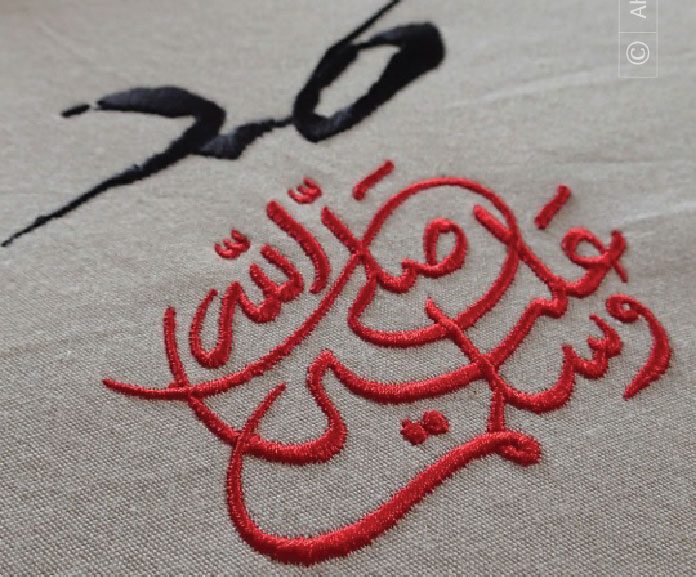
Muhammad the Messenger of Allah by Ahmad Jaa
This evocative photograph captures a delicate piece of Arabic embroidery featuring the sacred phrase, 'Muhammad the Messenger of Allah.' Digitized directly from the photographer's own handwriting, the image serves as a profound visual meditation on faith and the spiritual path of following divine guidance. The composition highlights the intricate texture of the thread against the fabric, transforming a traditional craft into a modern artistic statement. Its award-worthy quality lies in the seamless fusion of personal devotion and technical precision, offering viewers a serene and contemplative look at the intersection of calligraphy, textile art, and Islamic heritage.
Ahmad Jaa
Based in Kuala Lumpur, Malaysia, Ahmad Jaa is a self-taught photographer whose creative journey began in 2008. While he maintains a particular fascination with geometry, his work remains refreshingly diverse, driven by a desire for self-discovery and sincere expression. Through his lens, Jaa explores new perspectives on life, continuously refining his craft while prioritizing the joy of the artistic process. His evolving portfolio reflects a dedicated commitment to learning and a versatile approach that transcends traditional genre boundaries.
Resonance Score Breakdown
Transparency Note: The resonance score (13.2/20) is calculated based on social engagement metrics collected before the award announcement.
Expert Photography Reviews · 6
The Weave of Devotion
There is a quiet rhythm in the act of repetition. When the hand moves to trace a sacred shape, or when the needle pulls thread through fabric, time seems to slow its frantic pace.
Read the reflection →The Weight of a Stitch
I remember sitting in a small workshop in Fez, watching an old man pull a needle through heavy linen. He didn't speak much, but he told me that every stitch was a form of breathing.
Read the reflection →Reviews & Comments
Share your thoughts about this award-winning photograph. Your reviews contribute to the community engagement score.
The thread pulls tight against the weave. It’s a quiet tension. I’ve spent minutes watching the shadows caught in the embroidery. There’s a stillness here that makes my own breath feel loud. Nothing here is accidental. The empty corner is not empty. It’s a pause. A deliberate absence of noise. I find myself leaning in, wanting to touch the fabric, but I don’t. I just listen to the silence of the script. It’s enough.
We look at these threads and we aren’t just seeing embroidery; we’re hearing a heartbeat. Ahmad Jaa has stitched a conversation with the divine into the fabric. It’s a portrait of a soul’s devotion, where every curve of the ink-turned-thread feels like a whispered prayer. I find myself holding my breath, feeling the weight of that sacred name. It’s a quiet, intimate portrait of faith that asks to be returned to, again and again.
Shadow isn’t merely the absence of light here; it’s the silence where the embroidery breathes. Jaa’s threads emerge from a void that feels heavy, almost tectonic. I’ve stared at the way the dark fabric swallows the edges of the script, and it’s unsettling—it forces me to confront the weight of the divine. It doesn’t invite us to look; it demands we surrender to the darkness that gives the sacred text its terrifying, beautiful gravity.
At a macro scale, the focal plane is razor-thin, isolating the individual fibers of the embroidery. The diffraction of light across the thread’s topography is, in the strictest physical sense, extraordinary. I’m genuinely moved by how the lens resolves the microscopic fraying of the silk, revealing a tactile intimacy the naked eye misses. It’s a rare instance where the optics don’t just capture a subject; they translate the physical labor of faith into pure, luminous geometry.
The embroidery’s topography dictates the frame. It’s a rigid geometry of thread against weave, where the negative space functions as a necessary anchor. The calligraphic curves provide a structural fulcrum, balancing the textile’s inherent softness. I’d argue the tension here is almost architectural. It doesn’t rely on sentiment; it relies on the discipline of the stitch. It’s rare to see such precise spatial control. The frame holds because the composition demands it.
The frame holds a quiet, rhythmic tension. It’s a close-up that breathes. The thread’s texture catches the light like a film grain, tactile and deliberate. I’m struck by how the calligraphy doesn’t just sit there; it pulses with the weight of a long, sustained take. Jaa understands the stillness here. It’s the kind of shot an editor keeps because the pacing is perfect. It’s not just embroidery; it’s a sequence that refused to move.